Understanding Persuasive Technology and Dark Patterns
Persuasive technology design intentionally influences user behavior through interface elements that are often deceptive. These techniques, commonly known as dark patterns, are characterized by their manipulative design and are intended to drive outcomes that may not align with users' genuine interests[1]. Dark patterns are used, for example, to nudge users toward providing personal data or consenting to services under conditions that obscure genuine choices, thereby affecting user autonomy[5]. The overall aim of these strategies is to interfere with the user's ability to make free, informed decisions by creating an environment where misleading defaults or obstructive opt-out processes are prevalent[11].
Legislative Proposals and Policy Interventions


Recent legislative initiatives have focused on banning or restricting dark patterns in digital environments. For instance, the DETOUR Act proposed in the United States would prohibit large online platforms from deploying user interfaces that deliberately obscure or manipulate choice options. This legislation goes further by requiring periodic disclosures regarding behavioral experiments or manipulative designs targeting vulnerable users such as children and teenagers[2]. In parallel, regulatory guidance issued by agencies such as the California Privacy Protection Agency (CPPA) emphasizes that interfaces providing privacy options must present these choices in a clear and balanced manner, effectively outlawing designs that intentionally create friction for opting out of data sharing[3].
Legislation in other regions has adopted similar measures. In the EU, regulations such as the Digital Services Act and the Digital Markets Act set requirements for fair and transparent interface design, explicitly prohibiting dark patterns that distort user autonomy. These regulations are complemented by additional frameworks like the General Data Protection Regulation (GDPR) and proposals under the AI Act and Data Act, which together aim to cover the spectrum of manipulative digital practices[1].
Moreover, proposals by industry experts have emphasized the need for a clear definition of dark patterns in law, noting the fragmentation of current legislation and the difficulties it creates for consistent enforcement. As highlighted by the European Parliamentary Research Service, there is an urgent call for integrating clearer and more specific prohibitions for manipulative digital interfaces into existing consumer protection laws[11].
Feasibility and Stakeholder Pushback


While there is widespread recognition of the harms caused by dark patterns, the legislative proposals to limit persuasive design face significant challenges regarding feasibility and stakeholder resistance. On one hand, policymakers argue that regulations are essential to protect consumers from deceptive practices and to uphold the principles of transparency and fairness in digital markets[4]. On the other hand, major technology companies and industry associations have voiced concerns that strict regulatory measures might stifle innovation and limit the legitimately persuasive techniques that companies use to optimize user engagement and prompt decisions. For example, tech industry groups criticized the broad regulatory approach outlined in the Biden administration's recent executive order on artificial intelligence, stating that overly prescriptive measures could place a significant burden on emerging companies and limit competition[9].
Additionally, lobbying efforts by Big Tech have been vigorous on both sides of the Atlantic. In regions such as Latin America, for instance, there is documented evidence of coordinated campaigns by large tech companies to resist regulation, reflecting a global trend where economic power and technological dominance contribute to political pressure against tighter regulatory frameworks[8]. This tension between regulatory intent and commercial interests underscores the complexity of enforcing a digital fairness agenda. Ensuring compliance while preserving the dynamic nature of digital innovation remains a critical policy challenge.
Empirical Insights on Default Choices and Design Ethics

Research in behavioral psychology provides insights into how default options can shape consumer decisions and, consequently, affect the validity of consent in digital environments. A study from the University of Illinois found that default actions are particularly effective under time constraints; when users are pressured by limited decision time, they are more likely to accept default settings, even if these defaults are not in their best interests[10]. This finding raises important ethical considerations: while defaults can facilitate decisions in emergency contexts, such as in critical healthcare situations, they become problematic when used in less time-sensitive scenarios merely to boost engagement or data collection metrics.
From a policy standpoint, these observations reinforce the need for regulations that not only address the overt use of dark patterns but also scrutinize the timing and context in which defaults are employed. Policies that call for symmetry in user options—such as requiring that withholding consent must be as straightforward as giving it—are increasingly being embedded in legislative frameworks, particularly under laws like the California Consumer Privacy Act and similar EU statutes[4].
Global Precedents and Future Directions

Globally, there is a recognized need to harmonize the approach to regulating digital interfaces, as disparate legal frameworks have led to inconsistencies in enforcement. The European Union, for example, is actively working to integrate provisions across various legislative acts—from consumer protection directives to data protection regulations—to create a more coordinated response to dark patterns[5]. In contrast, the U.S. is witnessing a mix of federal and state-level initiatives that seek to curb manipulative design practices while balancing the desire to preserve technological innovation.[2].
Looking ahead, the trend appears to favor a tightening of regulatory oversight not only on the use of dark patterns but also on other forms of persuasive design that compromise consumer autonomy. Governments and regulatory agencies are increasingly considering measures that extend beyond mere consent issues to encompass broader aspects of user interface design and data rights management. These developments signal a shift towards digital fairness by design, where the emphasis is placed on ensuring that every digital interaction upholds transparency, fairness, and user empowerment[11].
Let's look at alternatives:
- Modify the query.
- Start a new thread.
- Remove sources (if manually added).
 Curated by Joan


Raining Fish: A Scientific Explanation from the 19th Century
The phenomenon of fish falling from the sky, often termed 'animal rain,' has puzzled observers for centuries. While it may seem to defy logic, the explanation does not involve fish forming in clouds. Instead, a compelling mechanical theory suggests that powerful atmospheric events can transport aquatic life from its natural habitat into the air, only for it to fall back to earth miles away. This report examines the explanation presented in the 1870 book 'Odd Showers: Or, An Explanation of the Rain of Insects, Fishes, and Lizards' by Carribber, which sought to demystify such occurrences through the lens of natural science[1][1]. The book, intended for young readers, was the culmination of nearly three decades of research into unusual atmospheric phenomena[1].
The Lifting Mechanism: Waterspouts and Whirlwinds
The central claim of the book is that showers of fish are not meteorological anomalies but are the result of powerful natural forces acting on bodies of water[1]. The primary agents responsible for this transportation are identified as waterspouts and whirlwinds (or hurricanes)[1]. These intense vortices possess enough power to suck up or lift a column of water from a stream, pond, or the sea, along with any fish or other small creatures residing within it[1].
Waterspout Lifting Fish from the Ocean
An artistic depiction of a powerful waterspout forming over the ocean, its vortex drawing water and a school of small fish upwards into the storm clouds.
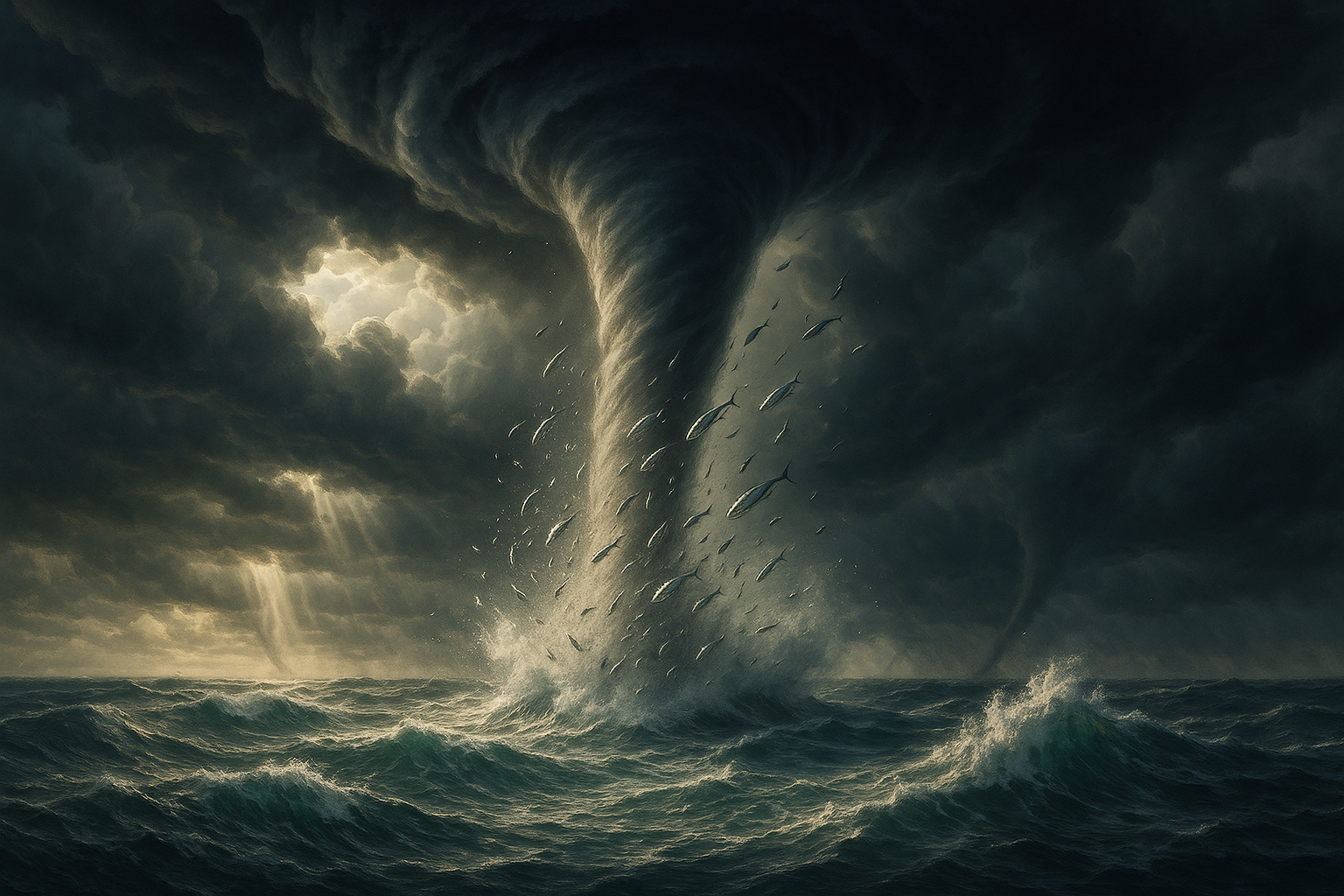
Once the fish are elevated, the 'propelling force and velocity of the wind' are strong enough to carry them a considerable distance, potentially many miles from their original location[1]. The book posits that the fish are held aloft as long as the upward force of the whirlwind or waterspout is greater than the downward pull of gravity[1]. This explains how fish can appear to 'rain' down on areas far from any significant body of water.
Historical Examples of Fish Showers
To anchor this explanation in observable events, the book provides several historical accounts. Two notable examples illustrate the specific circumstances surrounding these phenomena.
The Shower of Whitings in Kent, 1666
In 1666, near Wrotham, Kent, a pasture field was reportedly covered with small fish following a 'great tempest of thunder and rain'[1]. The details of this event support the whirlwind theory:
- Location: The event occurred in a two-acre field far from the sea and with no nearby fish-ponds, during a time of water scarcity[1].
- Fish Type and Quantity: The fish were identified as young whitings, about the length of a small finger, and the total amount was estimated to be about a bushel[1].
- Localization: The shower was highly localized, with no fish found in any of the adjacent fields, which is consistent with the concentrated fallout from a dissipating whirlwind[1].
The Fish Fall at Mountain Ash, 1859
A more recent account from February 11, 1859, in Mountain Ash, Glamorganshire, describes a shower of small fish that fell during a period of severe weather[1]. This case provides further evidence for the atmospheric transport hypothesis:
- Weather Conditions: The event coincided with a 'heavy shower of rain and storm of wind,' including a 'very stiff gale from the South'[1].
- Condition of the Fish: Many fish, measuring up to four inches long, were found alive after the fall and were successfully kept in bottles of fresh water[1]. This suggests they were airborne for a relatively short period. Their 'instantaneous death' when placed in salt water indicates they were freshwater fish[1].
- Distribution: Similar to the Kent incident, the shower was confined to a specific area, covering the premises of a Mr. Nixon, with no fish observed in other parts of the neighborhood[1].
The Inevitable Descent: Gravity's Role
The book emphasizes that the suspension of fish in the atmosphere is temporary. The phenomenon concludes when the energy of the lifting force dissipates. According to the author, the fish 'must soon descend by the natural laws of gravitation when the forces that elevated them were spent'[1]. This occurs when the whirlwind weakens or moves over land, losing its source of power and moisture.
A Waterspout over the Ocean
A photograph of a real waterspout, a tornadic water vortex, forming over a body of water. This illustrates the type of natural phenomenon capable of lifting water and marine life into the atmosphere.
Another explanation offered is that as the column of water drawn up by the waterspout 'disseminates into vapor,' it is followed by a heavy shower of rain[1]. The objects carried within that column, such as fish, are no longer supported and fall along with the precipitation[1]. This process explains why the fall of fish is often, though not always, accompanied by a severe rainstorm, as was the case in both the Kent and Mountain Ash examples.
Explaining Animal Rain and Waterspouts
These videos provide visual explanations of the meteorological phenomena, such as waterspouts, that are believed to cause strange weather events like raining fish and frogs.
Conclusion
The explanation provided in 'Odd Showers' demystifies the rain of fish by attributing it to powerful, albeit uncommon, meteorological events rather than supernatural causes. By proposing that waterspouts and whirlwinds can lift fish from water and transport them over land, the book offers a rational framework grounded in physics. The lifting force of the vortex temporarily overcomes gravity, but once that force subsides, the transported fish inevitably fall back to earth. The historical accounts of localized fish falls during severe storms provide compelling anecdotal evidence for this theory, illustrating how seemingly impossible events can be understood through the 'well known and unerring laws of natural and physical science'[1].
References
Let's look at alternatives:
- Modify the query.
- Start a new thread.
- Remove sources (if manually added).
Get more accurate answers with Super Pandi, upload files, personalised discovery feed, save searches and contribute to the PandiPedia.
Let's look at alternatives:
- Modify the query.
- Start a new thread.
- Remove sources (if manually added).



The dreadful spout, Which shipmen do the hurricano call, Constring'd in mass by the almighty sun.
Shakespeare[1]

I bind the sun's throne with a burning zone, And the moon's with a girdle of pearl;
Shelley[1]

The volcanoes are dim, and the stars reel and swim, When the whirlwinds my banner unfurl.
Shelley[1]

Now o'er their head the whizzing whirlwinds breathe, And the live desert pants and heaves beneath;
Darwin[1]

Tinged by the crimson sun, vast columns rise Of eddying sands, and war amid the skies;
Darwin[1]
Let's look at alternatives:
- Modify the query.
- Start a new thread.
- Remove sources (if manually added).
Let's look at alternatives:
- Modify the query.
- Start a new thread.
- Remove sources (if manually added).
In 1819, Montreal experienced extreme darkness and soot showers followed by a shock of an earthquake.
In 1815, darkness occasioned in the day time by ashes in Java equalled the darkest night known.
In 1755, black dust smelling strongly of sulphur covered the faces and hands of people in Shetland.
In 472, a great fall of black dust fell near Constantinople, during which the heavens seemed to burn.
In 1835, volcanic ashes from Cosequina fell on Jamaica after traveling 700 miles against the regular wind.
Let's look at alternatives:
- Modify the query.
- Start a new thread.
- Remove sources (if manually added).
Get more accurate answers with Super Pandi, upload files, personalised discovery feed, save searches and contribute to the PandiPedia.
Transcript
Imagine the sky turning dark and rain the color of blood falling from the clouds. For centuries, these events were looked upon as terrible and fatal omens. But did it ever really rain blood? According to the records of physical science, these occurrences have natural explanations. In sixteen hundred and eight, a supposed shower of blood in France was discovered to be the red exudations of butterflies as they transformed from their chrysalis state. Other times, the cause is microscopic. Red rain collected in eighteen hundred and sixty was found to contain tiny plant like organisms belonging to the algae family. Even crimson snow has been traced to vegetable productions like the fungus uredo nivalis. Sometimes, the earth itself provides the pigment. Red dust or volcanic ashes, known as puzzolana, can be carried into the atmosphere and mix with falling rain or snow to create a startling brick red hue. While these sights once inspired fear of the supernatural, they are actually governed by the unerring laws of natural science.
Let's look at alternatives:
- Modify the query.
- Start a new thread.
- Remove sources (if manually added).
Transcript
This book explores the strange phenomena of odd showers, where creatures like fish and insects or substances like red rain seem to fall from the sky. It explains that these events are not supernatural omens but are caused by natural forces like waterspouts and hurricanes. For instance, in eighteen fifty-nine, residents of Mountain Ash in Glamorganshire experienced a heavy rain that brought down a large quantity of small fish, some measuring four inches long. Even more bizarre are the insect showers along the Saint Lawrence River, where so many shad-flies fall at once that the air looks like it is filled with a heavy snowstorm. Next time you are caught in a downpour, just remember that it might be more than just water falling from the clouds. Did you know that some red rain is actually caused by blood-colored drops left behind by swarms of butterflies?
Let's look at alternatives:
- Modify the query.
- Start a new thread.
- Remove sources (if manually added).
Odd Showers: A Victorian Examination of Strange Precipitation
Published in London in 1870, the book Odd Showers: Or, An Explanation of the Rain of Insects, Fishes, and Lizards; Soot, Sand, and Ashes; Red Rain and Snow; Meteoric Stones; and other Bodies sought to provide rational, scientific explanations for seemingly miraculous or terrifying atmospheric phenomena[1]. Authored by Sir George Duncan Gibb under the pseudonym Carribber, the work was specifically written for a younger audience, aiming to demystify the world around them[1][1]. The author's own curiosity was piqued in 1841 after he personally witnessed a shower of small frogs near Montreal, an event that prompted a deeper investigation into such unusual occurrences[1]. This report summarizes the key findings and explanations presented in this Victorian-era text.
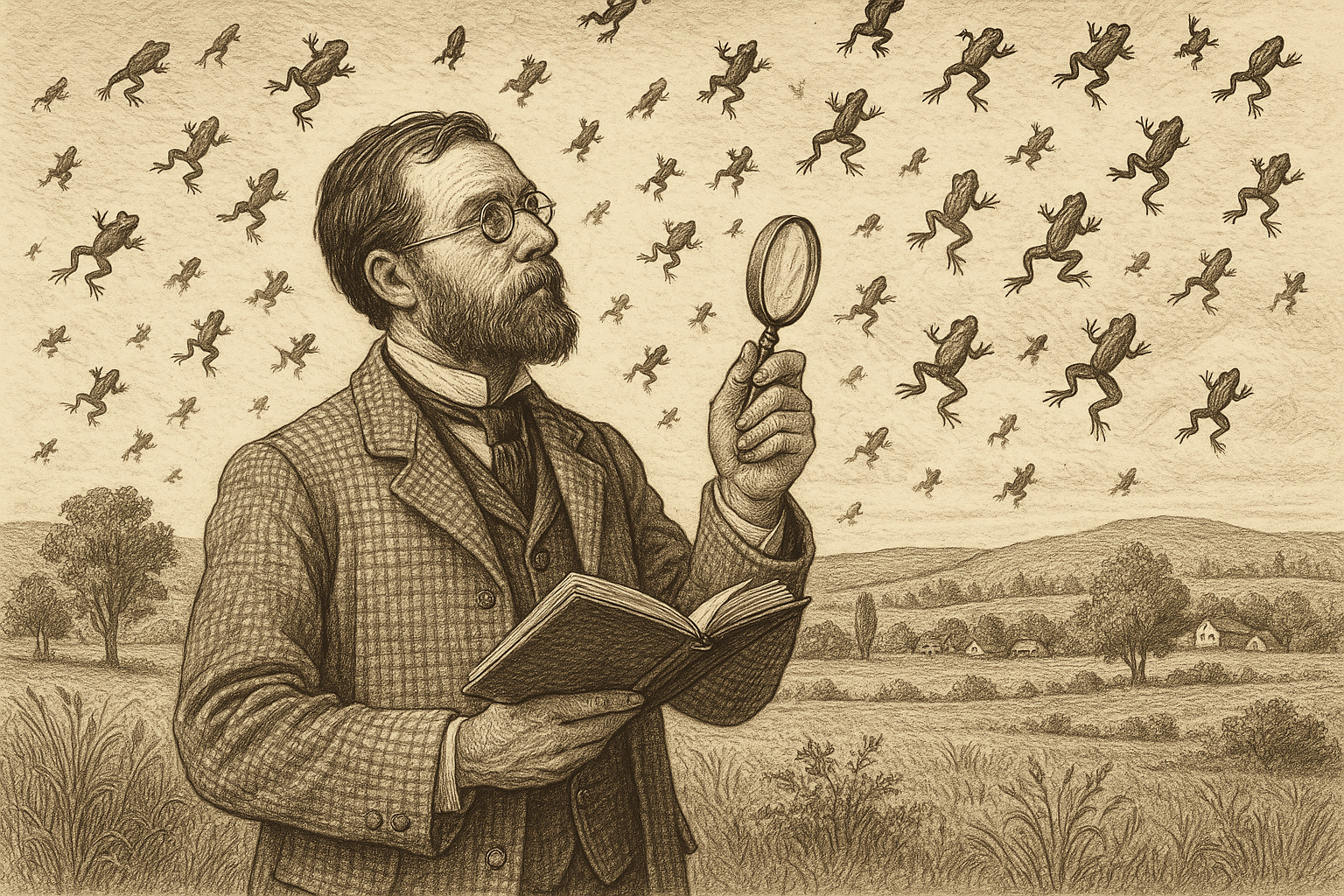
A Victorian Naturalist Observing a Strange Shower
An illustrative depiction of a 19th-century scientist, reminiscent of the book's author, observing and documenting an unusual fall of small frogs from the sky, with a journal and magnifying glass in hand. The style reflects the era's spirit of scientific inquiry.
Explaining the Rain of Living Creatures
A central focus of the book is to explain how living animals can seemingly fall from the sky. The primary mechanism proposed is the power of atmospheric disturbances like waterspouts or hurricanes. The author posits that these powerful weather events can suck up water, along with the creatures living in it, and transport them over significant distances before releasing them[1]. This single, powerful explanation is applied to various accounts of animal rain.
A Waterspout Forming Over the Ocean
A photograph of a powerful waterspout, a rotating column of water and spray, connecting a large body of water to a cumuliform cloud. This illustrates the natural force described in the book as capable of lifting fish and other small creatures into the atmosphere.
- Insect Showers: The book notes that showers of insects are a recorded phenomenon. An example is given of flies along the St. Lawrence River appearing in such vast quantities that their fall "resembles a heavy fall of snow"[1]. Locusts are cited as the most extreme example, with swarms so large they can obscure the sun across entire countries[1].
- Fish Showers: Historical accounts are used to support the theory. One such event occurred in Kent in 1666, where a shower of "young whitings" was recorded[1]. A more contemporary example from 1859 in Mountain Ash, Wales, is also documented, lending further credibility to the phenomenon[1].
- Amphibian Showers: The author's personal experience with falling frogs near Montreal serves as a foundational anecdote, confirming that such events, while strange, are observable realities that can be explained by natural transport[1].
From Soot to 'Blood Rain': Inorganic and Colored Showers
The book extends its scientific lens to showers of non-living matter and strangely colored precipitation, which were often sources of superstition and fear. The author systematically breaks down these events into their component parts, attributing them to geological or biological sources.
Volcanic eruptions are identified as a major source of inorganic showers. Soot and fine ashes from a volcano can be propelled high into the atmosphere, where strong air currents can carry the material for "hundreds of miles" before it falls back to earth, sometimes far from the eruption site[1].
The particularly alarming phenomenon of "showers of blood" is also addressed. The author reassures the reader that these are not supernatural events but are simply rain or snow colored by foreign substances. The red hue can be caused by several factors, including red-colored volcanic ash known as 'puzzolana', fine particles of red vegetable matter lifted by the wind, or the reddish-brown excretions of certain butterfly species[1][1]. By identifying these causes, the book concludes that "Showers of red rain and red snow are therefore genuine and undoubted facts, and when we know what it is that imparts to them their peculiar colour... there is nothing preternatural or marvellous about them"[1].
Celestial Visitors: Meteoric Stones
In its final section, the book turns its attention from terrestrial sources to extraterrestrial ones, discussing the nature of meteoric stones. Moving away from atmospheric transport, the author explains the accepted scientific doctrine of the time. Meteors are defined as "cosmical bodies floating in space" that are drawn into Earth's atmosphere and fall to the surface due to the fundamental "laws of general gravity"[1]. This explanation firmly places the phenomenon within the realm of astronomy and physics, completing the book's mission to replace superstition with scientific understanding.
Conclusion: Demystifying the Marvelous
Sir George Duncan Gibb's Odd Showers serves as a clear example of Victorian-era popular science, aiming to educate and reassure a general audience, particularly young people. The book's core insight is that even the most bizarre and seemingly inexplicable events often have logical, natural explanations. By attributing rains of animals to waterspouts, colored rain to dust and organic matter, and falling stones to cosmic gravity, the author systematically dismantles the "preternatural or marvellous"[1]. The work champions a worldview where observation and scientific reasoning can make sense of a world that might otherwise seem chaotic and mysterious.
References
Let's look at alternatives:
- Modify the query.
- Start a new thread.
- Remove sources (if manually added).
It would have been impossible for me to kill this affectionate mother, who had exhibited such an example of presence of mind, reason, and sound judgment.
Wilson[1]
Undoubtedly, all birds have a more or less well-defined means of communication, though differing.
Unknown[1]
The clever little builders are, as a rule, far from being distressful, and often exhibit intelligence that is undeniable.
Unknown[1]
Being very sleepy little fellows, they rarely move, and though standing within a few inches of them, the observer might suppose them to be two old brown leaves.
Unknown[1]
So strong is this habit of striking with its sword that when a dead fish is tossed overboard, the swordfish will strike at it.
Unknown[1]
Let's look at alternatives:
- Modify the query.
- Start a new thread.
- Remove sources (if manually added).