How can a shower of fish happen without fish actually forming in the clouds?. Explain the text claim that fish can be lifted from water by waterspouts or whirlwinds, then fall when the lifting force ends. Use one or two concrete examples from the book to anchor the explanation.
Raining Fish: A Scientific Explanation from the 19th Century
The phenomenon of fish falling from the sky, often termed 'animal rain,' has puzzled observers for centuries. While it may seem to defy logic, the explanation does not involve fish forming in clouds. Instead, a compelling mechanical theory suggests that powerful atmospheric events can transport aquatic life from its natural habitat into the air, only for it to fall back to earth miles away. This report examines the explanation presented in the 1870 book 'Odd Showers: Or, An Explanation of the Rain of Insects, Fishes, and Lizards' by Carribber, which sought to demystify such occurrences through the lens of natural science[1][1]. The book, intended for young readers, was the culmination of nearly three decades of research into unusual atmospheric phenomena[1].
The Lifting Mechanism: Waterspouts and Whirlwinds
The central claim of the book is that showers of fish are not meteorological anomalies but are the result of powerful natural forces acting on bodies of water[1]. The primary agents responsible for this transportation are identified as waterspouts and whirlwinds (or hurricanes)[1]. These intense vortices possess enough power to suck up or lift a column of water from a stream, pond, or the sea, along with any fish or other small creatures residing within it[1].
Waterspout Lifting Fish from the Ocean
An artistic depiction of a powerful waterspout forming over the ocean, its vortex drawing water and a school of small fish upwards into the storm clouds.
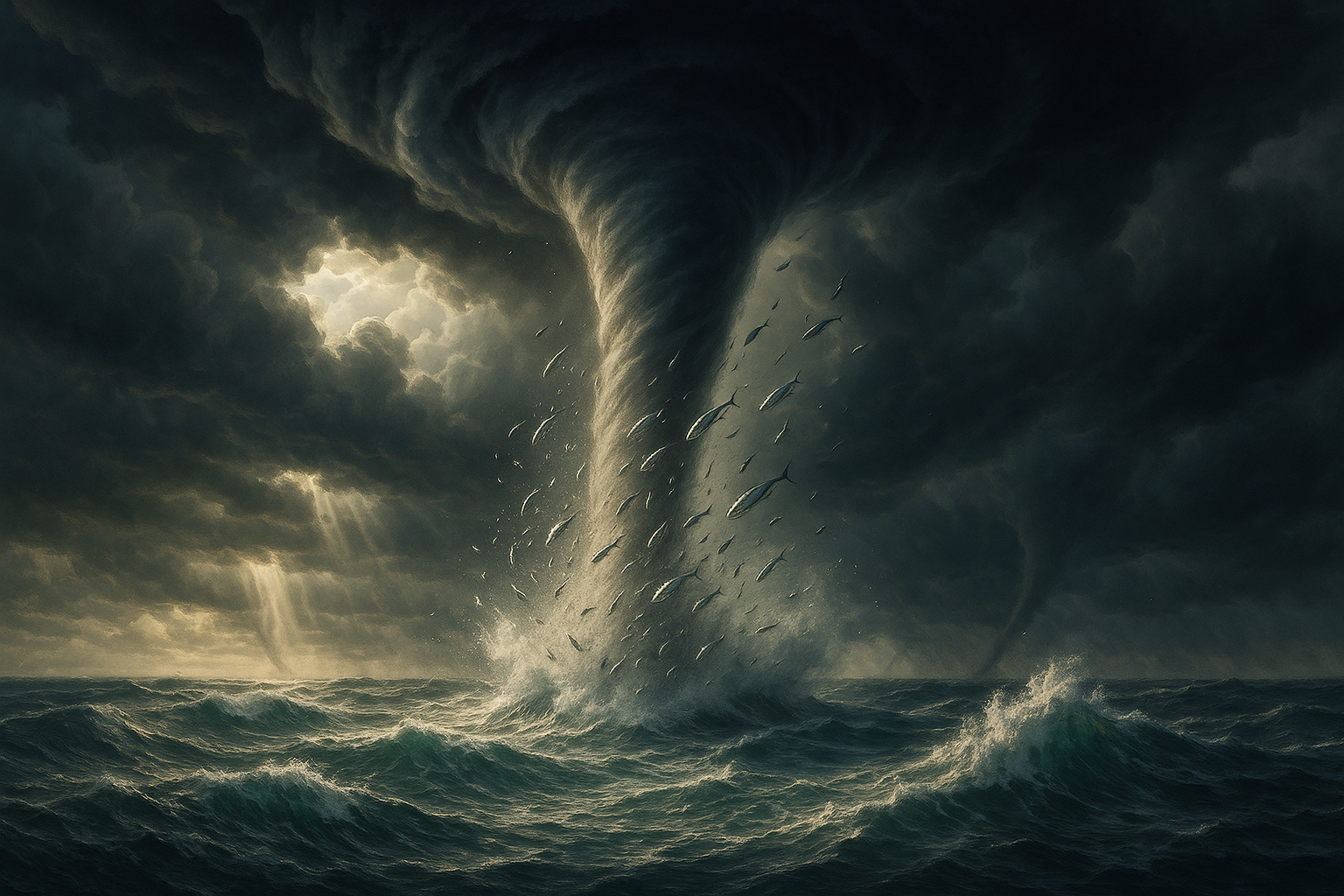
Once the fish are elevated, the 'propelling force and velocity of the wind' are strong enough to carry them a considerable distance, potentially many miles from their original location[1]. The book posits that the fish are held aloft as long as the upward force of the whirlwind or waterspout is greater than the downward pull of gravity[1]. This explains how fish can appear to 'rain' down on areas far from any significant body of water.
Historical Examples of Fish Showers
To anchor this explanation in observable events, the book provides several historical accounts. Two notable examples illustrate the specific circumstances surrounding these phenomena.
The Shower of Whitings in Kent, 1666
In 1666, near Wrotham, Kent, a pasture field was reportedly covered with small fish following a 'great tempest of thunder and rain'[1]. The details of this event support the whirlwind theory:
- Location: The event occurred in a two-acre field far from the sea and with no nearby fish-ponds, during a time of water scarcity[1].
- Fish Type and Quantity: The fish were identified as young whitings, about the length of a small finger, and the total amount was estimated to be about a bushel[1].
- Localization: The shower was highly localized, with no fish found in any of the adjacent fields, which is consistent with the concentrated fallout from a dissipating whirlwind[1].
The Fish Fall at Mountain Ash, 1859
A more recent account from February 11, 1859, in Mountain Ash, Glamorganshire, describes a shower of small fish that fell during a period of severe weather[1]. This case provides further evidence for the atmospheric transport hypothesis:
- Weather Conditions: The event coincided with a 'heavy shower of rain and storm of wind,' including a 'very stiff gale from the South'[1].
- Condition of the Fish: Many fish, measuring up to four inches long, were found alive after the fall and were successfully kept in bottles of fresh water[1]. This suggests they were airborne for a relatively short period. Their 'instantaneous death' when placed in salt water indicates they were freshwater fish[1].
- Distribution: Similar to the Kent incident, the shower was confined to a specific area, covering the premises of a Mr. Nixon, with no fish observed in other parts of the neighborhood[1].
The Inevitable Descent: Gravity's Role
The book emphasizes that the suspension of fish in the atmosphere is temporary. The phenomenon concludes when the energy of the lifting force dissipates. According to the author, the fish 'must soon descend by the natural laws of gravitation when the forces that elevated them were spent'[1]. This occurs when the whirlwind weakens or moves over land, losing its source of power and moisture.
A Waterspout over the Ocean
A photograph of a real waterspout, a tornadic water vortex, forming over a body of water. This illustrates the type of natural phenomenon capable of lifting water and marine life into the atmosphere.
Another explanation offered is that as the column of water drawn up by the waterspout 'disseminates into vapor,' it is followed by a heavy shower of rain[1]. The objects carried within that column, such as fish, are no longer supported and fall along with the precipitation[1]. This process explains why the fall of fish is often, though not always, accompanied by a severe rainstorm, as was the case in both the Kent and Mountain Ash examples.
Explaining Animal Rain and Waterspouts
These videos provide visual explanations of the meteorological phenomena, such as waterspouts, that are believed to cause strange weather events like raining fish and frogs.
Conclusion
The explanation provided in 'Odd Showers' demystifies the rain of fish by attributing it to powerful, albeit uncommon, meteorological events rather than supernatural causes. By proposing that waterspouts and whirlwinds can lift fish from water and transport them over land, the book offers a rational framework grounded in physics. The lifting force of the vortex temporarily overcomes gravity, but once that force subsides, the transported fish inevitably fall back to earth. The historical accounts of localized fish falls during severe storms provide compelling anecdotal evidence for this theory, illustrating how seemingly impossible events can be understood through the 'well known and unerring laws of natural and physical science'[1].
Create your account to keep this answer and continue from it later.
Let's look at alternatives:
- Modify the query.
- Start a new thread.
- Remove sources (if manually added).