Summarize the key points and insights from the sources
Odd Showers: A Victorian Examination of Strange Precipitation
Published in London in 1870, the book Odd Showers: Or, An Explanation of the Rain of Insects, Fishes, and Lizards; Soot, Sand, and Ashes; Red Rain and Snow; Meteoric Stones; and other Bodies sought to provide rational, scientific explanations for seemingly miraculous or terrifying atmospheric phenomena[1]. Authored by Sir George Duncan Gibb under the pseudonym Carribber, the work was specifically written for a younger audience, aiming to demystify the world around them[1][1]. The author's own curiosity was piqued in 1841 after he personally witnessed a shower of small frogs near Montreal, an event that prompted a deeper investigation into such unusual occurrences[1]. This report summarizes the key findings and explanations presented in this Victorian-era text.
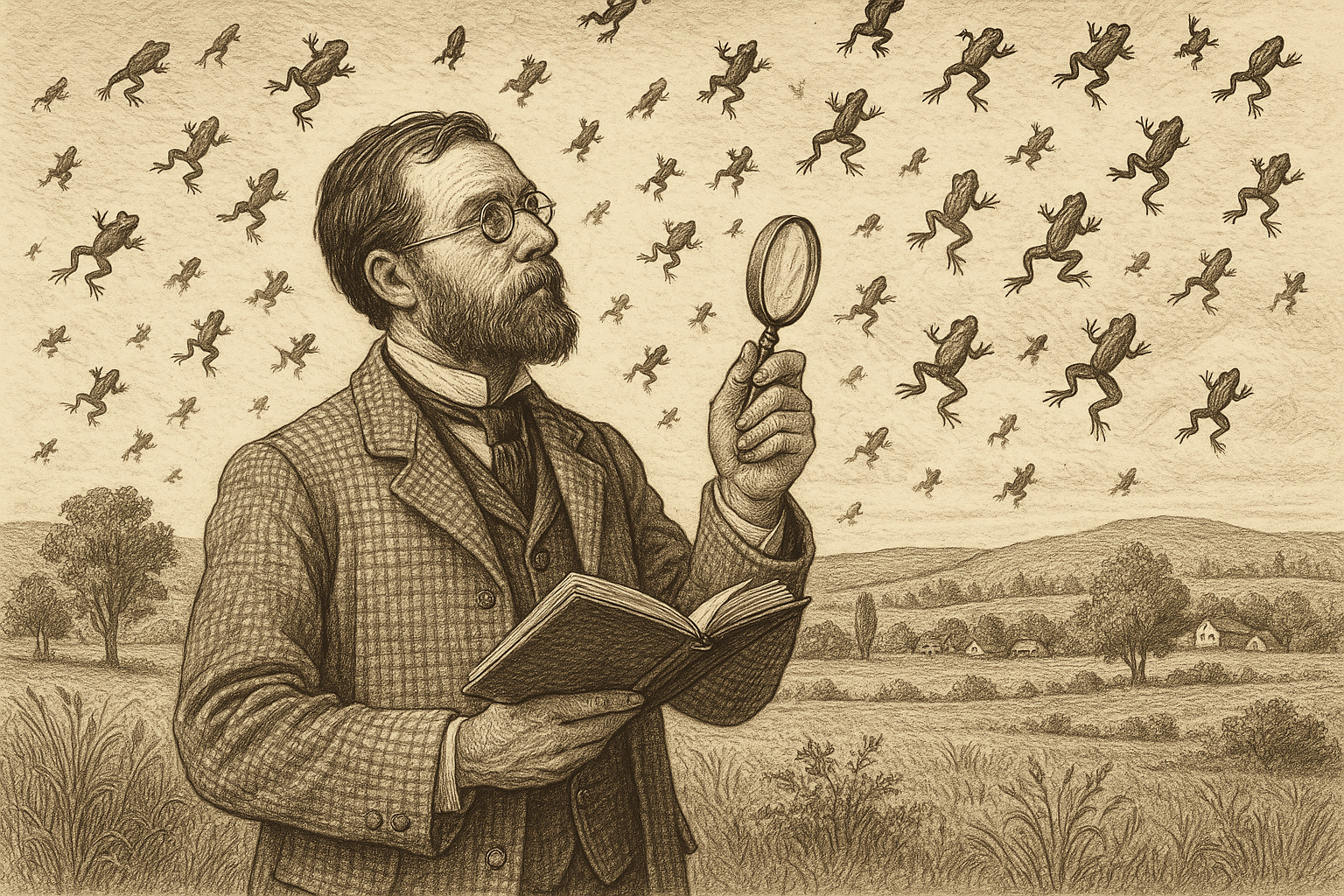
A Victorian Naturalist Observing a Strange Shower
An illustrative depiction of a 19th-century scientist, reminiscent of the book's author, observing and documenting an unusual fall of small frogs from the sky, with a journal and magnifying glass in hand. The style reflects the era's spirit of scientific inquiry.
Explaining the Rain of Living Creatures
A central focus of the book is to explain how living animals can seemingly fall from the sky. The primary mechanism proposed is the power of atmospheric disturbances like waterspouts or hurricanes. The author posits that these powerful weather events can suck up water, along with the creatures living in it, and transport them over significant distances before releasing them[1]. This single, powerful explanation is applied to various accounts of animal rain.
A Waterspout Forming Over the Ocean
A photograph of a powerful waterspout, a rotating column of water and spray, connecting a large body of water to a cumuliform cloud. This illustrates the natural force described in the book as capable of lifting fish and other small creatures into the atmosphere.
- Insect Showers: The book notes that showers of insects are a recorded phenomenon. An example is given of flies along the St. Lawrence River appearing in such vast quantities that their fall "resembles a heavy fall of snow"[1]. Locusts are cited as the most extreme example, with swarms so large they can obscure the sun across entire countries[1].
- Fish Showers: Historical accounts are used to support the theory. One such event occurred in Kent in 1666, where a shower of "young whitings" was recorded[1]. A more contemporary example from 1859 in Mountain Ash, Wales, is also documented, lending further credibility to the phenomenon[1].
- Amphibian Showers: The author's personal experience with falling frogs near Montreal serves as a foundational anecdote, confirming that such events, while strange, are observable realities that can be explained by natural transport[1].
From Soot to 'Blood Rain': Inorganic and Colored Showers
The book extends its scientific lens to showers of non-living matter and strangely colored precipitation, which were often sources of superstition and fear. The author systematically breaks down these events into their component parts, attributing them to geological or biological sources.
Volcanic eruptions are identified as a major source of inorganic showers. Soot and fine ashes from a volcano can be propelled high into the atmosphere, where strong air currents can carry the material for "hundreds of miles" before it falls back to earth, sometimes far from the eruption site[1].
The particularly alarming phenomenon of "showers of blood" is also addressed. The author reassures the reader that these are not supernatural events but are simply rain or snow colored by foreign substances. The red hue can be caused by several factors, including red-colored volcanic ash known as 'puzzolana', fine particles of red vegetable matter lifted by the wind, or the reddish-brown excretions of certain butterfly species[1][1]. By identifying these causes, the book concludes that "Showers of red rain and red snow are therefore genuine and undoubted facts, and when we know what it is that imparts to them their peculiar colour... there is nothing preternatural or marvellous about them"[1].
Celestial Visitors: Meteoric Stones
In its final section, the book turns its attention from terrestrial sources to extraterrestrial ones, discussing the nature of meteoric stones. Moving away from atmospheric transport, the author explains the accepted scientific doctrine of the time. Meteors are defined as "cosmical bodies floating in space" that are drawn into Earth's atmosphere and fall to the surface due to the fundamental "laws of general gravity"[1]. This explanation firmly places the phenomenon within the realm of astronomy and physics, completing the book's mission to replace superstition with scientific understanding.
Conclusion: Demystifying the Marvelous
Sir George Duncan Gibb's Odd Showers serves as a clear example of Victorian-era popular science, aiming to educate and reassure a general audience, particularly young people. The book's core insight is that even the most bizarre and seemingly inexplicable events often have logical, natural explanations. By attributing rains of animals to waterspouts, colored rain to dust and organic matter, and falling stones to cosmic gravity, the author systematically dismantles the "preternatural or marvellous"[1]. The work champions a worldview where observation and scientific reasoning can make sense of a world that might otherwise seem chaotic and mysterious.
Create your account to keep this answer and continue from it later.
Let's look at alternatives:
- Modify the query.
- Start a new thread.
- Remove sources (if manually added).