Discover Pandipedia
A growing directory of useful answers selected by the Pandi community. Search the collection or browse the latest discoveries.
3439 entries available
Python Libraries for Language Detection
Let's look at alternatives:
- Modify the query.
- Start a new thread.
- Remove sources (if manually added).

The Future of Scotland's Tech Startups: A Comprehensive Outlook
A Robust and Evolving Ecosystem
Scotland’s technology ecosystem has made significant strides over recent years, establishing itself as a vibrant and dynamic hub for startup activity. Increasing numbers of tech companies are emerging in regions such as Edinburgh, Glasgow, Dundee, and Aberdeen, and the country is rapidly gaining recognition as a promising destination for innovation. Studies and reports indicate that Scotland distinguishes itself from other UK regions by recording a steady increase in IT company incorporations and new hires, even as many parts of the UK have experienced declines[5][25]. Government-backed programs, such as those highlighted in comprehensive ecosystem reviews, have helped lay the groundwork for this growth by supporting early-stage entrepreneurial activity and setting ambitious targets for scaling startups[16]. This positive momentum, combined with Scotland’s historical strength in areas like fintech and gaming, underpins the strong prospects for the future.
Investment Trends and Support Networks


Investment is playing a crucial role in fueling the growth of Scotland’s tech startups. The Techscaler program, a flagship government initiative, is a case in point. Over the past two years, participant companies have collectively raised more than £118 million in capital, with the number of member companies nearly doubling from 502 to 978[6][17][20]. This infusion of capital not only validates the potential of these startups but also helps bridge the funding gap at early and mid-stages. Additionally, a network of incubators, accelerators, and funding bodies provide tailored support—from mentorship and access to industry experts to workspace and networking opportunities[9]. Surveys conducted within the ecosystem also shed light on investor confidence and the importance of aligning investment interests with the specific needs of innovative tech firms, even as some concerns about later-stage capital remain[22].
Technological Trends Fueling Innovation


Technological advancements are at the heart of Scotland’s tech startup revolution. The integration of artificial intelligence (AI) across multiple sectors is driving transformative changes, with applications ranging from enhanced cybersecurity and data analytics to more sophisticated digital services in the public sector[2][12]. GovTech innovations – including the use of generative AI, spatial computing, and digital twins – are beginning to redefine how public services are delivered, thereby providing additional market opportunities for startups[1][26]. Meanwhile, sectors like health tech, fintech, agritech, and space exploration are witnessing rapid evolution; several emerging companies are developing breakthrough solutions that improve remote patient monitoring, streamline financial services, and enable sustainable food production[11][18]. These developments not only signal a transition toward smarter, more efficient business models but also pave the way for startups to venture into new and globally competitive domains[12][23].
Overcoming Challenges Through Collaborative Efforts


Despite these positive trends, challenges persist. One of the primary obstacles is scaling: many Scottish startups face hurdles in acquiring later-stage capital, which hampers rapid expansion and long-term planning[8][25]. Additionally, there exists a clear skills gap, with a shortage of specialists in areas such as advanced software development, AI, and data science. In response, both public and private sectors are investing in educational reforms and workforce upskilling programs to ensure that talent keeps pace with technological advancements[13][21]. Regulatory environments and the need for updated digital strategies also present challenges; however, coordinated efforts are underway among government agencies and industry stakeholders to modernize policy frameworks and public sector infrastructure, thereby creating more predictable conditions for startup growth[7][10][14].
Government Policy and Industrial Strategy
The role of government policy remains instrumental in shaping the future of Scotland’s tech startups. A series of strategic initiatives—ranging from national innovation strategies and tailored industrial roadmap reviews to the launch of clusters such as the Scottish GovTech Cluster—highlight the commitment to fostering a more integrated and globally competitive tech ecosystem[3][10][14]. These policies are designed to drive collaboration between public bodies, academia, and private enterprises, ensuring that digital transformation is mainstreamed across the economy. Efforts to refresh digital strategies, streamline regulatory processes, and invest in the necessary infrastructure are all part of a holistic approach intended to propel Scotland towards a post-tipping-point phase where network effects reinforce and sustain growth[7][16][26].
Outlook and Concluding Insights

Taken together, the trends and initiatives discussed paint an optimistic picture for the future of Scotland’s tech startups. There is clear evidence that the region’s entrepreneurial spirit, bolstered by robust government support, proactive investment instruments, and an ever-expanding network of support services, has set the stage for rapid innovation and economic growth[4][21][24]. Although challenges—such as scaling hurdles, workforce shortages, and evolving competitive dynamics—remain, the continued focus on targeted support measures and strategic public–private partnerships promises to mitigate these obstacles. Many experts forecast that, over the next five years, the sector will not only continue to grow rapidly but also drive significant economic benefits through job creation, improved productivity, and enhanced global competitiveness[5][17][24]. As a result, Scotland’s tech startups are well positioned to become global leaders in innovation, turning challenges into opportunities and ensuring that the nation remains at the forefront of technological progress[15][19].
Let's look at alternatives:
- Modify the query.
- Start a new thread.
- Remove sources (if manually added).

Create your account to shape this feed around what you search for and enjoy.
Quina utilitat tenen els plats del Stegosaurus?

:max_bytes(150000):strip_icc()/GettyImages-1149885212-9360a85a66374012b310538353c01147.jpg "Why Did Stegosaurus Have Plates on Its Back?")


Els plats de Stegosaurus, que són una de les seves característiques més distintives, tenen diverses teories sobre la seva funció. Els plats es creu que poden haver servit per a múltiples finalitats:
Regulació de la temperatura: Els plats estaven molt vascularitzats i podrien haver actuat com a radiadors, permetent que Stegosaurus alliberés calor del cos a un ambient més fred o absorbís calor del sol. Això suggereix una funció potencial en la regulació de la temperatura corporal[3][4][5].
Exhibició sexual: Els plats podien haver evolucionat com a característiques seleccionades sexualment, on exemplars amb plats més grans i prominents eren més atractius per a possibles parelles, similar als ocells amb plomes ornamentals[2][4][5].
Defensa: Una altra teoria és que els plats proporcionaven una certa forma de defensa, ja que el seu disseny podria haver provocat que un depredador pensés dues vegades abans d'atacar. No obstant això, es discuteix si la seva estructura era realment efectiva per a la defensa, ja que no estaven dissenyats per protegir els flancs de l'animal[4][5].
Reconixement d'espècie: També s'ha suggerit que els plats podien ajudar per al reconeixement d'espècies, permetent que els Stegosaurus identifiquessin membres de la seva pròpia espècie o atreguessin altres individus[1][2][5].
En conjunt, és probable que els plats tinguessin diverses funcions simultànies, incloent-hi la regulació de la temperatura, la display sexual i possiblement una certa defensa[2][3][4].
Let's look at alternatives:
- Modify the query.
- Start a new thread.
- Remove sources (if manually added).
Promising Early Stage Startups in Scotland
Let's look at alternatives:
- Modify the query.
- Start a new thread.
- Remove sources (if manually added).
Exploring the Vastness of the Universe
Understanding Cosmic Definitions
Our understanding of the universe begins with distinguishing between the part we can observe and the entire cosmos. The observable universe refers to the region from which light has had time to reach us since the beginning of cosmic expansion, while the entire universe encompasses all of space and matter—even regions we cannot see. In essence, every observer is at the center of his or her own observable sphere, though the whole universe may have no center and may be vastly larger or even infinite[4][5].
Size of the Observable Universe

Multiple measurements and techniques have led scientists to determine that the observable universe has a diameter of roughly 93 billion light‐years. This value is derived from the fact that, although the universe is about 13.8 billion years old, space itself has expanded over time. As a result, distant objects that originally emitted light 13.8 billion years ago are now approximately 46.5 billion light-years away from us in every direction[3][5]. In other words, the observable universe forms a sphere with a radius of about 46.5 billion light-years, giving it an overall diameter near 93 billion light-years[8][12].
The Entire Universe Versus the Observable Portion
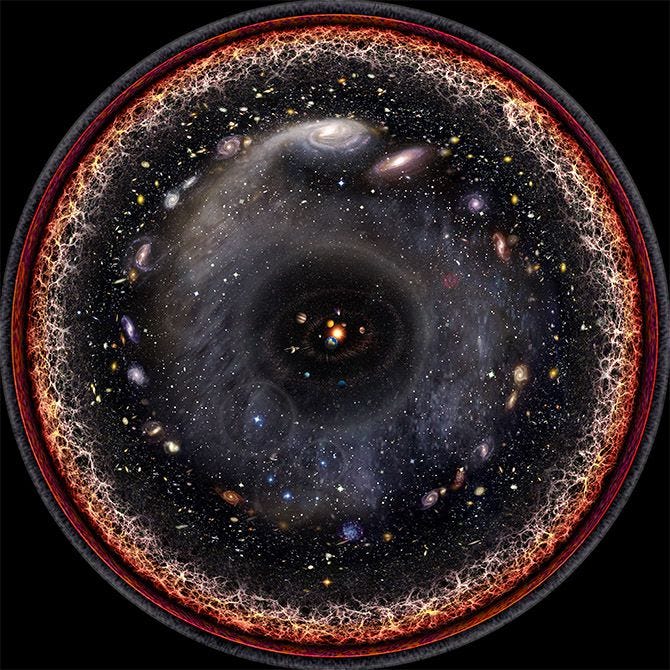

Although the observable universe is enormous, it is only a fraction of the entire cosmos. Many cosmological models suggest that the entire universe may be vastly larger than the portion we can see. Some estimates indicate that the total size could be hundreds of times—if not infinite—in extent compared to the observable region. For instance, one approach based on Bayesian model averaging suggests that our universe might be at least 250 times the size of the observable universe, meaning that while the visible part spans about 93 billion light-years in diameter, the whole universe could be many trillions of light-years across or even unbounded[1][7][6].
How Do Scientists Measure Cosmic Distances?
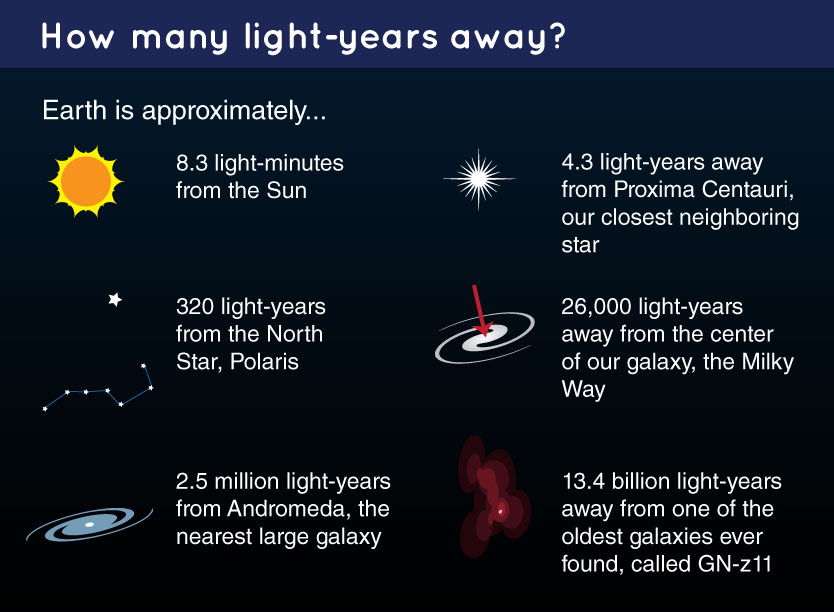
Measuring the vast scales of the cosmos involves a series of techniques that build one upon the other. Astronomers first use standard candles such as Cepheid variable stars, whose brightness variations are directly related to their intrinsic luminosity. By comparing their actual brightness with how bright they appear from Earth, distances to nearby galaxies can be determined accurately[2][13]. For more distant objects, techniques involving Type Ia supernovae, redshift measurements, and the cosmic microwave background (CMB) radiation are employed. The CMB, which represents the leftover radiation from the early universe, provides further clues to the scale of cosmic expansion. These multiple distance-measurement techniques—involving parallax at close ranges and redshift at great distances—allow scientists to create a cosmic distance ladder that leads to the current estimates of the observable universe’s dimensions[9][10].
Cosmic Expansion and Future Measurements
One of the key discoveries of the 20th century was that the universe is expanding. Edwin Hubble’s observation that galaxies are receding from us in proportion to their distance laid the foundation for this concept. More recent studies have shown that this expansion is accelerating due to a mysterious component known as dark energy[14]. While the most straightforward model incorporates dark energy as a constant—a term popularized by Einstein’s cosmological constant—new evidence suggests that dark energy may evolve over time, which would have profound implications for the ultimate size and fate of the universe[14]. Advanced instruments like the Hubble Space Telescope, and its successors, continue to refine our measurements and spur new theories. As our tools and methods improve, we may not only refine our estimates of size and age (currently about 13.8 billion years old) but also uncover deeper insights into the nature of dark energy and the universe’s long-term evolution[13][14].
Implications and Ongoing Research
The sheer vastness of the universe has both philosophical and scientific implications. The fact that the observable universe alone spans approximately 93 billion light-years in diameter illustrates how small our local region is compared to the whole cosmos. Nevertheless, this observable part still contains an immense number of galaxies—estimated to be in the trillions—with each galaxy composed of billions of stars and countless other forms of matter[5][11]. The ongoing study of the cosmic distance scale and dark energy is critical not just for understanding the geometry and size of the universe, but also for predicting its fate. Whether the universe will continue to expand indefinitely (leading to a Big Freeze scenario), halt, or even collapse under its own gravity remains an open question. What is clear, however, is that with every new observation, our picture of the universe grows richer and more complex, inviting further research into areas that challenge our current theories[7][14].
Let's look at alternatives:
- Modify the query.
- Start a new thread.
- Remove sources (if manually added).
What is the temperature of a neutron star?

Neutron stars are incredibly hot celestial objects, with surface temperatures reaching over 10 million Kelvin (K) at the time of their formation. However, they do not produce heat through nuclear fusion like many other stars. Instead, they cool over time, and their surface temperatures can drop significantly. For instance, neutron stars can reach a temperature of about 1 million K when they are between 1,000 to 1,000,000 years old[1][2].
An example of a well-studied neutron star, RX J1856.5−3754, has an average surface temperature of around 434,000 K[1][2]. This is still much hotter than our Sun, which has a surface temperature of about 5,780 K[2][3].
Let's look at alternatives:
- Modify the query.
- Start a new thread.
- Remove sources (if manually added).
Create your account to shape this feed around what you search for and enjoy.
How does the water not evaporate in a Quasar given it’s so hot?

In a quasar, while the environment is extremely hot, the water vapor still exists due to its specific conditions. The quasar emits immense energy, heating the surrounding gas and dust, creating a region with water vapor that is described as “unusually warm and dense” compared to typical conditions in galaxies like the Milky Way, even at about minus 63 degrees Fahrenheit[1].
Water can remain in vapor form because the presence of such high energy prevents immediate condensation, allowing it to exist despite the high temperatures in the vicinity of the supermassive black hole that powers the quasar[1].
Let's look at alternatives:
- Modify the query.
- Start a new thread.
- Remove sources (if manually added).
What new AI features has Meta recently released?

Meta has recently introduced a number of updates that enhance how users interact with its AI assistant across its platforms. For instance, you can now speak directly with Meta AI on Messenger, Facebook, WhatsApp, and Instagram DM—it will respond out loud in a natural, conversational style and lets you choose different voice options (including ones modeled on celebrities like Awkwafina, Dame Judi Dench, and John Cena)[2][4]. In addition, the assistant’s visual capabilities have been upgraded. Users can share photos with Meta AI and ask questions about them, request photo edits such as adding or removing objects or changing a background, and even generate entirely new images[2][4].
Meta has also enhanced its language support with a new translation tool for Reels. This feature automatically translates audio using real-time dubbing and lip-syncing so that content can be enjoyed across different languages[2][4]. Moreover, Meta AI now integrates more deeply into group interactions—you can invoke it in group chats by typing “@MetaAI” to get ideas, plan trips, or answer questions collaboratively[1][3].
For creators and businesses, there is also the launch of AI Studio, a platform that lets them build personalized AI experiences to better engage with their communities, along with newly personalized chat themes and improved AI-powered ad tools that have already shown to boost campaign performance[4].
Each of these upgrades is part of Meta’s ongoing effort to extend its AI capabilities across its ecosystem while offering more intuitive and useful interactions for both individual users and enterprises[2][4].
Let's look at alternatives:
- Modify the query.
- Start a new thread.
- Remove sources (if manually added).
The Largest Ocean in the Universe
Let's look at alternatives:
- Modify the query.
- Start a new thread.
- Remove sources (if manually added).

What is a digital nomad hotspot?

A digital nomad hotspot is a portable device that provides internet access, allowing digital nomads to work from virtually any location. These devices broadcast a Wi-Fi signal, enabling multiple devices to connect to the internet through cellular data. Unlike smartphone hotspots, dedicated mobile hotspots do not drain your phone's battery and offer stronger security with advanced encryption features.
Digital nomad hotspots can connect multiple devices simultaneously and support the latest Wi-Fi and cellular technology for reliable connections, making them essential tools for remote workers. Some popular mobile hotspots include devices like the Simo Solis Lite and the Nighthawk M6 Pro, known for their portability and performance, respectively. These hotspots allow digital nomads to stay connected whether they are in a café, on a beach, or traveling between countries, ensuring they can manage their work effectively while enjoying the flexibility of their lifestyle[1][2][3].
Let's look at alternatives:
- Modify the query.
- Start a new thread.
- Remove sources (if manually added).