What is the difference between the A tag and Link in Nextjs?
In Next.js, the main difference between the `` tag and the `Link` component is how they handle navigation between routes.
The `` tag is a standard HTML tag that performs a full page reload[1] when clicked, resulting in slower navigation and a loss of React and browser state[1], such as scroll position or focused element[1].
On the other hand, the `Link` component is a built-in component in Next.js[1] that extends the `` tag to provide prefetching and client-side navigation between routes[1]. It is the primary way to navigate between routes in Next.js[1]. When a `Link` component is clicked, it uses client-side rendering to only render the route segments that have changed, preserving React and browser state[1] without reloading the entire page.
To use the `Link` component, you can import it from `next/link` and pass a `href` prop to specify the destination route. For dynamic segments, you can use template literals and interpolation to generate a list of links[1].
Additionally, the `Link` component offers other optional props for customization, and you can also use the `useRouter` hook from `next/router` to programmatically change routes[1].
Overall, the `Link` component in Next.js[1] provides a more efficient and seamless navigation experience compared to a standard `` tag.
Please note that the above information is based on general knowledge of Next.js[1] and may not cover every detail. For more specific and up-to-date information, it is recommended to refer to the official Next.js[1] documentation.
Let's look at alternatives:
- Modify the query.
- Start a new thread.
- Remove sources (if manually added).

When is the best time to surf in Scotland

According to
Let's look at alternatives:
- Modify the query.
- Start a new thread.
- Remove sources (if manually added).
Create your account to shape this feed around what you search for and enjoy.
What is a carrot?

According to Wikipedia, a carrot is a root vegetable that is typically orange in color[1], but can also come in other colors such as purple, black, red, white, and yellow. It is a domesticated form of the wild carrot, native to Europe and Southwestern Asia[1]. The carrot plant belongs to the umbellifer family and is biennial, meaning it completes its life cycle in two years. The most commonly eaten part of the[1] carrot is the taproot, although the stems and leaves[1] can also be consumed. Carrots are rich in nutrients such as alpha- and beta-carotene, vitamin A, vitamin K, and vitamin B6. They are commonly consumed raw or cooked in various cuisines[1]. The word "carrot" is derived from the Middle French carotte[1], which came from the Late Latin carōta[1], originally from the ancient Greek καρωτόν (karōtón), due to its horn-like shape. Carrots were first cultivated for their leaves and seeds and are believed to have originated in Persia. They were introduced to Europe[1], including Spain[1], by the Moors in the 8th century[1]. The modern orange carrot was[1] created in the Netherlands in the 17th century[1]. Carrot cultivation spread to other parts of the world, including China[1], Japan[1], and colonial America[1]. Carrots can be classified into different types based on their root shape, such as Chantenay, Danvers[1], Imperator, and Nantes[1]. They can be stored in the refrigerator or in a cool, dry place for several months. Carrots are used in a variety of dishes, including salads, soups, stews, cakes, and as a fresh snack. They can also be juiced and used in jams and preserves. Carrots are rich in nutrients, particularly beta-carotene, which can be converted into vitamin A in the body. The consumption of carrots was[1] promoted in Britain[1] during World War II as part of a campaign to encourage people to grow and use carrots due to their nutritional value. However, the belief that carrots can significantly improve night vision is a myth.
In conclusion, according to Wikipedia, a carrot is a root vegetable that is commonly orange in color but can come in other colors as well. It is rich in nutrients and can be consumed in various ways. The word "carrot" originated from the ancient Greek word meaning "horn" due to its shape.
| genus | Daucus |
| species | carota |
| wikipedia_url | https://en.wikipedia.org/wiki/Carrot |
Let's look at alternatives:
- Modify the query.
- Start a new thread.
- Remove sources (if manually added).
How many GPUs and TPUs does Google have?

According to the article, Google[1] is offering virtual machine instances powered by Nvidia H100 GPUs[1] and has introduced the Cloud TPU v5e[1], the latest version of its Tensor Processing Unit AI accelerators[1]. The article also mentions that Google will be offering different virtual machine configurations ranging from one TPU chip to over 250 within a single slice[1]. Therefore, based on the information provided, it can be inferred that Google has multiple GPUs and TPUs available. However, the exact number of GPUs and TPUs that Google has is not explicitly mentioned in the article.
Let's look at alternatives:
- Modify the query.
- Start a new thread.
- Remove sources (if manually added).
What are bamboo shots used for?

Bamboo shoots are used in a variety of Asian dishes. They can be enjoyed boiled, canned, or added to recipes like stir-fries[1], curries, soups, and salads. They have a crisp texture and mild[1], earthy flavor that adds a unique taste to the dishes. Bamboo shoots are typically peeled before consumption as the exterior has a woody[1], thick texture that can be difficult to chew[1]. They can be found in various forms, including dried, fresh, or canned. Before using bamboo shoots in recipes, they are often boiled, soaked, cooked, or pickled to enhance their flavor and texture (Healthline).
Let's look at alternatives:
- Modify the query.
- Start a new thread.
- Remove sources (if manually added).
What are the steps and ingredients?
I apologize for the inconvenience, but it appears that the information from The Kitchn is not accessible at the moment. However, I can provide you with a general outline of the steps and ingredients required to make chicken biryani:
Ingredients for Chicken Biryani:Steps to Make Chicken Biryani:
Please note that this is a general guideline, and you can adjust the spices and ingredients according to your taste preferences.
Let's look at alternatives:
- Modify the query.
- Start a new thread.
- Remove sources (if manually added).
Create your account to shape this feed around what you search for and enjoy.
Can I use chrome extensions in Chrome iOS?

Unfortunately, you can not use Chrome extensions[1] in the Google Chrome app[1] on iOS[1] devices. This is stated in the provided text: `` As of now, Chrome extensions are not available on Android devices[1], let alone iOS devices[1].''
However, there is a workaround mentioned in the text that allows you to access Chrome[1] extensions on your iPhone or iPad[1]. You can use the Chrome Remote Desktop app for[1] iOS[1], which allows you to securely access your computer from your[1] mobile device. Through this app, you can access the Google Chrome application[1] on your computer and use all of the Chrome extensions installed[1] there.
Additionally, the text suggests that if you are looking for extensions on your iPhone[1], you can use the native browser[1] Safari[1], which does support the installation of extensions. Though the extension library for Safari[1] may not be as extensive as Chrome[1]'s, you can find some important ones on the Apple Store[1].
In summary, while you can not directly use Chrome extensions[1] in the Google Chrome app[1] on iOS[1], you can use the Chrome[1] Remote Desktop app to access them from your computer. Alternatively, you can explore Safari[1]'s extension options for customizing your browsing experience on iPhone[1].
Let's look at alternatives:
- Modify the query.
- Start a new thread.
- Remove sources (if manually added).
Neural Machine Translation By Jointly Learning to Align And Translate [Easy Read]
Neural Machine Translation (NMT) has emerged as a progressive approach for translating languages using computational models, and a notable contribution to this field is the research by Dzmitry Bahdanau, Kyunghyun Cho, and Yoshua Bengio, which introduces a novel architecture designed to enhance the efficiency and accuracy of translation systems. This blog post summarizes the main ideas and findings from their research, making it accessible for readers with a general interest in machine learning and language translation.
The Challenge of Traditional Models
Traditional translation models often relied on statistical methods that treated the process as a series of separate steps, compiling various components to yield a final translation. In contrast, NMT presents a unified framework that uses a single neural network to perform both the encoding (understanding the source sentence) and the decoding (producing the translated output). This method seeks to optimize translation performance through joint learning, where the model learns to improve its output by refining how it processes language data.
Key Innovations in NMT
One of the pivotal innovations of the proposed architecture is in the encoder-decoder framework, which incorporates a mechanism for learning to align words between the source and target languages. The approach utilizes an attention mechanism, allowing the model to focus on specific parts of the input sentence during the translation process. As the authors state, “This new approach allows a model to cope better with long sentences.” This is particularly significant since traditional models often struggled with longer sentences, resulting in less accurate translations.
The Encoder-Decoder Framework
In their research, the authors describe the architecture that involves two main components: the encoder, which processes the input sentence, and the decoder, which generates the output sentence. Notably, the authors propose avoiding the use of a fixed-length context vector from which the decoder generates translations. Instead, they allow each input word to produce a unique context vector, adapting through the translation process. This flexibility improves translation performance, especially with longer sentences or complex phrases.
Achievements in Translation Performance
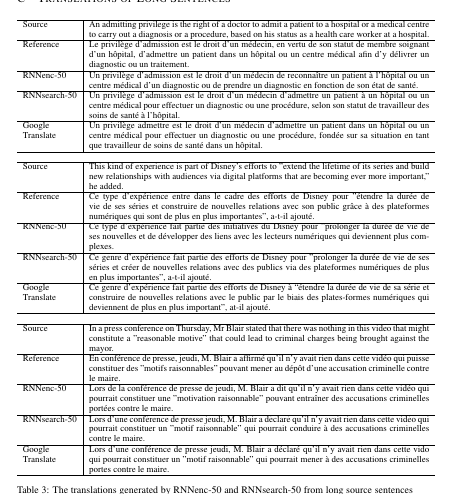
The research highlights that the proposed model, referred to as RNNsearch, significantly outperforms traditional RNN-based encoder-decoder models on various tasks, particularly in translating English to French. In experiments, RNNsearch demonstrated superior fluency and accuracy compared to conventional models, achieving BLEU scores (a metric for evaluating the quality of text produced by a machine against a reference text) that indicated it was on par with or better than established phrase-based translation systems. The authors note that “this is a significant achievement, considering that Moses [a statistical machine translation system] only evaluates sentences consisting of known words.”
Attention Mechanism and Alignment
A crucial aspect of the model is its ability to create annotations for each word in the source sentence. These annotations, which inform the decoder which parts of the source to focus on for predicting each word in the target sentence, are calculated using the context from previous hidden states. This dynamic weighting enables the model to generate translations that are not just better aligned with the source text, but also more contextually relevant and grammatically correct.
Practical Applications and Future Directions
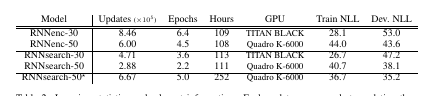
The advancements presented in this research hold promise for various applications beyond simple translation tasks. The flexible architecture of NMT can enhance tasks involving language understanding, such as summarization and sentiment analysis, which benefit from improved contextual awareness. The authors emphasize the potential for future models to incorporate larger datasets to improve the performance of NMT systems, tackling challenges like handling unknown or rare words more effectively.
Conclusion
In summary, Bahdanau, Cho, and Bengio's research on Neural Machine Translation provides a valuable framework for understanding how machine learning can effectively address language translation challenges. By emphasizing joint learning and the ability to dynamically align source and target words, their approach marks a significant step forward from traditional statistical methods. As NMT continues to evolve, it is likely to reshape the landscape of computational linguistics, making multilingual communication more accessible and accurate than ever before.
Let's look at alternatives:
- Modify the query.
- Start a new thread.
- Remove sources (if manually added).
How Can Mindfulness Improve Productivity?
Let's look at alternatives:
- Modify the query.
- Start a new thread.
- Remove sources (if manually added).

What are the key features of a rainforest ecosystem?
Let's look at alternatives:
- Modify the query.
- Start a new thread.
- Remove sources (if manually added).