Comparative research report: space tourism companies in 2026 (vehicles, training, pricing, safety, timelines)
The State of Space Tourism: A 2026 Comparative Analysis
As of 2026, the space tourism industry has evolved from a distant dream into a burgeoning commercial reality, albeit one still reserved for the exceptionally wealthy. A handful of pioneering companies now offer distinct experiences, ranging from brief, rocket-powered flights to the edge of space to multi-day orbital missions and gentle, high-altitude balloon ascents. This year marks a pivotal moment, with established players refining their operations and new vehicles poised to enter service, expanding the options available to private astronauts.
This report provides a comparative analysis of the leading space tourism companies active in 2026. It examines their operational vehicles, mission profiles, passenger training requirements, pricing structures, and safety protocols. By comparing the offerings of key operators such as Virgin Galactic, Blue Origin, SpaceX, and emerging contenders like Space Perspective, this analysis offers a comprehensive snapshot of the market's landscape, timelines, and the unique value propositions shaping this new frontier of travel.
The Fleet of 2026 Space Tourism
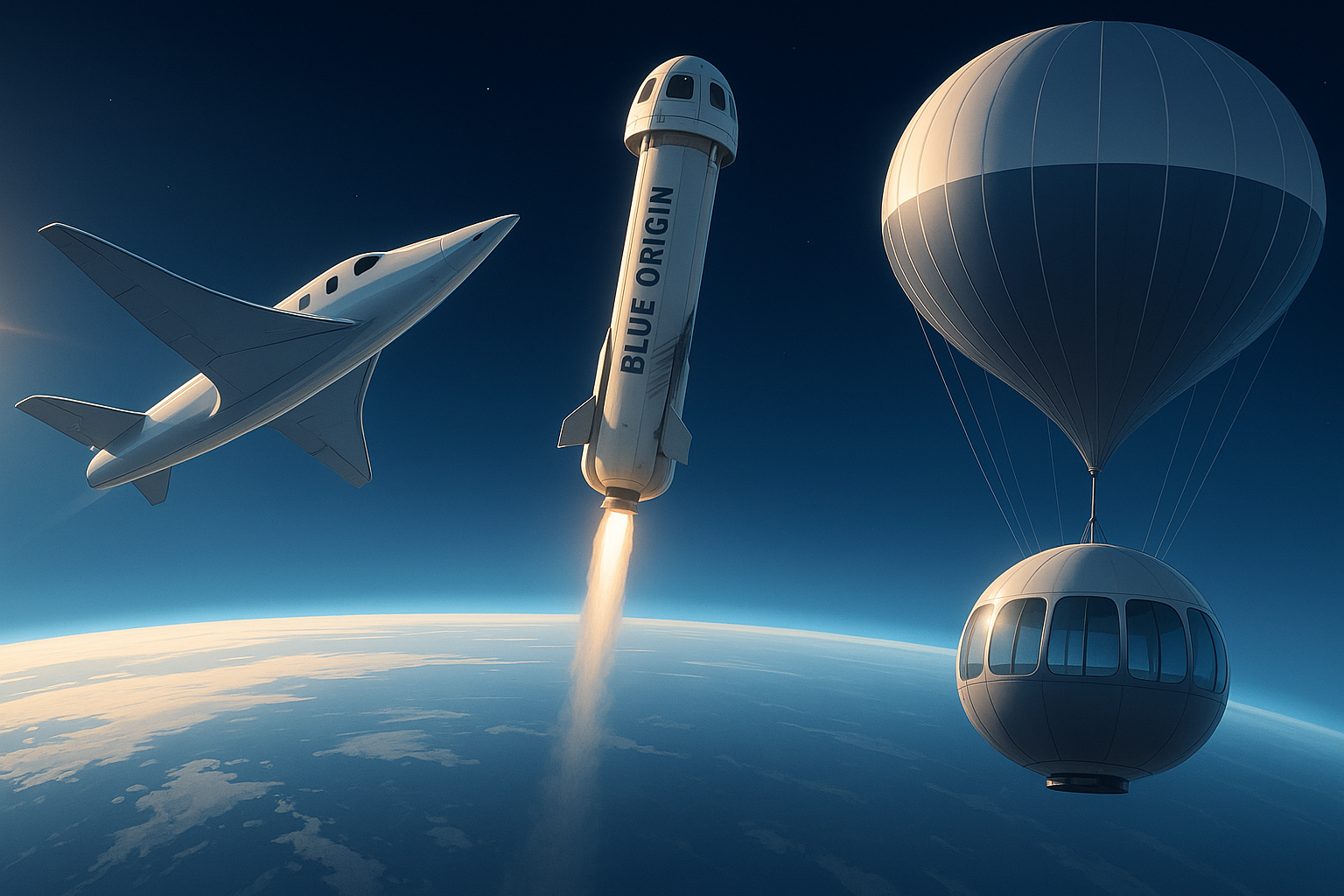
An illustrative montage showcasing the different types of vehicles used for space tourism in 2026, including a suborbital spaceplane, a vertical launch rocket and capsule, and a high-altitude balloon capsule, all depicted with Earth in the background.
Key Players in the 2026 Space Tourism Market
The space tourism market in 2026 is dominated by a few key companies, each targeting a specific segment of the market. These range from suborbital flights offering a few minutes of weightlessness to extended orbital journeys to the International Space Station (ISS). Virgin Galactic and Blue Origin are the primary competitors in the suborbital space, utilizing a spaceplane and a reusable rocket, respectively[1]. SpaceX, in partnership with companies like Axiom Space, leads the orbital market with its proven Crew Dragon capsule[5]. Meanwhile, a new category of 'near-space' tourism is emerging with companies like Space Perspective, World View, and Zero 2 Infinity offering gentle, high-altitude balloon flights[21][45][44].
| Company | Primary Mission Type | Key Vehicle(s) |
|---|---|---|
| Virgin Galactic | Suborbital | Delta-Class Spaceplane |
| Blue Origin | Suborbital | New Shepard Rocket & Capsule |
| SpaceX | Orbital | Crew Dragon, Starship (testing) |
| Axiom Space | Orbital (ISS Missions) | SpaceX Crew Dragon |
| Space Perspective | Stratospheric Balloon | Spaceship Neptune |
| World View | Stratospheric Balloon | Pressurized Capsule |
| Zero 2 Infinity | Stratospheric Balloon | Bloon Pod |
Other significant entities in the market include Space Adventures, a firm specializing in organizing bespoke private space missions, including trips to the ISS, and established aerospace giant Boeing, which is also recognized as a principal player in the sector[1][3]. While some companies have clear flight plans for 2026, others, like Axiom Space, have their next private mission scheduled for early 2027, and Space Adventures has no publicly detailed missions for this year.
Vehicles and Mission Profiles: A Comparative Overview
The experience of a space tourist in 2026 is defined by the vehicle and mission profile offered by each company. These experiences vary dramatically in terms of duration, altitude, g-forces, and overall journey.
Virgin Galactic's VSS Unity in Flight
Virgin Galactic's VSS Unity spaceplane, a predecessor to the upcoming Delta-class, is shown during a suborbital flight. The Delta-class will follow a similar flight profile, launching from a carrier aircraft before rocketing to the edge of space.
Blue Origin's New Shepard Capsule
The reusable New Shepard crew capsule from Blue Origin after landing. This vehicle takes passengers on a vertical ascent past the Kármán line, offering large windows for viewing Earth.
SpaceX Crew Dragon Approaching the ISS
The SpaceX Crew Dragon spacecraft is pictured here as it approaches the International Space Station. This vehicle is used for multi-day orbital missions for both NASA astronauts and private citizens.
Virgin Galactic is set to begin commercial service with its new Delta-class spaceplanes in 2026[5]. These vehicles are designed to carry up to six passengers on suborbital flights[4]. The mission lasts approximately one hour from takeoff to landing, reaching altitudes around 87-88 km and providing a few minutes of weightlessness[31][36].
Blue Origin continues to offer suborbital flights on its reusable New Shepard launch system[1]. The entire mission is a brief, 10-minute journey that propels the capsule to an altitude near the Kármán line (100 km), offering passengers stunning views and a short period of weightlessness before returning to Earth under parachutes[32][35]. However, the company has temporarily paused these flights to focus on other projects[43].
SpaceX provides orbital missions using its Crew Dragon capsule, launched atop a Falcon 9 rocket[5]. These are long-duration flights, typically lasting a week or more and taking private astronauts to destinations like the International Space Station[8]. The company is also developing its Starship vehicle, with plans for a long-duration orbital flight test in 2026, which could pave the way for future lunar tourism[4][34].
Space Perspective offers a starkly different experience with its Spaceship Neptune, a pressurized capsule lifted by a high-altitude balloon[21]. The six-hour journey is a gentle ascent to 100,000 feet (about 30 km), where passengers spend two hours enjoying panoramic views through the largest windows ever flown to this altitude[24][22]. The capsule accommodates eight passengers and a pilot and includes amenities like a bar and a bathroom[21].
| Company | Mission Type | Max Altitude (Approx.) | Mission Duration | Weightlessness |
|---|---|---|---|---|
| Virgin Galactic | Suborbital | 88 km | ~1 hour | A few minutes |
| Blue Origin | Suborbital | 100 km | ~10 minutes | A few minutes |
| SpaceX / Axiom Space | Orbital | >400 km (ISS Orbit) | Multiple Days | Extended |
| Space Perspective | Stratospheric | 30 km | ~6 hours | No |
Pricing and Timelines for 2026
Access to space remains an exclusive venture, with ticket prices varying significantly based on the mission's complexity and duration. In 2026, the market offers a clear hierarchy of costs, from stratospheric balloon rides to multi-million dollar orbital expeditions.
| Company / Operator | Mission Type | Estimated Price Per Seat (USD) | 2026 Status |
|---|---|---|---|
| Virgin Galactic | Suborbital | $600,000+ | Flights to begin with new Delta-class vehicle[10] |
| Blue Origin | Suborbital | High six-figures (variable) | Flights temporarily paused[43] |
| SpaceX / Axiom Space | Orbital (ISS) | $55 Million | No specific private missions announced for 2026 |
| Space Perspective | Stratospheric | $125,000 | Commercial flights slated to begin[21] |
| World View | Stratospheric | $50,000 | Commercial operations planned[45] |
| Zero 2 Infinity | Stratospheric | $132,483 | Commercial operations planned[44][46] |
Virgin Galactic plans to restart its commercial service in 2026 with its new Delta-class vehicle, increasing its ticket price to around $600,000 from the previous $450,000[10]. Blue Origin's pricing is not public, but seats have been sold in the high six-figure range, with some auctioning for millions[11]. For the ultimate experience, an orbital mission to the ISS with Axiom Space costs approximately $55 million per seat[27][29]. SpaceX's development of Starship aims to drastically reduce the cost of orbital and lunar trips, with projections suggesting a potential drop to between $2 million and $10 million per passenger in the future, possibly as soon as 2026[8][9].
Passenger Training and Preparation
The level of training required for space tourists is directly proportional to the intensity and duration of their flight. Suborbital hops require minimal preparation compared to the rigorous training needed for orbital missions.
- SpaceX / Axiom Space: The most intensive training is for orbital missions. Passengers undergo three to six months of preparation, accumulating 200-400 hours of training. This covers spacecraft systems, emergency procedures, and physical conditioning for microgravity[14]. Axiom has used a 15-week regimen and is testing a new six-month protocol to enhance readiness[27][30].
- Virgin Galactic: Passengers complete a three-day pre-flight 'Space Readiness Program'. This includes medical checks, centrifuge sessions to simulate g-forces, and briefings on spacecraft operations and emergency protocols[13][14].
- Blue Origin: The training for a New Shepard flight is significantly shorter, consisting of about 14 hours over two days. This covers safety procedures, vehicle ingress/egress, and simulations for the flight experience[15].
- Space Perspective & other balloon operators: The training is the most minimal. Passengers receive a safety briefing similar to one on a commercial airliner before boarding[41]. Zero 2 Infinity requires two days of dedicated safety training before its flights[44].
Safety Records and Regulatory Framework
As of 2026, the commercial space tourism industry operates under a unique regulatory framework overseen by the Federal Aviation Administration (FAA). Current regulations focus primarily on the safety of the public on the ground rather than a comprehensive certification process for passenger safety[16]. Passengers are required to provide informed consent, acknowledging the inherent risks of spaceflight by signing waivers[16]. Operators must inform participants in writing of known hazards and provide training on emergency procedures[20].
Regarding safety records, Blue Origin and SpaceX have maintained perfect safety records on all their crewed missions[48]. SpaceX has successfully flown multiple commercial and NASA missions with its Crew Dragon without injury[49]. Virgin Galactic, while having completed its initial commercial flights without passenger incidents, has a more complex history that includes two fatal accidents during the test phases of its vehicle development in 2007 and 2014[49]. All companies have incorporated advanced safety systems, including multiple redundancies and automated abort capabilities, to mitigate risks and improve operational safety[18].
Conclusion: The Trajectory of Commercial Spaceflight
The year 2026 represents a dynamic and maturing phase for the space tourism industry. The market is clearly segmented, offering a spectrum of experiences from the gentle, scenic ascents of stratospheric balloons to the intense, brief thrill of suborbital rocket flights and the profound, life-altering perspective of orbital journeys. While Virgin Galactic's return to service with its new Delta-class vehicle signals a push towards more regular suborbital flights, the high price point across all providers ensures that space remains a destination for a select few.
Safety protocols and vehicle technology continue to advance, with operators like SpaceX and Blue Origin demonstrating impressive crew safety records. However, the regulatory environment continues to rely on an 'informed consent' model, placing the onus of risk on the passenger. Looking ahead, the development of next-generation reusable vehicles like SpaceX's Starship holds the promise of dramatically lowering costs and increasing access, potentially transforming the landscape from exclusive tourism to more widespread space travel in the coming decade.
References
Get more accurate answers with Super Pandi, upload files, personalized discovery feed, save searches and contribute to the PandiPedia.
Let's look at alternatives:
- Modify the query.
- Start a new thread.
- Remove sources (if manually added).
 Curated by Joan