What was the true cause of the "Rain-tree" phenomenon in the Peruvian Andes?. This question seeks the scientific explanation for the observed "rain" from the Pithecolobium saman tree. The answer reveals it was due to cicadas sucking plant juices and squirting fluid.
The Mystery of the Peruvian Rain-Tree: Unraveling the True Cause
In the lush landscapes of the Eastern Peruvian Andes, tales of a remarkable tree that produced its own rain captured the imagination of many in the 19th century. Known locally as Tamia-caspi, or the "Rain-tree," this botanical wonder was rumored to possess the extraordinary ability to draw moisture from the air and shower it onto the ground below. This report examines the historical accounts of this phenomenon, contrasting the popular myth with the scientific explanation that ultimately demystified the weeping tree. The investigation reveals a fascinating symbiotic relationship between flora and fauna, where the true source of the "rain" was not the tree itself, but a multitude of insects.
The Saman Tree (Pithecolobium saman)
A photograph of a Pithecolobium saman, commonly known as a Rain Tree. These large, wide-canopied trees are native to the neotropics and are the type of tree associated with the "raining" phenomenon in Peru.
The Popular Myth: A Self-Watering Wonder
Widespread reports of the Rain-tree gained significant traction around 1877, largely fueled by an account attributed to the United States Consul in Moyobamba, Northern Peru[1]. This narrative described a tree capable of absorbing and condensing atmospheric humidity with what was called "astonishing energy"[1]. According to the story, the tree's process was so efficient that water would constantly ooze from its trunk and drip from its branches in copious amounts[1]. The volume of this supposed precipitation was said to be so great that the ground directly beneath the tree's canopy was transformed into a "perfect swamp"[1].
The tale was not merely a curiosity; it carried practical implications. Proponents of this theory suggested that the Rain-tree could be a solution to agricultural challenges in arid regions. There was a serious proposal to cultivate these trees in the dry coastal areas of Peru, with the hope that they would irrigate the land and benefit local farmers[1]. This captivating story of a self-watering tree presented a seemingly miraculous solution to drought, blending botanical marvel with agricultural promise.
The Scientific Explanation: An Entomological Answer
While the story of the humidity-condensing tree was compelling, a more scientific explanation was provided by Dr. Spruce, a respected traveler with extensive experience in South America[1]. Dr. Spruce confirmed that the Tamia-caspi was indeed a real phenomenon, but not in the way popular rumor described it[1]. He clarified, "The Tamia-caspi, or Rain-tree of the Eastern Peruvian Andes is not a myth, but a fact, although not exactly in the way popular rumour has lately presented it"[1].
Dr. Spruce recounted his own direct observation of the phenomenon, which occurred near Moyobamba in September 1855. On a morning with a completely clear sky, he and his companions walked under a tree from which a "smart rain was falling"[1]. Intrigued, he looked up into the branches to find the true source. His investigation revealed that the 'rain' was not a product of the tree itself. Instead, he observed "a multitude of cicadas, sucking the juices of the tender young branches and leaves, and squirting forth slender streams of limpid fluid"[1].
Cicadas Creating the 'Rain' on a Tree Branch
An illustrative, detailed macro view of several cicadas on a lush green tree branch. The cicadas are shown piercing the bark to suck sap and excreting fine streams of fluid, which fall like a gentle rain, capturing the true cause of the Rain-tree phenomenon. The lighting is bright and natural, as if on a clear day.
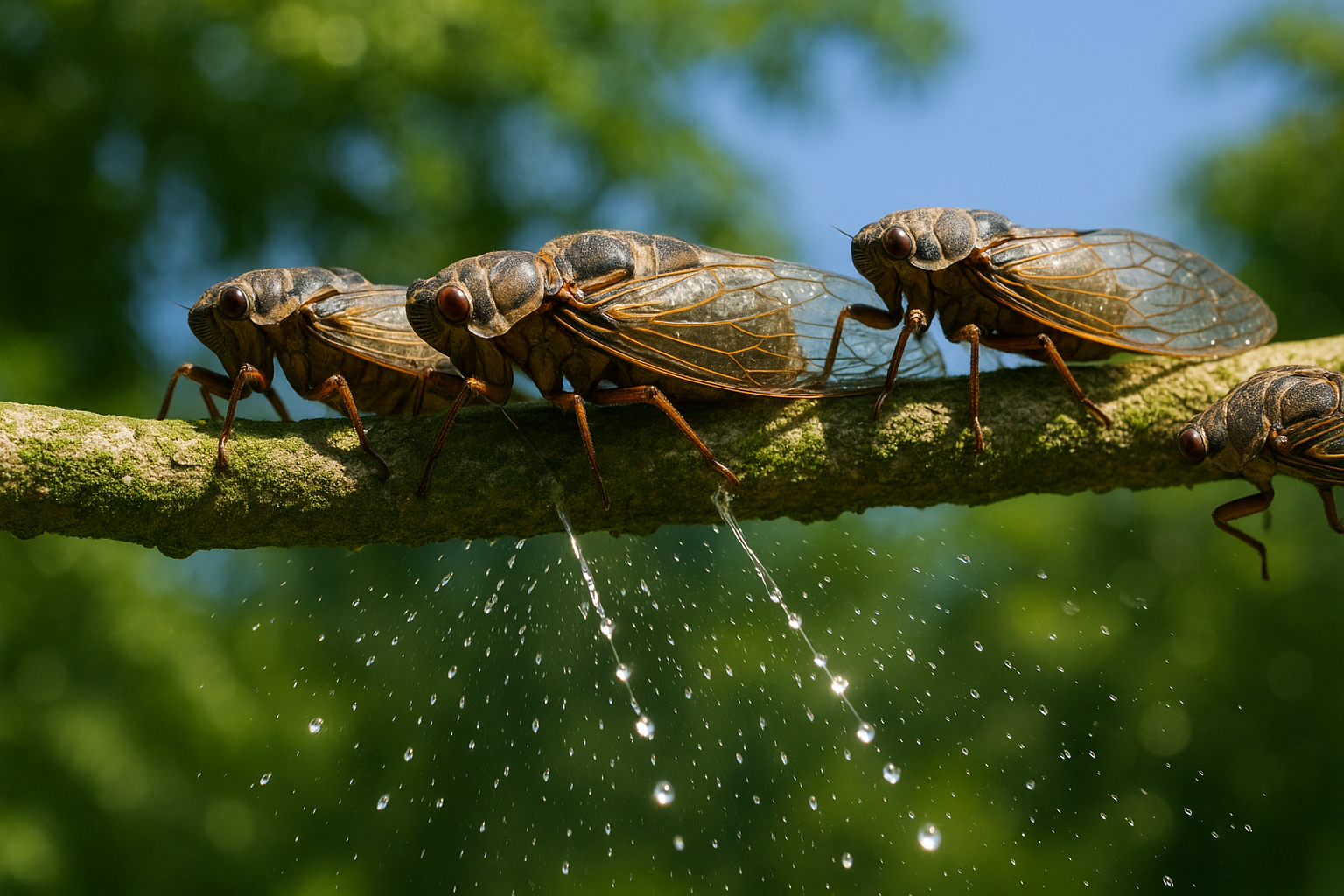
This observation provided the definitive answer. The 'rain' was the excrement, often called honeydew, from a massive number of cicadas feeding on the tree's sap. The insects would consume the nutrient-rich sap and expel the excess water and sugars as a clear liquid. When thousands of cicadas did this simultaneously, the collective discharge created the effect of a continuous shower. Dr. Spruce noted that his Peruvian guides were already well-acquainted with this occurrence, understanding that virtually any tree hosting a large population of feeding cicadas could become a temporary Tamia-caspi[1]. He concluded that while a specific tree might have been famously known for this effect, the cicada was the universal agent responsible for the moisture[1].
Conclusion
The true cause of the "Rain-tree" phenomenon in the Peruvian Andes is not a botanical marvel of atmospheric condensation, but rather a remarkable example of insect biology. The popular 19th-century myth of a tree that could water the earth beneath it was debunked by the careful observations of Dr. Spruce. His firsthand account clarified that the "rain" was, in fact, the collective fluid excretions of a vast number of cicadas feeding on the tree's sap[1]. This scientific explanation replaces a fantastical tale with an equally fascinating natural reality, highlighting the powerful, and sometimes surprising, impact that insects can have on their environment.
Create your account to keep this answer and continue from it later.
Let's look at alternatives:
- Modify the query.
- Start a new thread.
- Remove sources (if manually added).