
Exploration of Sweden's Mythological Beings in Folklore
Sweden's Most Famous Mythological Tales: A Research Overview
Swedish folklore is renowned for vivid tales of nature spirits, water beings, household guardians, and hidden folk whose stories have been told and sung for centuries across forests, farms, and waterways[1].
This report synthesizes well-attested legends that are widely cited as among Sweden's most famous, including the Skogsrå or Huldra of the forest, the water spirit Näcken, trolls of mountain and wood, the farm guardian Tomte, the hidden Vittra and their invisible paths, the tragic ballad of Sir Olof and the elves, and the haunting revenant known as the myling[1][8][15].
Night of Swedish Folklore
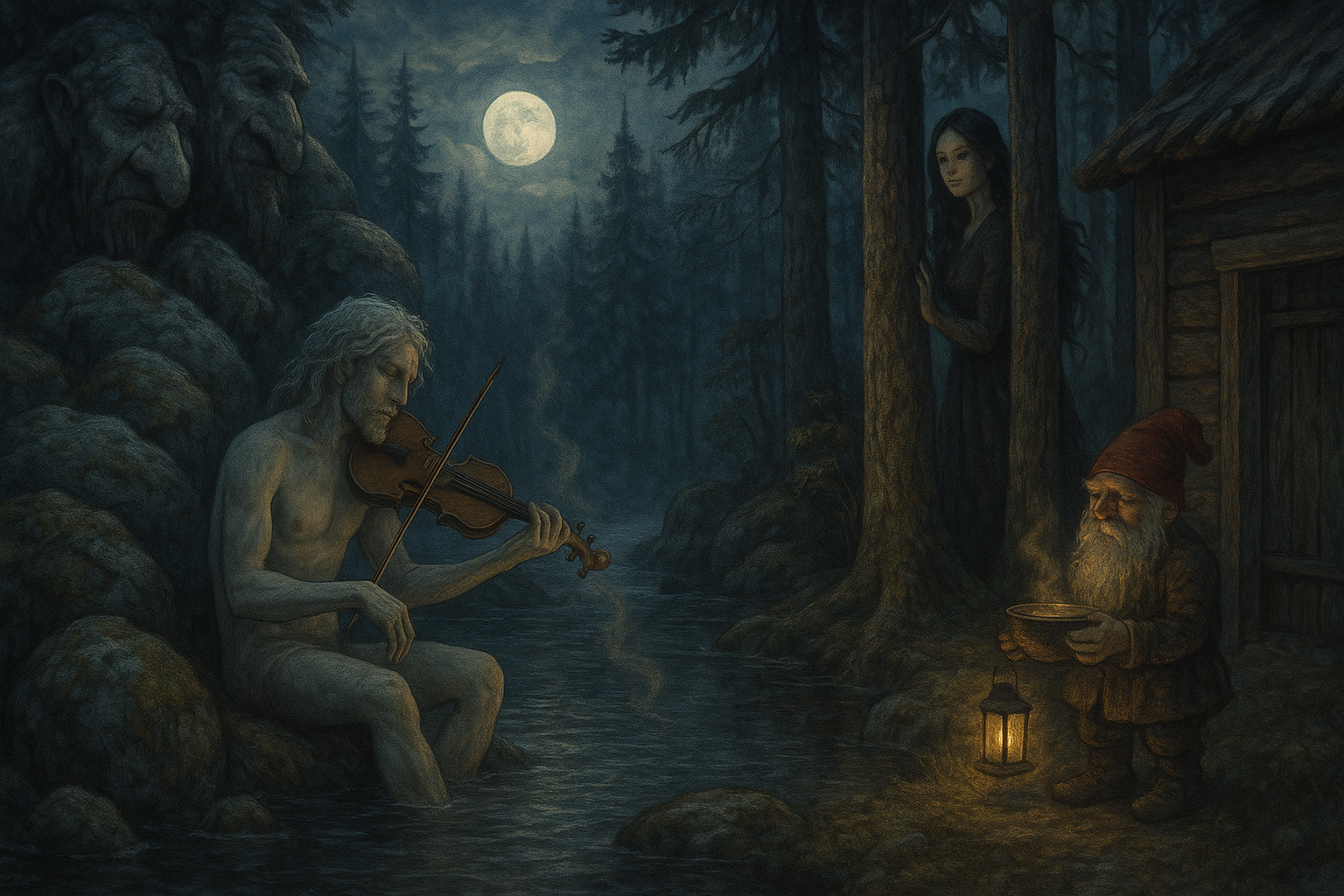
Concept illustration: Näcken plays a violin beside a moonlit stream, the Skogsrå emerges from a pine forest, a Tomte stands by a barn with a bowl of porridge, and trolls loom among rocky outcrops.
Forest Beings and Hidden Nature Spirits
The Skogsrå, also called the Huldra, is among Sweden's most famous forest spirits, often appearing as a striking woman who conceals a cow's tail and is sometimes said to become fully human after a church wedding[1].
Trolls occupy a central place in Swedish legend as powerful, nature-bound beings of forest and mountain, a presence made widely recognizable through beloved folk-tale art and retellings[1][2].
Later Scandinavian folklore commonly adds that trolls risk turning to stone in sunlight, a motif that underscores their affinity for nighttime and wild places beyond human settlements[6].
Elves in Swedish tradition are alluring yet perilous, often depicted as beautiful beings encountered in mists and edges of the human world, inspiring both fascination and caution in classic tales and songs[1].
- Skogsrå/Huldra: beautiful forest guardian who may reward respect yet imperil the unwary
- Trolls: wild, powerful beings of mountains and woods, often dangerous to travelers
- Elves: captivating and otherworldly, associated with liminal places and cautionary encounters
Water Spirits and Luring Legends
Näcken is the iconic Swedish water spirit, typically portrayed as a naked man playing a fiddle in streams or rivers, whose enchanting music lures listeners toward the water with deadly consequence in many tales[1][28].
Closely related within water lore is the bäckahäst, a large and beautiful supernatural horse that tempts children to climb on its back before stretching in length and drawing them into the water, a danger that can be averted in some traditions by throwing a piece of steel to break its power[25].
The Tomte and the Christmas Porridge Custom
The Tomte is a small household and farm guardian who helps with chores and watches over people and animals, yet he is easily offended if not properly respected or fed[29][31].
A well-known custom is to offer the Tomte a bowl of porridge, often associated with Christmas but historically also given at other times, sometimes with a pat of butter on top to show appreciation for his work[29][30][33].
If offended by poor offerings or neglect, the Tomte might retaliate with mischief or worse on the farm, a theme echoed in both scholarly summaries and popular retellings of Swedish folk belief[34][13].
One classic tale recounts a prank in which butter was hidden under the porridge rather than placed on top, enraging the Tomte who killed the family's best cow before later replacing it to atone for the overreaction, a narrative that illustrates his strict sense of respect and reciprocity[12][14].
Hidden Folk and the Rules of the Land: The Vittra
The Vittra are hidden folk associated with nature and herding who live in parallel to human communities, sometimes beneath the ground, and who demand that their ways and spaces be respected[18].
Many stories warn against building across vittrerstigar, the invisible routes the Vittra use between their dwellings, since blocking these paths is said to bring misfortune such as sick animals, broken tools, insomnia, or uncanny encounters until the obstruction is removed[21].
Accounts further emphasize that construction too close to Vittra homes or disturbances that block their roads may provoke deliberate accidents that endanger human life, underscoring the broader Scandinavian ethic of respecting unseen neighbors and their domains[24].
Ballads and Revenants: Sir Olof and the Myling
The medieval ballad 'Herr Olof och älvorna' (Sir Olof and the Elves) tells of a bridegroom who refuses to dance with elves on the eve of his wedding, is cursed with a deadly illness, and dies before the ceremony, a cautionary tale that appears in multiple Scandinavian variants and warns of the peril of otherworldly encounters[8][9][10][11].
Equally haunting is the myling, the restless spirit of an unbaptized or murdered newborn that seeks burial in consecrated ground and grows unbearably heavy on the back of anyone who carries it toward a graveyard, a motif that emphasizes communal obligations to the dead and the consequences of hidden crimes[15][16][17].
Transmission, Collections, and Modern Summaries
Classic tales of trolls and other beings became widely known through illustrated collections such as John Bauer's Swedish folk tales, which helped fix the visual imagination of Swedish folklore for later generations[2].
Modern compilations and websites continue to circulate these legends, from curated volumes of Swedish folktales to popular summaries that list iconic creatures found in Swedish storytelling traditions[4][3].
Conclusion
Sweden's most famous mythic tales orbit a core set of beings and narrative patterns that teach respect for nature, caution at liminal boundaries, and reciprocity in daily life[1][29][21].
From the Skogsrå's double-edged beauty and the lures of Näcken, to the Tomte's porridge rite, the Vittra's invisible roads, the tragic elfin ballads, and the burdensome appeal of the myling, these narratives remain central to how Swedish folklore frames the relationship between humans and the more-than-human world[1][25][12][21][8][15].
Let's look at alternatives:
- Modify the query.
- Start a new thread.
- Remove sources (if manually added).