Let's look at alternatives:
- Modify the query.
- Start a new thread.
- Remove sources (if manually added).
 Curated by Joan





Transcript
Imagine a botanical gallery wall that evokes the warm charm of a cabin window; choose a tight theme of ferns, wildflowers, and mushrooms using vintage prints sourced from thrift books and public-domain scans. Unify your frames effortlessly with one simple trick: use identical white mats to tie diverse frame styles into one cohesive design, whether arranged in a neat grid or an organic cluster. Hang your art using removable methods such as Command strips or picture rail hacks, ensuring a damage-free installation ideal for renters. Finally, a wide shot reveals the room transforming into a lush, nature-infused sanctuary where the gallery wall becomes a window into a vibrant, rustic retreat.
Let's look at alternatives:
- Modify the query.
- Start a new thread.
- Remove sources (if manually added).




Get more accurate answers with Super Pandi, upload files, personalised discovery feed, save searches and contribute to the PandiPedia.

Common sitemap submission mistakes include adding URLs that are set to 'noindex,' blocked by robots.txt, or canonicalized to another page. This can lead to non-indexable URLs remaining in the sitemap, which should be avoided to ensure proper indexing by search engines[1]. Additionally, not updating the sitemap regularly can result in it containing outdated or irrelevant pages that waste crawl budgets[2].
Another mistake is failing to submit the sitemap to Google Search Console, which limits its visibility to search engines[3]. Lastly, exceeding the limits of 50,000 URLs per sitemap or a size of 50MB without properly segmenting them can cause issues, as search engines may ignore part of the URLs[4].
Let's look at alternatives:
- Modify the query.
- Start a new thread.
- Remove sources (if manually added).










Let's look at alternatives:
- Modify the query.
- Start a new thread.
- Remove sources (if manually added).




Let's look at alternatives:
- Modify the query.
- Start a new thread.
- Remove sources (if manually added).






Let's look at alternatives:
- Modify the query.
- Start a new thread.
- Remove sources (if manually added).





Get more accurate answers with Super Pandi, upload files, personalised discovery feed, save searches and contribute to the PandiPedia.

Let's look at alternatives:
- Modify the query.
- Start a new thread.
- Remove sources (if manually added).
Let's look at alternatives:
- Modify the query.
- Start a new thread.
- Remove sources (if manually added).






Let's look at alternatives:
- Modify the query.
- Start a new thread.
- Remove sources (if manually added).
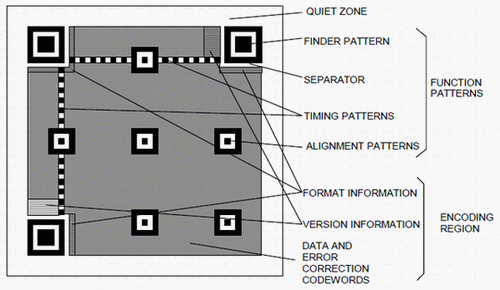
QR codes store data as binary information within a grid of black and white modules[3]. To ensure reliable scanning, they use Reed-Solomon error correction, which adds redundant data to the code[3]. This allows the scanner to reconstruct missing pieces if the code is damaged, smudged, or obscured by up to 30%[2][6]. Finder patterns at the corners help the device locate and orient the code, while alignment markers ensure accuracy even if the surface is skewed[2][6]. Designers often place logos in the center, treating them as intentional damage that the error correction algorithm easily ignores[2].
Let's look at alternatives:
- Modify the query.
- Start a new thread.
- Remove sources (if manually added).