Descubre Pandipedia
Un directorio creciente de respuestas útiles seleccionadas por la comunidad de Pandi. Busca en la colección o explora los últimos descubrimientos.
2292 entradas disponibles

AI apprenticeship programs hiring now in 2025

Veamos alternativas:
- Modifica la consulta.
- Inicia un nuevo hilo.
- Eliminar fuentes (si se han agregado manualmente).
The green economy is booming
Veamos alternativas:
- Modifica la consulta.
- Inicia un nuevo hilo.
- Eliminar fuentes (si se han agregado manualmente).
Differences Between Quantum and Classical Computing
Differences Between Quantum and Classical Computing

Quantum computing is poised to revolutionize the way we process and analyze information, offering capabilities that extend far beyond those of classical computing. Below is a comprehensive report that highlights the fundamental differences between quantum and classical computing, based on insights from multiple reliable sources.
Fundamental Differences
Data Representation
The core difference between quantum and classical computing lies in how they represent data. Classical computers use bits as their basic unit of information, which can exist in one of two states: 0 or 1. This binary system is the foundation of classical computing and all its operations [1][2][4][6].
On the other hand, quantum computers use qubits, which can exist in a state of 0, 1, or both simultaneously thanks to a phenomenon known as superposition [1][2][3][4][6][7][10]. This enables quantum computers to encode and process vastly more information at the same time compared to classical computers.
Data Processing
Classical computers perform operations sequentially, solving problems step-by-step [1][3][4][6]. Even with parallel processing capabilities, classical computers still essentially rely on their bits flipping between 0 and 1 states to compute [4][7].
Quantum computers, however, can perform multiple calculations simultaneously. This is facilitated by superposition and entanglement—where qubits become interconnected, such that the state of one qubit depends on the state of another, allowing for faster information transfer and processing [1][2][3][4][6][7][10].
Computational Power
Exponential vs. Linear Scaling

Classical computing power increases linearly with the number of transistors. A traditional computer with more transistors can process more bits but only linearly increases its computational speed [2][7].
In contrast, a quantum computer's power scales exponentially with the number of entangled qubits. For instance, while two qubits can store and process 4 bits of information, three qubits can handle 8, and so on [1][4][6][7][10].
Use Cases and Suitability
Classical computers are well-suited for everyday tasks and operate efficiently under normal conditions, making them ideal for use in a wide array of applications from basic computing needs to complex simulations [1][2][4].
However, quantum computers excel in solving specific types of problems that involve large datasets and complex variables, such as cryptography, drug discovery, climate modeling, and optimization tasks. For example, quantum computers can simulate molecular interactions at a quantum level, offering potential breakthroughs in drug development and materials science [3][5][6][10].
Environmental and Operational Conditions
Physical Requirements
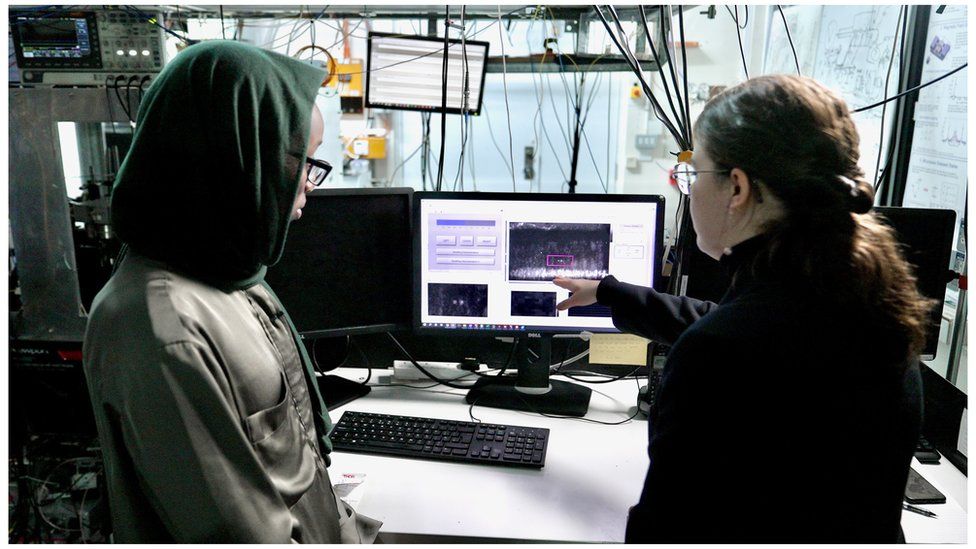
Classical computers typically operate in environments that do not require stringent physical conditions. They perform well within typical room temperatures and are highly adaptable [1][2].
Quantum computers, however, often need to be in highly controlled environments, such as temperatures near absolute zero, to minimize noise and maintain qubit stability. Achieving these extremely cold environments is crucial to prevent qubits from decoherence, which is the process where qubits lose their quantum state due to environmental interference [1][2][4][6][10].
Error Rates and Stability
One of the main challenges for quantum computing is maintaining qubit stability and reducing error rates. Whereas classical bits offer reliable and consistent performance, qubits are highly sensitive to environmental disruptions, leading to higher error rates. Advanced error correction techniques are required to manage and mitigate these issues [1][4][6][8][10].
Practicality and Development Stage
Current Capabilities and Limits

Despite its potential, quantum computing is still in its nascent stages. Current quantum computers face limitations in terms of scalability, qubit stability, and error rates. They are not yet capable of replacing classical computers for most everyday tasks or commercial applications [1][2][3][5][6][7][8].
Research and Future Prospects
Ongoing research and substantial investments are pushing the boundaries of what quantum computing can achieve. Major technology firms like IBM, Google, and Microsoft, along with startups and research institutions, are heavily invested in advancing quantum technology. The future potential for quantum computing includes significant applications in various fields, as highlighted by IBM's prediction that quantum computing could become a $1.3 trillion industry by 2035 [1][3][6].
Conclusion
Quantum computing differs fundamentally from classical computing in its use of qubits, its operational mechanisms, and its potential computational power. While classical computers will continue to be indispensable for many applications, quantum computers offer unprecedented capabilities for solving specific, complex problems that are currently beyond the reach of classical technology. As research progresses and technological barriers are overcome, quantum computing is expected to complement classical computing, jointly pushing the frontiers of what is possible in data processing and problem-solving [1][2][3][4][5][6][7][8][10].
Veamos alternativas:
- Modifica la consulta.
- Inicia un nuevo hilo.
- Eliminar fuentes (si se han agregado manualmente).
Quantum algorithms for rendering and simulation

Veamos alternativas:
- Modifica la consulta.
- Inicia un nuevo hilo.
- Eliminar fuentes (si se han agregado manualmente).
Leaders on Human-AI Symbiosis

Technology begins to feel like a natural extension, augmenting human capability, bridging gaps in expertise and experience, and breaking down barriers like language and accessibility.Sundar Pichai[1]




Veamos alternativas:
- Modifica la consulta.
- Inicia un nuevo hilo.
- Eliminar fuentes (si se han agregado manualmente).
The clearest global digital gender gap signals found in the search
Veamos alternativas:
- Modifica la consulta.
- Inicia un nuevo hilo.
- Eliminar fuentes (si se han agregado manualmente).
What made Winston Churchill a significant leader?
Transcripción
Winston Churchill was a significant leader due to his remarkable ability to inspire the British people during World War II through powerful speeches and relentless determination.
Fuentes
Veamos alternativas:
- Modifica la consulta.
- Inicia un nuevo hilo.
- Eliminar fuentes (si se han agregado manualmente).
YouTube Video - Chopin: Rondo in E Flat Major - Sheet Music with Audio

You can find the sheet music for Chopin's 'Rondo in E-flat Major, Op. 16' available for download on Free-scores. This piece is for piano solo and comes from the Romantic era, composed in 1833. You can view and download the score directly using this link[1].
For audio performances, you can enjoy the piece on YouTube. Notable recordings, such as those by Fei-Fei Dong, are also available[2]. Here's a link to one such performance[2].
Veamos alternativas:
- Modifica la consulta.
- Inicia un nuevo hilo.
- Eliminar fuentes (si se han agregado manualmente).
Quantum error correction hits new lab milestones

Veamos alternativas:
- Modifica la consulta.
- Inicia un nuevo hilo.
- Eliminar fuentes (si se han agregado manualmente).
The one metric you should monitor today
Transcripción
Welcome to today's health clip where we explore the one metric you should monitor to better understand your body. Heart rate variability is the tiny difference in time between each heartbeat, offering a unique glimpse into how your body is handling stress and recovering. When you experience higher heart rate variability, it means your body is relaxed and ready to recover. On the other hand, a lower heart rate variability indicates that your body is stuck in a state of stress, keeping you in constant alert. This single measure acts like a window into your nervous system, showing the balance between your fight or flight response and your rest and digest state. By paying attention to heart rate variability, you can learn whether your daily routines, sleep, and exercise are truly giving you the recovery you need. So, consider monitoring this metric as it may reveal the hidden signs of stress and help you take action to feel more balanced and energized.
Veamos alternativas:
- Modifica la consulta.
- Inicia un nuevo hilo.
- Eliminar fuentes (si se han agregado manualmente).