The Living Animals of the World, Volume II: Birds, Reptiles and Amphibians, Fishes, Jointed Animals, Molluscs, etc.
All are more or less migratory in their habits, some covering enormous distances in journeying to and fro between their winter retreats and their summer breeding-places. The COMMON SWALLOW and HOUSE-MARTIN, for example, leave the shores of Africa early in the spring, and distribute themselves over Europe, thousands visiting the British Islands. After rearing in their respective breeding-places from two to three broods, they return with their offspring before the rigours of winter set in to the African Continent. The routes and destinations of the swallow are now well known; but as much cannot be said for the house-martin, whose winter quarters are as yet enshrouded in mystery. That they must be somewhere in Africa is all that can at present be said. Three species of the Swallow Tribe visit England regularly every year, and remain to breed. These are the
Photo by J. T. Xeaman] _BcfkltamsUd. ^,~, YOUNG SWALLOWS. COMMON Or CHIMNEY-SWALLOW,
For hundreds of years it has been regarded as most unlucky to kill a swallow. and the HOUSE-MARTIN JUSt referred to, and the little SAND-MARTIN. In the two first mentioned the upper-parts are of a dark steel-blue colour with a metallic gloss, but they are, nevertheless, easily distinguished one from another, since the swallow has a deeply forked tail, and a bright chestnut patch on the throat, with a is similarly coloured band across the forehead; whilst the martin lacks the chestnut markings, and pure white beneath, with a large white patch on the lower part of the back, and a less markedly forked tail. Furthermore, the legs of the martin are feathered down to the claws, whilst the feet of the swallow are bare. The sand-martin is a little greyish-brown bird, with white under-parts. It is the earliest of the Swallow Tribe to arrive in Britain, and the first to depart
LYRE-BIRDS AND SCRUB-BIRDS.
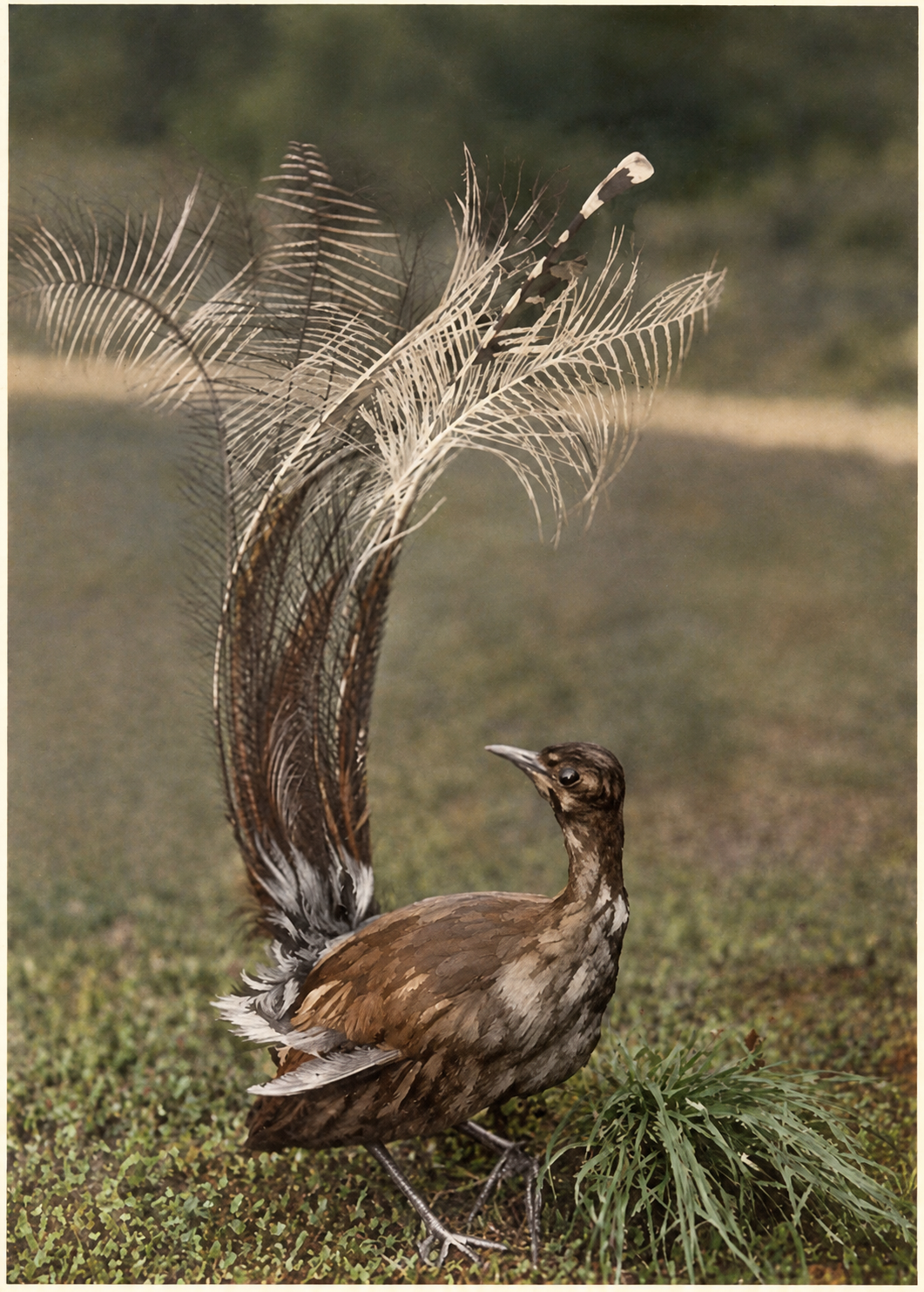
At the beginning of the account of the Perching-birds it was stated that the group was divided into two sections, and that each of these was further sub-divided into two. With the Swallows the first sub-division of the first section ended; the second we are to consider now in the very singular LYRE-BIRDS and SCRUB-BIRDS of Australia. is Rendered conspicuous on account of the remarkable lyrate tail, from which the name derived, the LYRE-BIRDS, on closer acquaintance, prove to be exceedingly interesting forms, though materials for a really complete biography of the three known species are not yet available. The males, it seems, are skilled mimics, reproducing the songs of other birds with great fidelity, this being especially true of the species known as PRINCE ALBERT'S LYRE-BIRD. During the courting-season the males construct hillocks, to which they resort to display their very beautiful and graceful tails, elevating them over the head, and drooping the wings after the fashion of a peacock, accompanying this display with certain spasmodic pecking and scratching actions. They are solitary birds, more than a pair never being seen together, and even these are exceedingly difficult to approach, stratagem always being necessary. But a single egg is laid, which has the appearance of being smeared with ink; whilst the young bird differs from that of all other perching-birds in the thickness of its downy covering and the great length of time in which it remains in the nest. The nest, made of sticks, moss, and fibres skilfully interwoven, and lined inside with the leaf of a tree-fern which resembles horse-hair, is a large domed structure, with a single aperture serving as an entrance.
Lyre-birds are essentially ground-dwellers, feeding upon insects, especially beetles and snails, and keeping to the wilder regions of the country.
Chatterers 541
The SCRUB-BIRD is an extremely interesting form, scientifically. Only the males are known at the present time, and these are dull-coloured birds of the size of a thrush. Of the female, eggs, and nest, we as yet know absolutely nothing.
CHATTERERS, ANT-THRUSHES, BROAD-BILLS, ETC.
The second major division of the Perching-birds embraces a few forms of considerable interest. The group of CHATTERERS includes several remarkable forms of very diverse coloration, many representing the most gorgeous of all South American birds.
One of the most remarkable is the UMBRELLA-BIRD. This bird is funereal in appearance, being clothed in a plumage of deep black, with the head surmounted by a large, drooping, flat-topped crest, resembling in shape the familiar crest of certain varieties of the canary, whilst from the throat hangs a long lappet of feathers reaching nearly down to the feet. The female is duller than her mate, and lacks the peculiar plumes. The umbrella-bird is a forest-dwelling
Photo by W. F. Piggotf] [Leighton Buzzard. SAND-MARTINS. This photograph shows a portion of a sand bank, pierced with the tunnel-like nests made by these feeble builders.
species, confined to the Upper Amazons, and dwelling in the tops of the highest trees, where it finds ample sustenance in wild fruits. But few naturalists have ever seen it in a wild state.
Equally wonderful are the BELL-BIRDS, so called on account of their note, which bears an anvil, though it hasextraordinary resemblance to the sound made by a blacksmith upon an often been likened to the tolling of a bell. Four species are known, in three of which the males have a pure white plumage, with much naked, vividly coloured skin on the face. One species has a curious pendulous process hanging from the forehead, thinly covered with feathers. By some this is said to be capable of erection during periods of excitement. Like the umbrella-bird, these are forest-dwelling species.
For brilliancy of plumage amongst the Chatterers, the palm must be given to the COCKS- OF-THE-ROCK, in the males of which orange-red predominates, whilst the general effect is heightened by crests and curiously curled and frayed feathers growing from the lower part of the back. The males indulge in remarkable love-displays, the performances being held in appears tosome open space, and in the presence of the females. One at a time each male swaying ofgo through a kind of dance, accompanying his peculiar steps and hops with much signal which is under-the head and extending of the wings. When tired, the performer gives a stood by his fellows, and retires from the ring, his place being immediately taken by another.
of the World542 The Living Animals
The nesting habits of the Chatterers vary greatly, some building nests of mud and twigs, which they fasten on projections of rock in damp caves; others simply lining holes in trees with dry grass. Some build a cup-shaped nest of lichens, others a simple platform of sticks, whilst some of the THICK- BILLED CHATTERERS hang large nests of leaves, plant-stalks, and wool from low branches^ the entrance to the nest being from a hole in the side. The eggs vary in number among the different species from two to four, and in colour may be white, chocolate, pale salmon-coloured, or greenish blue, and are for the most part spotted. Closely allied to the Cocks-of-the-rock are the MANAKINS, for the most part small and thick-set birds, and in many instances brilliantly coloured at least in the case of the males. Some seventy species are known,
Photo by D. U Soue.f\ [Melbourne.
VICTORIAN LYRE-BIRD.
Lyre-birds, which are also known to the colonists as " Pheasants," are great mimics. all of which are confined to South America. They must be sought for, as a rule, in the forests or thick undergrowth of marshy places.
The Manakin Family contains several species of considerable interest, on account of the peculiar modifications which certain of the quill-feathers of the males have undergone. In some species what are known as the secondary quill-feathers are peculiarly twisted, and have the shafts much thickened. With these modified feathers the birds are enabled, probably by clapping the wings and bringing the thickened feathers violently together, to make a sharp sound, which has been likened to the crack of a whip. Other species have the quill-feathers of the hand the primaries, as they are called similarly thickened, and they probably are also used to produce sounds. One species is known as the BAILADOR, or DANCER, on account of a very remarkable habit Photoby W. Saville-Kent, F.Z.S.] (.Mil/ord-on-Sea. which the males have of dancing. Two males, TAIL OF AUSTRALIAN LYRE-BIRD. tail is worn only by the male.choosing some secluded spot, select a bare twig, This ornamental

Ant-thrushes, Plant-cutters, and Wood-hewers 543
and, taking up a position about a foot and a half apart, alternately jump about two feet in the air, and alight again on exactly the same spot from which they sprang. With the regularity of clockwork one bird jumps up the instant the other alights, each bird performing a musical accompaniment to the tune of “to-le-do—to-le-do—to-le-do,” uttering the syllable “to” as he crouches to spring, “le” while in the air, and “do” as he alights; and this performance appears to be kept up till the birds are exhausted.
Some of the manakins are very beautifully coloured. One species, for example, is black, with a blue mantle and a crimson crest; another, black, with orange-coloured cheeks and breast and similarly coloured band round the neck, green rump, and yellow abdomen. The females are generally duller in coloration.
The ANT-THRUSHES, or PITTAS, are long-legged, short-tailed birds, of brilliant coloration,
having their headquarters in the Malay Archipelago; but the family is represented in India, Australia, and West Africa.
These birds are very shy and exceedingly difficult to approach. One species, the large GROUND-THRUSH, is described by Wallace as one of the most beautiful birds of the East. Velvety black above, relieved by pure white, the shoulders are azure-blue and the belly a vivid crimson. The nest recalls, in the plan of its architecture, that of the Oven-birds, being more or less globular in form, and having a lateral entrance; it is composed of twigs, roots, bark, moss, leaves, and grass, and is frequently cemented with earth. The eggs are usually spotted, and have a creamy-white ground-colour: the spots may be brown, reddish grey, or purplish black.
The curious PLANT-CUTTERS of the temperate regions of South America are nearly related to the Chatterers, though at one time it was believed they were allied to the True Finches. Constituting
but a small family, the plant-cutters are remarkable for their strangely serrated beaks, the cutting-edges of which are armed with a series of fine saw-like teeth.
This beak is used in cutting down plants; and as these birds appear to cut down a great number in sheer wantonness, they are much disliked in the neighbourhood of gardens and plantations.
Plant-cutters are not conspicuous for the beauty of their plumage, and have a harsh and grating voice.