The Living Animals of the World, Volume II: Birds, Reptiles and Amphibians, Fishes, Jointed Animals, Molluscs, etc.
UNIV. OF
CALIFORNIA
CHAPTER X.
NIGHT-JARS, SWIFTS, AND HUMMING-BIRDS.
NIGHT-JARS.
It is probable that the NIGHT-JARS are the nearest allies of the Owls. As pointed out in the last chapter, although the latter have acquired the habits of the Hawk and Eagle Tribe, they are not really connected with that group by descent.
Soberly clad, so as to be in complete harmony with its surroundings, with large eyes, huge mouth, and peculiarly short beak, beset with long bristles, the night-jar may be distinguished at once from all other British birds. By day it hides, squatting close to the ground, or perched on the thick branch of a tree; but when on the latter, it sits along and not across the bough, like other birds, the complete harmony between its plumage and the bark rendering it as invisible as when on the ground.
Not until the spring has far advanced does this bird leave its winter resort in Africa for Europe, making its presence known by its conspicuous habit of hunting its food (which consists of moths and beetles) after twilight has fallen. Later, its extraordinary churring note is heard—
Photo by A. S. Rudland & Sons.
COMMON NIGHT-JAR.
Known also as Fern-owl and Goat-sucker.
Photo by A. S. Rudland & Sons.
PENNANT-WINGED NIGHT-JAR (FRONT VIEW).
The long and graceful plumes are much-lengthened quill-feathers, and by their resemblance to the waving grass in which the bird nests afford protection.
481 61
ol the World482 The Living Animals
a. note which has been likened to the noise made by a spinning-wheel, and so powerful as to : on the wing, while toyingbe audible half a mile off. This note is made while on the ground with its mate, another equally peculiar sound is made, which has been likened to the noise air.made by swinging a whip-thong through the
No nest is made by this bird; but the eggs, two in number and beautifully marked, are laid on the bare ground. The young are covered with down, and remain in the nest for some time. Another very remarkable feature is the fact that the claw of the middle toe has its inner edge curiously serrated, forming a sort of comb, the function of which is unknown. This comb-like claw occurs also in some few other birds bitterns, for instance.
A very remarkable kind is the PENNANT-WINGED NIGHT-JAR, in which one of the quill-feathers iii each wing is produced into a "pennant" of some 17 inches in length. The shaft of the feather is bare for the greater part of its length, and terminates in a feathery blade. is known.Tt is an Abyssinian species about which not much Some of the night-jars, as the New World NIGHT-HAWK and the Old World EARED NIGHT-JARS, are particularly owl-like, a resemblance " " imparted by long ear-like tufts of feathers which rise from the back of the head. Others, as the MORE-PORK of the Tasmanian colonist, or the FROG-MOUTH, as it is called in Australia, are remarkable for the huge size of the mouth, bounded, as it appears to be, by huge lips, represented by the short, round-edged beak. Very nearly related to the night-jars is the OIL-BIRD of South America, which lives in caves in Trinidad, Ecuador, and Peru, where it builds a nest which has been likened in appearance to a huge cheese, and in which are laid from I'liotoby W. Saville-Kent, F.Z.S.~; - [Milford-on-Sea. two to four white eggs. Like the MORE-POKKS. these birds feed by So called from the note they utter. night-jars, night, emerging from their gloomy is entirely retreats at twilight with much noise and in great numbers, Their food, however, of a vegetable nature, consisting of oily nuts or fruits.
The young, soon after they are hatched, become perfect masses of fat, and on this account are much in demand by the Indians, who make a special business of killing them and extracting the oil.
SWIFTS. In general appearance SWIFTS bear a strong superficial resemblance to Swallows; in reality they are related, not to those harbingers of spring, but to the Night-jars on the one hand and the Humming-birds on the other. of. May, and stays till The COMMON Swirr arrives in England during the early part its course. Black in colour,the end of August, or sometimes till.September has half run relieved only by a white throat, it has little in the sense of beauty to recommend it; nevertheless, there are probably few who do not cherish tender feelings towards this bird.
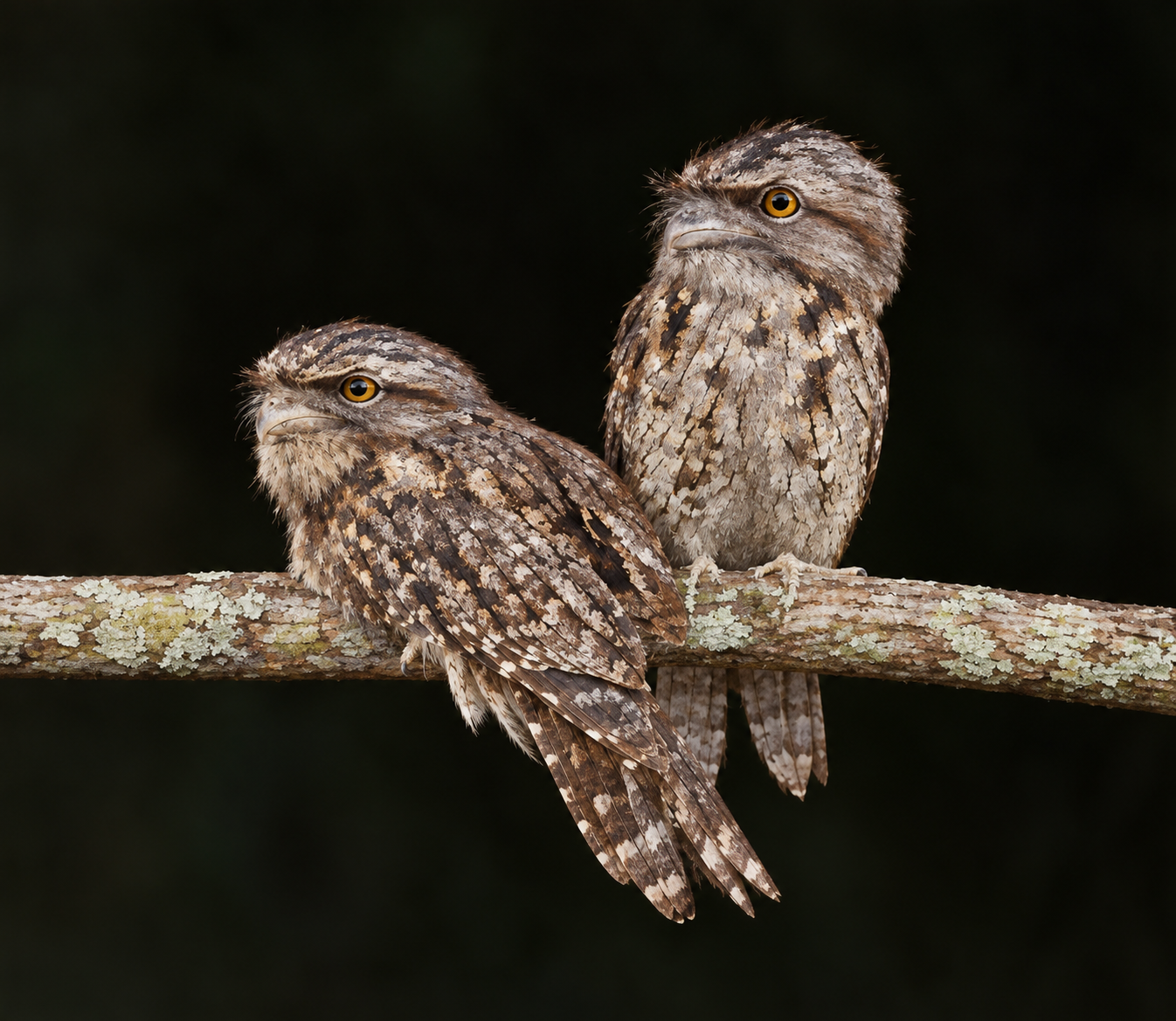

Photo by W. Saville-Kent, F.Z.S.] [Milford-on-Sea.
MORE-PORK.
This is one of the most owl-like of the Night-jars.
483
Photo by J. T. Newman] [Berkhamsted. SWIFT. A common British bird during the summer months.
The swift has great buoyancy of spirits, as is manifested by the wild, exuberant bursts of screaming to which it gives voice as it rushes in small parties down the lanes or along the less-frequented thoroughfares of towns as morning breaks or evening falls, and occasionally throughout the day. The greater part of its life is spent upon the wing (indeed, it appears to rest only when incubating or sleeping), and of all the smaller birds it is the most graceful in flight, turning and twisting in fairy mazes high in the heavens for hours at a time.
The swift chooses for its nesting-place the eaves of houses and holes in church towers, and occasionally a crevice in the face of a quarry. The nest is formed of bits of straw, dry grass, and a few feathers, glued together by a secretion of the salivary glands into a compact crust; in this the bird deposits from two to four white eggs. The young, which are hatched naked and blind, never develop down-feathers, but soon become more or less imperfectly clothed in a mass of tiny spines, representing the budding feathers; these give the bird somewhat the appearance of a young hedgehog.
In adaptation to its remarkable powers of flight, the wing has undergone considerable modification in form, so that it differs from that of all other birds. On the other hand, the legs, being so little required, have diminished considerably, and are remarkable for their smallness—a fact which hampers the bird considerably, should it happen to alight on level ground, for, owing to the great length of the wings, it can arise only with considerable difficulty.
Nearly allied to the common swift is SALVIN’S SWIFT, remarkable on account of its nest, which has been described by Dr. Sharpe as the most wonderful in the world. About 2 feet long and 6 inches in diameter, it looks rather like the sleeve of an old coat than a nest. It is made entirely of the downy seeds of plants, which, floating through the air after the fashion of such seeds, are caught by the birds when on the wing, and, partly felted and partly glued by the salivary secretion, are woven slowly into the characteristic woolly domicile. The site and manner of fixation of the nest are scarcely less wonderful, for it is suspended from the flat surface of some projecting piece of rock on the face of a cliff, and is thus almost inaccessible; yet, as if to make assurance doubly sure, two entrances are made, one at
Nightjars, Swifts, and Humming'birds 485
call itthe bottom, which is really blind, and one at the top, near its foundation, if we may so, which leads into the nursery.
Still more swallow-like in general appearance are the diminutive EDIBLE SwiFrs, so called, not on account of the palatability of the birds themselves, but of their nests, which are in great demand by the wealthy Chinese for conversion into birds'-nest soup. It has already been remarked that the salivary glands are unusually active in the swifts, their secretion bearing a very important part in the construction of the nest, and serving as a kind of cement. It is, therefore, not surprising that in some members of the group we find this secretion playing a still more prominent part, forming, at least in one species, the entire material of the nest. " With these nests," writes Dr. Sharpe, " a large trade is done with China from many of the Malayan Islands, over 3,500,000 nests having been known to be exported in a single year from Borneo to the latter country. ... In Borneo and other places the caves in which the swiftlets build are leased to the collectors for a considerable sum; but it is only the white nests, made of the pure secretion, which are of any real value. The nests of those species which mix into their nests grass or feathers are not appreciated as an article of commerce." Colonel Legge gives some extremely interesting particulars concerning the nesting habits of these birds in Ceylon. " It is noteworthy," he writes, " that the partially fledged young which were procured on this occasion for me, and which I kept for the night scrambled out on to the exterior of the nest, and slept in an upright position, with the bill pointing straight up. This is evidently the normal mode of roosting resorted to by this species. The interior of this cave, with its numbers of active tenants, presented a singular appearance. The bottom was filled with a vast deposit of liquid guano, reaching, I was informed, to a depth of 30 feet, and composed of droppings, old nests, and dead young fallen from above, the whole mingled into a loathsome mass, with water lodged in the crevices, and causing an awful stench, which would have been intolerable for a moment even, had not the hundreds of frightened little birds, as they Photo by A. S. Rudiand tfc Hans. screamed and whirred in and out of the gloomy cave EDIBLE SWIFT. with a hum like a storm in a ship's rigging, power- The nests of this bird are used for soup; five are seen in this photograph.fully excited my interest, and produced a long examination of the colony. This guano-deposit is a source of considerable profit to the estate, the hospitable manager of which informed us that he had manured 100 acres of coffee with it during that season."
HUMMING-BIRDS. It is generally admitted that HUMMING-BIRDS are nearly related to Swifts, with which, however, they stand in the strongest possible contrast in the matter of plumage the latter being always inconspicuously coloured, whilst the former are for the most part clad in vestments so gorgeous as to render it extremely difficult to describe them in sober language..Moreover, so great is the wealth of species some hundreds in number and so varied are the form and coloration, and so closely do the various types pass one into the other, that their classification is a matter of extreme difficulty.