The Living Animals of the World, Volume II: Birds, Reptiles and Amphibians, Fishes, Jointed Animals, Molluscs, etc.
Very different in appearance from the members of the Shrike Family are a group of possibly allied forms known as WAX-WINGS. Of pleasing but sober coloration, they are remarkable for certain curious appendages to the inner quill-feathers, of a bright sealing-wax red colour, from which they derive their name: similar wax-like appendages occur also, sometimes, on the tail-feathers.
Breeding in the Arctic Circle, wax-wings occur in both the Old and New Worlds, though some species peculiar to the latter region lack the wax-like appendages characteristic of the majority of the species. These birds are erratic in their movements, and large bands occasionally visit the British Islands during the autumn and winter, the eastern counties being usually the most favoured spots; but on the occasion of one of these immigrations, in the winter of 1872, many were seen in the neighbourhood of the North of London. During the summer they feed faton insects, but in autumn and winter on berries and fruit. At this time they become very
Photo by J. 1. Newman] | Berkhamsted. SONG-THRUSH. A resident British species, sometimes called the Mavis. 535
of the World536 The Living Animals
and are then captured and sold in large numbers for food in the Russian markets, and occasionally are sent over to London. Passing over a small group of comparatively uninteresting American birds known as " Green-lets," we come to the WARBLERS, a group which constitutes one of the largest families of birds of the Old World. The species included in this family vary greatly in their characters, so that it is by no means easy to give diagnostic characters, whereby they may be readily distinguished from the Ply-catchers on the one hand or the Thrushes on the other. The Thrushes, however, as a group, may be distinguished from the Warblers by the circumstance that in the former the young have a distinctive spotted plumage, differing from that of the adults, while the young of the Warblers are not so marked, their plumage differing but little from that of their parents. More than twenty species of warblers are included amongst British birds. Although some of them are but rare and accidental visitors to
Photo by Scholastic Photo. Co.} {Parson's Green. YOUNG THRUSH. Britain, others are amongst the commonest of This photograph shows the mud-lined nest.
the spring migrants, remaining to nest, and leaving again in the autumn. Some, as the BLACK-CAP, WHITE-THROAT, CHIFF-
CHAFF, G-ARDEN-, WILLOW-, and WOOD-
WARBLERS, frequent woods, hedgerows, and gardens; whilst others, as the SEDGE-and REED-WARBLERS, are found only near water affording sufficient shelter in the shape of reed-banks or osier-plantations.
The BLACK-CAP and GARDEN-WARBLER rank as songsters of no mean talent, being held second only to the nightingale. As if by common consent, the two former never clash, so that where black-caps are common there are few garden-warblers, and vice versa. Most of these birds build a typical cup-shaped nest of dried grasses, lined with finer materials, and placed near the ground; but that of the REED-WARBLER is a most beautiful structure, the dried grass of which it is made being woven around some three or four reed-stems, Photo by J. T. Newman^ [Bwkhamsted. BLACKBIRD. making it seem as if the latter had, in The male and female are quite different one from another, and in ihi respect differ from the Thrushes, in which the sexes are alike.growing up, pierced the sides of the nest
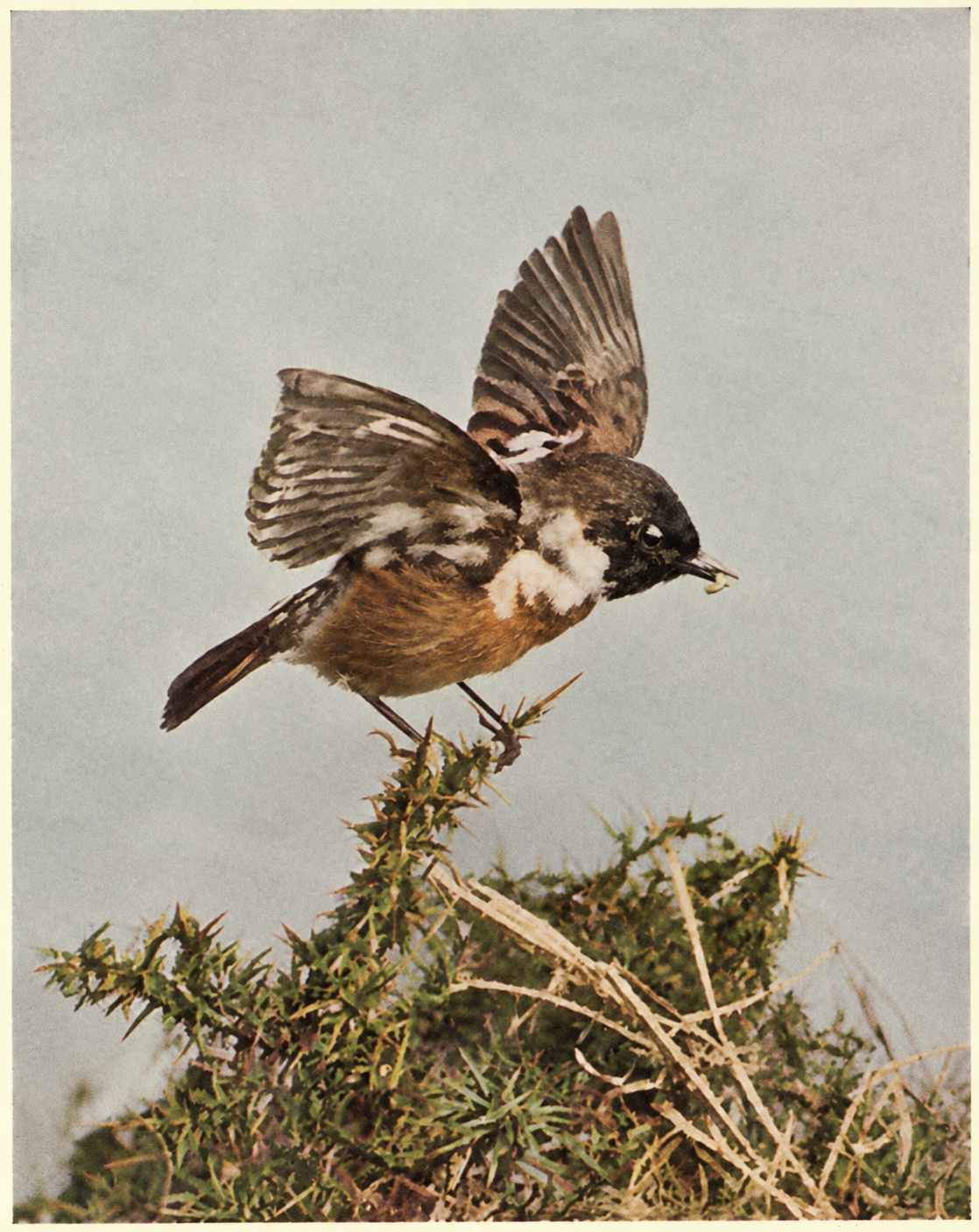
Thrushes and their Allies 537 in their course. The cup-shaped hollow is very deep, so that when the supporting reeds are bowed low in the breeze the eggs rest perfectly safe. We must pass now to a consideration of the Thrush Tribe, which, as we have already hinted, are very closely allied to the Warblers. Birds like the COMMON THRUSH and the BLACKBIRD are so common and so well known that they scarcely need comment here. The same perhaps is true of many other members of this group not 'popularly associated with the Thrush Tribe; such are the EED-BREAST, or KOBIN RED-BREAST, as it is more generally called, and the NIGHTINGALE. Few birds have inspired so many writers as the nightingale; it even holds a place in classical mythology. Professor Newton gives us one variant of a very : " Procne and Philomela were the common but pretty story daughters of Pandion, King of Attica, who in return for warlike aid rendered him by Tereus, King of Daulis in Thrace, gave him the first-named in marriage. Tereus, however, being enamoured of her sister, feigned that his wife was dead, and induced Philomela to take her place. On her discovering the truth, he cut out her tongue to hinder her from revealing his deceit; but she depicted her sad story on a robe which she sent to Procne, and the two sisters then contrived a horrible revenge for the infidelity of Tereus by killing and serving to Photo by IF. F. Piggott, Leighton Buzzard. him at table his son Itys. Thereupon the gods interposed, ROBIN. changing Tereus into a hoopoe, Procne into a swallow, The young robin wears a distinct livery, and Philomela into a nightingale, while Itys was restored quite different from that of its parents. to life as a pheasant, and Pandion (who had died of grief at his daughters' dishonour) as a bird of prey [the osprey]." A not infrequent error with regard to the red-breast may be pointed out here. Many people seem to suppose that the female is less brilliantly coloured than her mate. As a matter of fact this is not so; what are generally regarded as females of this species are the dull, spotted young, which, as we have already pointed out, assume this peculiar livery throughout the tribe. No less common in Britain, during the summer months at least, are the WHEAT-
EAES, STONE-CHATS, WHIN-CHATS, and KED-
STAKTS. Small and prettily coloured species, these are all insect-eaters, and, with the exception of the wheat-ears, lay blue eggs, deposited in somewhat coarsely constructed ; or Photo by A. S. Jiudiand & Sons.nests, placed on or near the ground in holes in ruins, trees, or walls, in the NIGHTINGALE. case of the red-starts; or in burrows or The sweetest and most renowned of all the British songsters. 68
under ledges of rock, as among the wheat-ears, which lay white eggs. The bird commonly known as the HEDGE-SPARROW is a close ally of the Thrush Family, having nothing to do with the sparrows proper which are finches as its name would imply. Another nearly related form is the DIPPER, or WATER-OUZEL. By no means brilliantly coloured, it is nevertheless an exceedingly interesting bird, and one never met with away from mountain streams. The group has a wide distribution, occurring in suitable localities in Europe, Asia, and the Kocky Mountains of America, and extending from Colombia to Peru and Tucuman. Squat in form, with rounded wings and short tail, the ouzel seeks the greater part of its food on the bottom of swiftly running streams. It is everywhere, writes Dr. Sharpe of the commoner of the two British species, a shy and watchful bird, and, except in the breeding-season, appears to be solitary. By patient watching Photo by G. Watrnough Webster & Sori\ [Chester. near the dipper's haunts, however, it is STONE-CHAT.
A resident and generally distributed British bird. possible to observe the bird scudding over the surface of the water with a rapid flight and a vigorous beating of the wings, something like that of a kingfisher, until it alights on a rock or large stone in the middle of the stream. Its white breast then stands out in bold relief, and, after pausing for a moment, the bird commences to edge to the side of the rock, and either walks deliberately into the water, or disappears suddenly beneath the surface, seeking its food at the bottom of the stream, in the shape of larvae, caddis-worms, water-beetles, and small snails.
The WRENS are probably near allies of the Dippers. The family includes a number of species of small birds, most largely represented in the New World, but distributed widely over isthe. Old World also. Two occur in the British Islands: of these, one, the COMMON WREN, found throughout Europe, and occurs also in Northern Africa, Asia Minor, and North Palestine; whilst the other, the ST. KILDA WREN, is only found on the island from which it takes its name. Considerations of space compel us to pass over three or four families, of comparatively little interest to any save the scientific ornithologist, in favour of the FLY-CATCHERS and SWALLOWS. The former, in that the young are spotted, appear to evince some affinity to the Thrush is surroundedTribe, but they have broad and flatter bills than the latter, whilst the mouth by more or less conspicuous bristles. They are entirely Old World forms, having their stronghold in Africa. Three species of fly-catcher occur in England, though only one, the COMMON or SPOTTED FLY-CATCHER, usually breeds in Great Britain, coming late in the spring from Africa. As its name implies, it feeds upon small insects, capturing them on the wing by sudden sallies, and returning immediately after to some perch, generally a garden-fence, or the bare bough of a tree. As a rule the prey is caught with a sudden dart, but sometimes only after a prolonged skill. Its nest,flight, when the bird will double and turn, as the necessity arises, with great

Swallows and Martins 539 made of dry grass and moss, lined with horse-hair and covered externally with spider-webs and lichens, is usually placed in some sheltered position, such as a crevice in the bark of a tree or in the creepers covering the trellis-work of a house; and owing to the skilful way in which it is covered externally, so as to resemble its surroundings, is difficult to find. The SWALLOWS and MARTINS constitute an exceedingly well-defined group of birds, Photo by J. T. Newman] [Serkhamsted. A PAIR OF WRENS.and one which holds a conspicuously high place in the Known nearly everywhere in England as the " Kitty" or " Jenny " Wren. regard of mankind, finding a welcome everywhere on account of the great benefits they confer by the removal of insect-pests in the shape of the smaller gnats and flies. These, were they not kept in check by the Swallow Tribe, would render most parts of the world uninhabitable. Earely seen upon the ground, save when procuring mud for the construction of their nests, the birds of this group are all peculiarly strong fliers, turning and twisting with the greatest speed and precision. All have very short beaks and wide mouths, long wings and tails, and small and weak feet. A large number build their nests of mud, collected in small pellets and held together by the secretion of the salivary glands. These nests are commonly more or less cup-shaped, and fastened under the eaves of dwelling-houses or other buildings, or placed on a convenient beam or other ledge. The KED-RUMPED SWALLOWS and FAIRY MARTINS species enjoying an enormous distribution, being found in India, Africa, America, and Australia build very large flask-shaped nests, having the entrance produced into a funnel often eight or nine inches in length. Others, like the SAND-MARTIN, excavate long tunnels, tei-minating in larger chambers, in the faces of sand-banks a performance which must certainly be regarded as wonderful, when one realises the feeble tools with which the task of excavating has to be performed. Some species utilise the holes Photo by Scholastic Photo. Co.] [.Parson's Green. made by other birds, in one species thisCOMMON WRENS, WITH NEST BUILT IN PHEASANT'S SKELETON. hole being itself bored within the burrowIn winter wrens have a custom of seeking some hole or other convenient shelter and huddling together in small parties for the sake of warmth. of the viscacha.