The Living Animals of the World, Volume II: Birds, Reptiles and Amphibians, Fishes, Jointed Animals, Molluscs, etc.
The HANG-NESTS, COW-BIRDS, and KICE-BIRDS are American birds, bearing in many respects a resemblance to the Starlings, chiefly, perhaps, in the form of the beak. Generally black in plumage, in many bright colour is conspicuous.
HANG-NESTS range from North and Central America to Southern Brazil. As a rule they are brilliantly coloured, the livery being bright orange and yellow, set off by black and white, The majority of the numerous species build remarkable nests, looking like long stockings, which they hang from the under side of the bough of a tree; they are composed of coarse grass deftly woven together. The COW-BIRDS are mostly South American, though the United States possess two or three species. Some, like the Cuckoos, are parasitic, dropping their eggs into the nests of other birds, to be hatched by the owners: the young cow-bird, however, dwells in harmony with his foster-brothers and -sisters, instead of ejecting them from the nest, like the young cuckoo. of the persistent way in whichThe name Cow-bird is bestowed upon these birds on account they haunt herds of cattle for the sake of the flies which congregate about those animals.
The KICE-BIRDS are represented by some rather showy forms, and others of wonderful powers of song. The typical RICE-BIRD, or BOB-O-LINK, is an especial favourite as a songster. Thoreau writes of this song: "It is as if he [the bird] touched his harp with a wave of liquid melody,
The Perching*birds 521
... and when he lifted it out the notes fell like bubbles from the strings. Away he launched and the meadow is all bespattered with melody." Where rice is extensively cultivated, however, this bird is by no means so enthusiastically welcomed, causing immense destruction to the standing crops flocks numbering, it has been said, some millions alighting in the fields and leaving too little grain to be worth the trouble of gathering.
We pass now to a group of exceedingly interesting birds, fcome of which are remarkable on account of the beauty of their plumage, others from their wonderful nesting-habits. The group includes many familiar as cage-birds, such as the LONG-TAILED WIDOW-BIRDS, the KED- BEAKED WAXBILLS, AMADAVATS, JAVA SPARROW, GRASS-FINCHES, MUNIAS, and so on, all of which are embraced under the general title of WEAVER-BIRDS, a name bestowed on account of their peculiar nests.
Photo by Dr. R. W. Shufeldt] [ Washington.
MEADOW-LAEK (NATUBAL SIZE).
Known also as the Meadow-starling. This bird, a native of the Eastern United States, has occurred three times in the British Islands, but it is doubtful whether these specimens were wild.
Abundant in Africa, and well represented in South-eastern Asia and Australia, these birds bear a strong family resemblance to the Finches, from which they differ in having ten primary quills in the wings. is the South African LONG-TAILED WHYDAH- or WIDOW-BIRD. One of the most peculiar Strikingly coloured, this bird is rendered still more attractive by the extremely elongated tail-feathers, which are many times longer than the body, so long, indeed, as to impede its flight, which is so laboured that children commonly amuse themselves by running the bird down. Kaffir children stretch lines coated with bird-lime near the ground across fields of millet and Kaffir corn, and thereby capture many whose tails have become entangled among the threads.
In brilliancy of coloration the Whydah-birds for there are several species are pressed hard 66
of the World522 The Living Animals
by the BISHOP-BIRDS, the handsomest of which is the red species. Sociable in habits, this bird throughout the year consorts in immense flocks, which in the summer consist chiefly of males. Of the more remarkable nest-builders, the most conspicuous are the BAYA SPARKOWS, or TODDY-BIRDS, of India and Ceylon, and the SOCIABLE WEAVERS. The former suspend their nests by a solidly wrought rope of *ibre from the under side of a branch, the rope expanding into a globular, chamber, and then again contracting into a long, narrow, vertical tube, through which the birds make their exit and entrance. The latter the SOCIABLE WEAVER-BIRD of Africa builds a still more wonderful structure. As a thing apart it has no existence, a number of birds, varying from 100 to 300, joining their nests together, so as to form a closely interwoven structure, resembling, when finished, a gigantic mushroom. The structure is built among the branches of large trees, so that the tree looks as though it had grown up through a native hut, carrying the roof with it. Cartloads of grass are required to rear this structure, which is nearly solid. Seen from below, it presents a flat surface riddled with holes; these are the entrances to the nests. Closely resembling the typical Finches in general appearance, is and often gorgeous in coloration, the group known as the TANAGERS, of which more than 400 distinct species are known to science. Exclusively American, the majority of the species are found in Central and South America, though a few move northwards into the United States in summer. The most beautiful are the SCARLET,
CRIMSON-HEADED, and WHITE-CAPPED
TANAGERS. The last-named is generally allowed to be the love-liest of the group. The entire plumage of both sexes is a beautiful cornflower-blue, surmounted by Photo by W. F. Piggott] [Leighton Buzzard. HAWFINCH. a cap of silvery-white feathers, a A resident in the eastern and midland counties of England. Crimson Spot On the forehead looking like a drop of blood. The identical coloration of the sexes is worth noting, as among the tanagers generally the female is dull-coloured. Among the Finches there is a considerable variety of coloration, though but little in bodily form; they are all attractive birds, and have the additional advantage that many are British. Distributed over both the northern and temperate regions of the Eastern and Western Hemispheres, they are unknown in Australia. The group, which comprises a very large number of species, may be divided, into three sections GROSBEAKS, TRUE FINCHES, and BUNTINGS. The GROSBEAKS, as their name implies, are characterised by the great stoutness of the beak, and some, as the EVENING-GROSBEAKS of America, are remarkable for their beauty.
Well-known British members of this section are the HAWFINCHES and GREENFINCHES. rare in Scotland and Ireland, the HAWFINCH contrivesCommon in many parts of England, though to make itself much disliked by the gardener, owing to its fondness for peas, though it fully compensates for the damage done in this direction by the numbers of noxious insects it destroys. The nest is a very beautiful structure; outside it is composed of twigs intermixed with lichens, inside of dry grasses lined with fine roots and hair. The site chosen
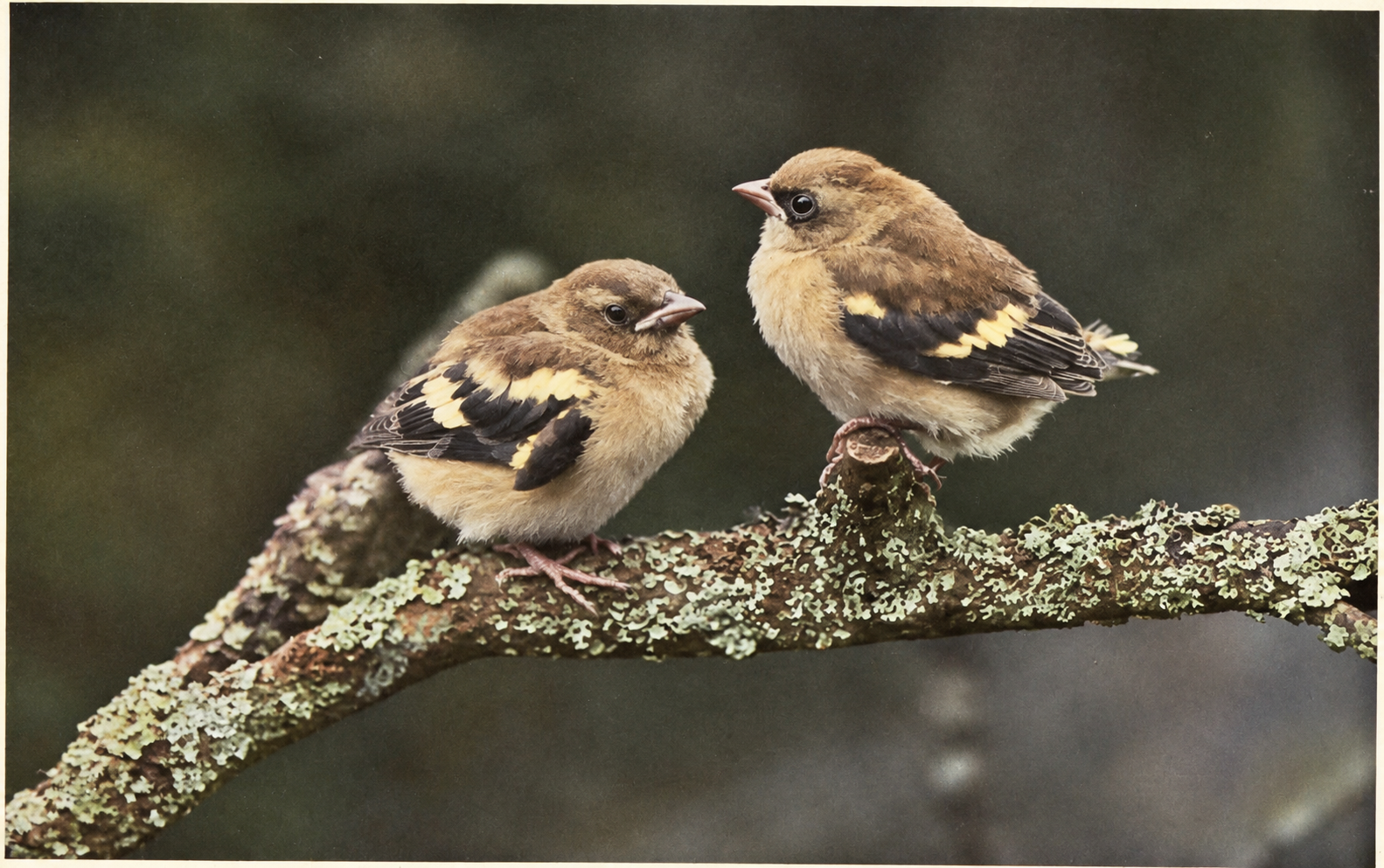
Photo by C. Reid] [Wishaw, N.B.
YOUNG CHAFFINCHES.
The chaffinch is one of the commonest of the British finches.
Photo by C. Reid. [Wishaw, N.B.
HOUSE-SPARROWS.
The sparrow is to be reckoned among the few really harmful British birds.
523
The Living Animals of the World
varies, a favourite place being an old apple- or pear-tree in an orchard; but the woods and fir plantations are not seldom resorted to. The GREENFINCH is an equally common British bird. Of a more confiding disposition than the hawfinch, it makes an excellent cage-bird, becoming with judicious treatment exceedingly tame. It is a useful bird, travelling during the autumn and winter in large flocks, and feeding on the seeds of wild mustard and other weeds. Its nest differs conspicuously from that of the hawfinch, being a somewhat untidy structure, composed of fibrous roots, moss, and wool, lined with finer roots, horsehair, and feathers. Among the TRUE FINCHES, distinguished from the Grosbeaks by their less powerful bills, are several other well-known British birds. Of these, none are better known than the CHAFFINCH. Gay in appearance and sprightly in habit, this is a general favourite
Photo by J. T. Neieman] [Berkhamsted. everywhere, and much in demand as a cage-bird. His BULLFINCH. short though delightful song possesses a peculiar Black varieties are occasionally taken in a wild state. Caged specimens fed on hemp-seed frequently turn black. charm, coming as it does with the earliest signs of returning spring. The fascination of this song has
:never been better expressed than in Browning's lines O to be in England Now that April's there; And whoever wakes in England Sees, some morning, unaware, That the lowest boughs of the brushwood sheaf Round the elm-tree bole are in tiny leaf, While the Chaffinch sings on the orchard bough
! In England now The nest, which is an exceptionally beautiful structure, takes about a fortnight to build. Closely ' woven, it appears to consist mainly of wool, into which moss and lichens of various colours are deftly woven. The outside is cunningly decorated with bits of lichen and the inner bark of trees, such as the birch, the whole being secured by a thin veil of spiders' webs. it with the -generalThe lichen and bark serve to render the nest inconspicuous by blending appearance of the bush or small tree in a forked bough of which it is placed. Inside the wool is more closely felted even than on the outside, and this is covered with fine hairs, amongst which a few feathers are intermixed. The work of building seems to be done by the female only, though the male helps by bringing the materials. is the Of the GOLDFINCH, LINNETS, and BULLFINCH, by far the most popular and beautiful GOLDFINCH, which is, and probably will long remain, one of the most prized of cage-birds. Gifted "with the fatal gift of beauty," this bird is much persecuted by bird-catchers; and indeed, partly owing to the depredations of these men, and partly to improved methods of agriculture, which have diminished its feeding-area, this handsome bird is growing more and more rare every year. Next to the goldfinch perhaps the LINNET is most sought after as a cage-bird. Large numbers are taken during the autumn, when the birds congregate in large flocks before departure on migration. Those captured in the spring are said to be very impatient of confinement, and only a small percentage seem to survive.
The linnet is one of the most variable of birds in the matter of plumage, and for a long while the opinion was generally held, especially by bird-catchers, that several distinct species
The Perching'birds 525
the KED, BROWN, and GREY LINNETS existed. It is now known that these are all phases of full summer dress the forehead and centreplumage common to one species. In the male in of the crown are blood-red, whilst the breast is of a glossy rose-red; but these bright colours do not seem to be acquired so universally as is the case with other birds which don a special breeding-dress, nor are they ever developed in captivity. Occasionally what are called LEMON- BREASTED varieties of the linnet occur in which the rose-colour of the breast is replaced by yellow. is by no means so abundant as The BULLFINCH, though one of the common British birds, the two foregoing species; for whilst the other two travel in small flocks, the bullfinch is a solitary bird. Few birds perhaps have earned a more evil name than the bullfinch, which is accused by the gardener of inflicting enormous damage on the flower-buds of fruit-trees in winter and spring. " On the other hand," writes Mr. Hudson, " he is greatly esteemed as a it. But the effect in both casescage-bird, and the bird-catchers are ever on the watch for is pretty much the same, since the hatred that slays and the love that makes captive are equally disastrous to the species." That it is diminishing in many districts there can be no doubt, and perhaps its final extermination is only a matter of time. Though by no means a remarkable songster in a wild state, in captivity it is capable of learning to whistle strains and airs of human composition with some skill, good performers fetching high prices. The SPARROW and the wild CANARY of Madeira from the latter of which our cage-pets have been derived are also members of the Finch Tribe, but are too well known to need fuller mention. Closely allied to the Finches are the BUNTINGS, which are really only slightly modified finches. Several species are British birds, one of the commonest being the CORN- BUNTING, a bird which bears a wonderful resemblance to a skylark, from which, however, it may be distinguished by its large beak and small claw on the hind toe.