The Living Animals of the World, Volume II: Birds, Reptiles and Amphibians, Fishes, Jointed Animals, Molluscs, etc.
Photo by C. Reid] [Wishaic, N.B.
A PAIR OF MAGPIES.
When taken young, the magpie is easily tamed, and can be taught to imitate human sounds.
to exhibit -themselves, --forming what are known as dancing-assemble early in the morning " parties," which take place on the topmost boughs of some giant tree. " From a dozen to twenty birds assemble together," writes Mr. Alfred Russel Wallace, " raise up their wings, stretch out their necks, and elevate their exquisite plumes, keeping them in continual vibration. Betweenwhiles they fly across from branch to branch in great excitement, so that the whole tree is filled with waving plumes in every variety of attitude and motion." The native hunter marks these playing-places, builds a shelter of palm-leaves in a convenient situation among the branches, and ensconces himself under it before daylight, armed with a bow and a number of arrows is in full swing, he shoots through the roof ofterminating in a round knob. When the dance his shelter with the blunt arrows, stunning every bird he strikes, which, falling down at once, are immediately picked up by a boy in waiting below. Often a considerable number will be thus secured before the alarm is taken.
Without coloured figures, or very numerous photographs from living birds, which we can hardly hope to get, it would be impossible, except at the risk of being wearisome, to describe all the wonderful combinations of form and colour which the feathers of the birds of paradise display. Breast-shields of metallic sheen, fans and crests in wonderful variety, feathers of a texture like velvet, or gorgeous colours, confuse one in their variety and combination.
The Perching'birds 517
Let it suffice to mention only the last discovered species the KING OF SAXONY'S BIRD OF PARADISE. " Velvety black above," writes Dr. Sharpe, "and yellowish below, there is nothing very striking in the aspect of the bird itself, which is smaller than our song-thrush. But the ' streamers' which it carries! Poised... on either side of the head is a long, shaft-like plume, from which depends, on the lower side only, a series of little flags of blue enamel, each quite separate from the one which precedes it, and not of a feathery structure in the least." Close allies of the Birds of Paradise are the remarkable BOWER-BIRDS of Australia. Conspicuously beautiful in Photo by Scholastic Photo. Co.] [.Parson's Green. coloration as are some members of this
CORNISH CHOUGH.
tribe, they are celebrated not so much Very nearly extinct as a British bird. on this account as for an extraordinary habit of constructing " bowers " or " playing-grounds " a trait which appears absolutely unique " These constructions," observes Mr. Gould, " consist in a collection of pieces ofamong birds. stick or grass, formed into a bower; or one of them (that of the SPOTTED BOWER-BIRD) might be called an avenue, being about 3 feet in length, and 7 or 8 inches broad inside; a transverse section giving the figure of a horse-shoe, the round part downwards. They are used by the birds as a playing-house, or 'run,' as it is termed, and are used by the males to attract the females. The ' run ' of the SATIN-less than 1 foot in BIRD is much smaller, being length, and, moreover, differs from that just described in being decorated with the highly coloured feathers of the Parrot Tribe. The SPOTTED BOWER-BIRD, on the other hand, collects around its ' run ' a quantity of stones, shells, bleached bones, etc.; they are also strewed down the centre within." More wonderful still are the structures reared by the GARDENER-BIRD of New Guinea, presenting, as Professor Newton remarks, " not only a modification of bower-building, but an appreciation of beauty perhaps unparalleled in ... builds the animal world.... This species at the foot of a small tree a kind of hut or cabin... some 2 feet in height, roofed with orchid-stems that slope to the ground, regularly radiating from the central support, which is covered with a conical mass of moss, and sheltering a gallery around it. One side of this hut is left open, and in front of it is arranged
Photo by W. SaviUe-Kent, F.Z.S.] [Milford-on-Sea. a bed of verdant moss, bedecked with blossoms ICING BIRD OF PARADISE. and berries of the brightest colours. As these
A native of New Guinea; remarkable for the curled ornaments wither they are removed to a heap tiil-fpathevs. behind the hut, and replaced by others that are
fresh. The hut is circular and some 3 feet in diameter, and the mossy lawn in front of it nearly twice that expanse. Each hut and garden are, it is believed, though not known, the work of a single pair of birds, or perhaps of the male only; and it may be observed that this species, as its trivial name implies, is wholly inornate in plumage. Not less remarkable is the more recently described ' bower ' of the GOLDEN BOWER-BIRD.... This structure is said... to be piled up almost horizontally around the base of a tree to the height of from 4 to 6 feet, and around it are a number of hut-like fabrics, having the look of a dwarfed native camp." Allied species, though building no bowers, yet clear a space of ground some 8 or 9 feet in diameter, on which to display themselves, and ornament this with little heaps of gaily tinted leaves, replacing them as they fade with fresh specimens. We pass next to the birds of the Starling Family, of which the BRITISH STARLING is the type. A bird so familiar needs no description here; but we may draw attention to the many interesting phases of plumage this species undergoes. is a uniform greyish The first plumage Photo by W. Savillc-Kent, F.Z.S.] [Milj d-on-Sea.
QUEENSLAND EIFLE-BIED.
This unique Australian representative of the Birds of Paradise is about the size of a pigeon. Its plumage is black with a purple sheen; the throat is brilliant metallic emerald-green, like that of a humming-bird.
brown. Later black feathers, with large white spots at the tips, make their appearance among the brown. These spotted feathers eventually replace the brown, and the bird enters upon a second quite distinct phase a black, spotted with white. Gradually this gives place to a plumage entirely unspotted, the feathers on the breast being spear-shaped. In the adult dress a wondrous variety of metallic reflections is and violet.acquired green, purple,
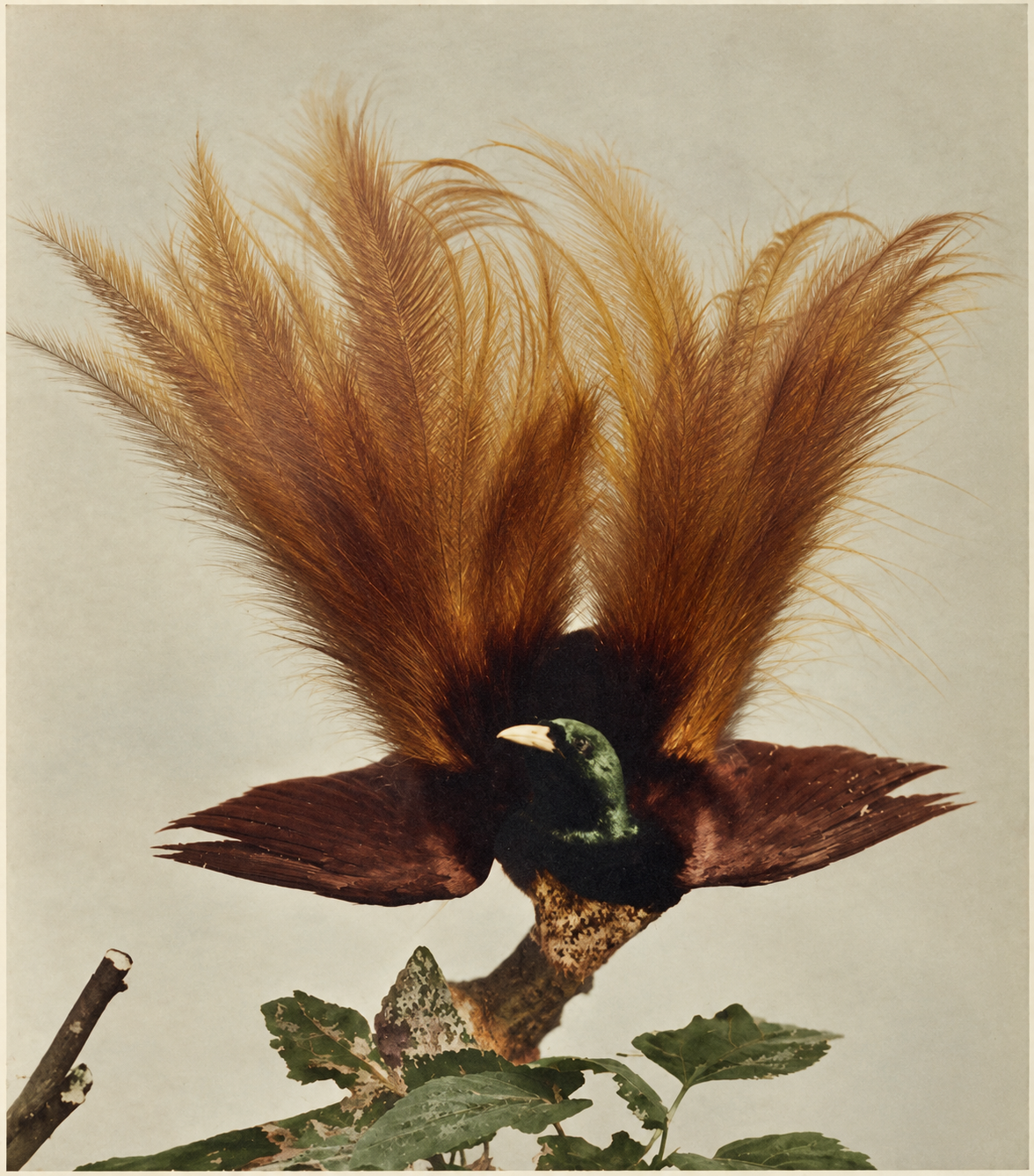
Associating in the autumn and winter in large flocks, starlings move from place to place in search of food. Sometimes the number of birds in these combined flocks rises to an enormous figure. One of the largest of these gatherings recorded in England existed on the Photo by W. Saville-Kent, F,Z.S.~\ [Milford-on-Sea. property of the late Mr. Miles near Bristol. RED BIRD OF PARADISE. "This locality is an evergreen plantation... Found only on the small island of Waigiou, off the north-west coast of New Guinea.covering some acres, to which these birds repair

The Perching'birds 519 of an evening... by millions, from the low grounds about the Severn, where their noise and stench are something altogether unusual. By packing in such myriads upon evergreens, they have stripped them of their leaves, except just at the tops, and have driven the pheasants, for whom the plantation was intended, quite away from the ground. In the daytime, when the birds are not there, the stench is still excessive. Mr. Miles was about to cut the whole plantation down, to get rid of them, two years ago, but I begged him not to do so, on account of the curiosity of the scene, and he has since been well pleased that he abstained."
A similar but still larger congregation has been described; in this, about the year 1845, from 150,000 to 200,000 starlings were computed to rest every night, between the end of October and the end of March, in certain trees in the gardens of the Zoological Society in Dublin. The roof of St. Patrick's Cathedral, in the heart of Dublin, has from time to time been resorted to, as many as 2,000 seeking shelter there. " Possessing very considerable powers of wing," observes Yarrell, "-these lire turned to account in an extraordinary manner by the birds composing the flock. They wheel, close, open out, rise and descend, as if each were obeying a commander, and all this is done with the utmost marvellous precision while the flock is proceeding at a rapid pace through the air. At times it may extend in a long and nearly straight thread; suddenly an undulation is visible along the line, and in a moment it takes the form of a thin and smoke-like cloud; another moment, and it is a dense and almost perfect globe; then possibly, having preserved this appearance for a perceptibly longer time, it [ WUhaw, N.B. becomes pear-shaped, and in YOUNG STARLINGS. another instant has assumed Starlings, if taken when young, are easily tamed and make excellent pets. a spiral figure; an instant after it has spread out like a sheet, and its members are streaming softly along the ground, perhaps to alight, or perhaps once more to mount aloft and circle as before." There are few more magnificent sights in the world than a flock of starlings when performing evolutions of this kind. Differing much, not only in general appearance, but also in coloration, from the common starling is the EOSE-COLOURED STARLING, so called from the beautiful rose-pink colour of the back and breast, set off by the rest of the plumage, which is black, glossed with violet, blue, and green reflections. This handsome bird occasionally visits Britain. Feeding largely upon locusts, these birds are much affected in their movements by the peregrinations of these pests; and this accounts for the sporadic appearance of the rose-coloured starling in huge flocks in places where it is generally seldom seen.
Dull in appearance, ungraceful in flight, and with a harsh, unmusical note, the starling
of the World520 The Living Animals
known as the OX-PECKER would seem at first sight to have little to recommend it; yet it is one of the benefactors of the larger African mammals, flies and other insect-pests. clearing them of Buffaloes, rhinoceroses, elephants, are alike grateful for its services, as it climbs about their huge bodies, picking off the liliputian enemies by which they are beset. But little appears to be known of the breeding-habits of these birds. In strong contrast to the dull-looking Ox-birds are the beautiful GLOSSY STARLINGS and G-RACKLES. The AFRICAN GLOSSY STARLINGS, indeed, represent the most beautiful of all the members of the Starling Tribe. In one of the handsomest and best-known species the LONG-TAILED GLOSSY STARLING metallic green and purple-violet are the predominating tones in the plumage, glossed with copper reflections, and relieved by black or darker bars of green and purple. In another species the GREEN GLOSSY STARLING of Eastern Africa the shimmer of the plumage is so wonderful that the exact shades of colour are difficult to describe, in that they change completely, accord- Photo by J. T. Newman] [Berkhamsted. COMMON STARLING. ing to the light in which the bird is held. The GRACKLES, or HILL-MYNAS, are Indian Starlings appear to be on the increase in Scotland, whilst larks are said to be on the decrease, owing to the destruction of their birds, with glossy black plumage, relieved by eggs by the former. bare flaps of yellow skin projecting backwards from the head immediately behind the eye. These birds make excellent pets, learning both to whistle and talk. We come now to the beautiful ORIOLES birds belonging to the temperate and tropical parts of the Old World. The males, as a rule, are clad in a vestment of brilliant yellow and black, but in some species the under-parts are relieved by rich crimson. One species the GOLDEN ORIOLE has on several occasions visited the British Islands, and even in one or two instances has nested there. But, as with all brightly plumaged birds in England, no sooner is their presence discovered than they are doomed to fall to the gun of some local collector.