The Living Animals of the World, Volume I: Mammals
of the World338 The Living Animals
tried to climb the tree, but was driven back by swarms of stinging ants; the poor little fellow slid down in a sad predicament, and plunged headlong into the brook to free himself."
On another occasion the same writer tells us he "saw a sloth swimming across a river at a place where it was 300 yards broad. I believe it is not generally known that this animal takes to the water. Our men caught the beast, cooked and ate him."
In past ages gigantic ground-sloths roamed over South America. The largest of these, the Megatherium, rivalled the elephant in size. Descendants of these giants appear to have lingered on till comparatively recent times, as witness the wonderful discovery by Moreno, made during last year (1900) in a cave in Patagonia. This was nothing less than a skull and a large piece of the hide of one of these monsters in a wonderful state of preservation, showing indeed undoubted traces of blood and sinew. That the hide was removed by human hands there can be no doubt, for it was rolled up and turned inside-out. Immediately after this discovery was announced, an expedition was dispatched from England to hunt, not so much for more remains, but for the animal itself. Time will show whether these efforts will prove successful.
THE ANT-EATERS.
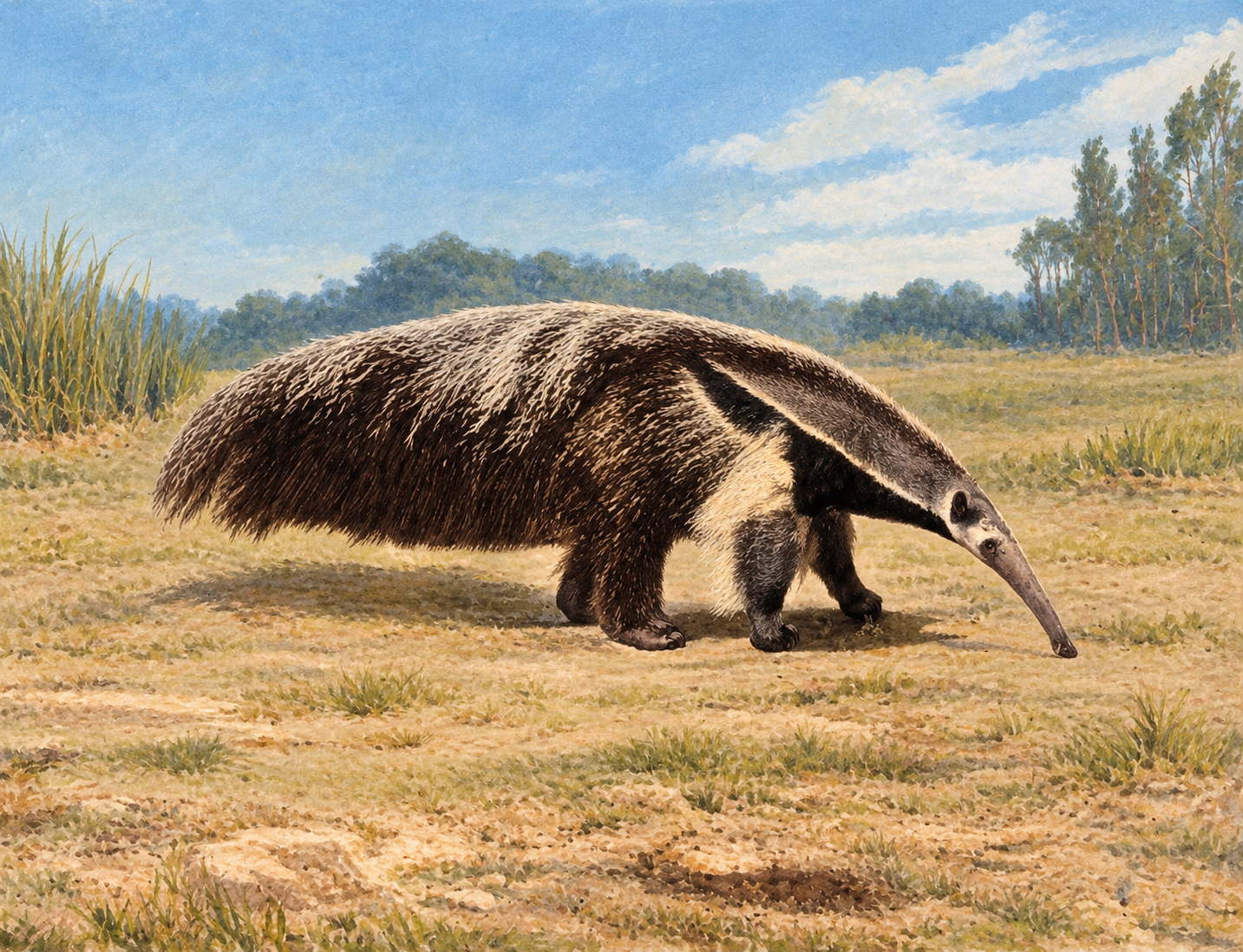
Unlike as the ant-eaters are to the sloths, they are nevertheless very closely related thereto. This unlikeness at the present day is so great that, were it not for " missing-links " in the shape of fossils, we should probably never have discovered the relationship. The head of the typical ant-eaters has been drawn out into a long tubular muzzle, at the end of which is a tiny mouth just big enough to permit the exit of a long worm-like tongue, covered with a sticky saliva. This tongue is thrust out with great rapidity amongst the hosts of ants and termites and their larvae, on which they prey. These victims are captured by breaking open -their nests. At once all the active inhabitants swarm up to the breach, and are instantaneously swept away by the remorseless tongue. The jaws of the ant-eaters are entirely toothless, and the eyes and ears are very small. The largest species of ant-eater is about 4 feet long. It lives entirely upon the ground. Generally speaking, it is a harmless creature; but at times, when cornered, it will fight furiously, sitting up on its hind legs and hugging its foe in its powerful arms. Bates, the traveller-naturalist, relates an instance in which a dog used in hunting the GREAT ANT-EATER was caught in its grip and killed. The tail of this large species is covered with very long hair, forming an immense brush. The claw on the third toe of each fore limb is of great size, and used for breaking open ants' and other insects' nests. But besides the great ground ant-eater there are some tree-haunting species.
Photo by Scholastic Photo. Co. \ [Parson's Green. These have a shorter muzzle, THE GREAT ANT-EATEB. and short hair on the tail, its toes ant-eater turns the so that the claws turn In walking inwards, and upwards inwards, which is used, as with of the a fifth the being borne the andthe weight body by pad on balls of the toe, horny third and fourth toes. the spider monkeys, as a

The Sloths, Ant-eaters, and Armadillos 339
Photo by A. S. Rudlam
TAMANDUA ANT-EATER.
This species, which is a. smaller animal than the Great Ant-eater, lives almost entirely in the trees, instead of on the ground.
fifth limb. Curled round the bough of a tree, its owner is free to swing himself out on to another branch. is not larger than a rat, and is a native of the The smallest of the tree-dwelling species is quitehottest parts of the forests of South and Central America. The muzzle in this species short, not long and tubular, as in the larger species. It is a very rare animal, or is at least very seldom seen, a fact perhaps due to its small size. It is known as the TWO-TOED ANT- EATEK, only the second and third ringers of the fore feet bearing claws. tells us that the natives of Surinam Von Sack, in his " Narrative of a Voyage to Surinam," that it will never eat,call this little animal " Kissing-hand " " as the inhabitants pretend it only licks its paws, in the same manner as the bear; thatat least when caught, but that it soon dies in confinement. Whenall trials to make it eat have proved in vain, and that I got the first, I sent to the forest for a nest of ants; and during the interim I put into its it refused to touch any of them. At last thecage some eggs, honey, milk, and meat; but ants' nest arrived, but the animal did not pay the slightest attention to it either. By the shape of its fore paws, which resemble nippers, I thought that this little creature might I therefore brought it a wasps' nest, and thenperhaps live on the nymphae of wasps, etc. it pulled out with its nippers the nymphae from the nest, and began to eat them with the greatest eagerness, sitting in the posture of a squirrel. I showed this phenomenon to many of the inhabitants, who all assured me that it was the first time they had ever known that species of animal take any nourishment."
THE ARMADILLOS.
Readers of this book will doubtless have noticed long ere this how manifold are the devices for the purpose of defence adopted by the Mammalia. The ARMADILLOS have certainly selected the most complete, having encased themselves in an impenetrable bony armour as perfect as the coat of mail of the warrior of the Middle Ages. Concerning this and the variations thereon adopted by the different members of the group we shall speak presently.
Armadillos are mostly confined to South America, and occur both in the open pampas and the shady depths of the forest. They live in burrows, which they dig with incredible speed. These burrows are generally found in the vicinity of the nests of ants and termites, which form their staple diet. One species, however, at least feeds apparently with equal relish upon vegetable matter, eggs, young birds, mice, snakes, and carrion.
The Living Animals of the World34Q
is disposed over the crown of the head, back, and flanks. It The bony armour is made up of numerous small, bony plates, buried deep in the skin, and each overlaid by a horny scale. The tail is protected by bony rings. The plates covering the shoulders and those directly over the hindquarters fuse into a solid mass, thus forming chambers into which the limbs can be withdrawn. In the region of the body, between these two shields, the plates are arranged in rows encircling the body, thus permitting the animal to roll itself up as occasion may require. Hairs grow out between the plates, and in- some cases give the animal quite a furry appearance.
Speaking of the burrowing powers of the armadillo, Darwin, in his most fascinating "Voyage of the Beagle," tells us that "the instant one was perceived, it was necessary, in order to catch it, almost to tumble off one's horse; for in soft soil the animal burrowed so quickly that its hinder quarters would almost disappear before one could alight. It seems almost a pity to kill such nice little animals; for as a Gaucho said, while sharpening his knife on the back of one, 'Son tan mansos' (They are so quiet).' r As a rule, armadillos are regarded as animals loving dry, sandy wastes; nevertheless, they are said to be able to swim both well and swiftly. The flesh of the armadillo is apparently by no means unpalatable.
THE PICHICIAGO.
One of the most remarkable of the armadillos is the PICHICIAGO, or FAIRY ARMADILLO. It is a tiny creature of some 5 inches long, found in the sandy wastes of the western part of the Argentine Eepublic. The horny covering of the bony plates is pinkish colour, and the hair is silky in texture and snow-white. But it is not on this account that the fairy armadillo is remarkable: its claim to notoriety rests on the peculiar arrangement of the bony plates constituting the armour. These bony plates-are small and thin, and covered, as in other species, with a horny coat; but instead of being embedded in the skin, they are attached only along the middle of the back, and project freely over the body on either side, leaving a space between the shield and the is specially body. The hinder end of the body protected by a nearly circular vertical shield, firmly fixed to the hip-girdle. This shield, it is said, is used as a plug to fill up its burrow with. THE PELUDO - Photo by A. S. TWO-TOED ANT-EATER. Armadillos of the normal type, wherein the body Although the fore feet have four toes, only the second and third armour is embedded in the skin, are represented by bear claws; hence the name "Two-toed" Ant-eater. numerous species. f\fOf one, iknown as the PELUDO,. Mr. Hudson has given us some interesting details. " It feeds," he tells us, " not only upon insects, but also upon vegetable matter, eggs, young birds, and carrion. Its method of capturing mice was certainly ingenious. It hunted by smell, and when nearing its prey became greatly agitated. The exact spot discovered, the body was raised slowly to a sitting posture, and then flung suddenly forwards, so that the mouse or nest of mice was imprisoned beneath, and promptly dispatched." "Still more remarkable," says Mr. Lydekker, "is the manner in which a peludo has been observed to kill a snake, by rushing upon it and proceeding to saw the unfortunate reptile in pieces- by pressing upon it closely with the jagged edges of its armour, and at the same time moving its body backwards and forwards. The struggles of the snake were all in vain, as its fangs could make no impression upon the panoply of its assailant, and eventually the reptile slowly dropped and died, to be soon afterwards devoured by the armadillo, which commenced the meal by seizing the snake's tail in its mouth, and gradually eating forwards."
The Sloths, Ant-eaters, and Armadillos 341
- Photo by York tfc Son] [Hotting Sill. Photo by L. Midland, F.Z.S.] _No-,-th Finchley.
WEASEL-HEADED ARMADILLO. HAIRY-BUMPED ARMADILLO.
The weasel-headed armadillos have from six to eight movable bands in This species, like the Peba Armadillo, varies its diet with the bony armour in which they are encased. carrion.
THE PANGOLINS.
The PANGOLINS, or SCALY ANT-EATERS, are perhaps even more curious creatures than the armadillos. They have been likened in appearance to animated spruce fir-cones, to which indeed they bear a strange resemblance. This resemblance is due to the wonderful armature of the skin, which takes the form of large overlapping, pointed, horny plates or scales. The pangolins are confined to the Old World, occurring in South Africa and South-eastern Asia. Like the American Ant-eaters, teeth are wanting, and the tongue is long and worm-like, being employed in the capture of insects, as in the New World ant-eaters. hairs. Like the spines The scales of the MANIS are formed by the fusion together of fine of the hedgehog and porcupine, they serve the purpose of offensive defence; for when the manis rolls itself up, these pointed scales project at right angles to the body, and offer a formidable resistance to any enemy whatsoever. They also serve to break the force of a fall, which, indeed, is often voluntary; for should the animal wish to descend from the branch of a tree, it will often take a short cut to the ground by deliberately dropping, the force of the fall being entirely broken by the elastic scales.