The Living Animals of the World, Volume I: Mammals
THE AARD-WOLF.
This small African hyaena-like creature stands in a family by itself. The animal is like a small striped hyaena, with a pointed muzzle, longer ears, and a kind of mane. It is common all through South and East Africa, where it lives on carrion, white ants, and lambs and kids. It has not the strong jaws and teeth of the dog or Photo by A. S. Rudland & Sons. AARD-WOLF. hyaena family. The colonists commonly The aard-wolf stands in a family by itself. It is allied to the hyaenas, but is a faj hunt and kill it with fox-terriers. feebler animal.
I'holo ly A'ao York Zoological Society.
rOTJNG GREY WOLF.
The grey wolf of North America, which once preyed mainly on young bison calves, is now a formidable enemy to tbe increasing flocks of sheep and herds of cattle in the north and west. 83
CHAPTER V.
THE DOG FAMILY.
5 rTIHE tribe now treated is called the Dog Family, and j rightly so, for our domestic dogs are included in the group, which comprises the "Wolves, Dogs, Jackals, Wild Dogs, and Foxes. Their general characters are too familiar to need description, but it should be noted that the foxes differ from the dogs in having contracting pupils to the eye (which in bright sun closes like a cat's to a mere slit) and some power of climbing. The origin of the domestic dog is still unsettled.
THE WOLF.
his dependants the This great enemy of man and creature against the ravages of which almost all the early races of Europe had to combine, either in tribes, villages, or principalities, to protect their children, themselves, and their cattle was formerly found all over the northern hemisphere, both in the Old and New Worlds. In India it is rather smaller, but equally fierce and
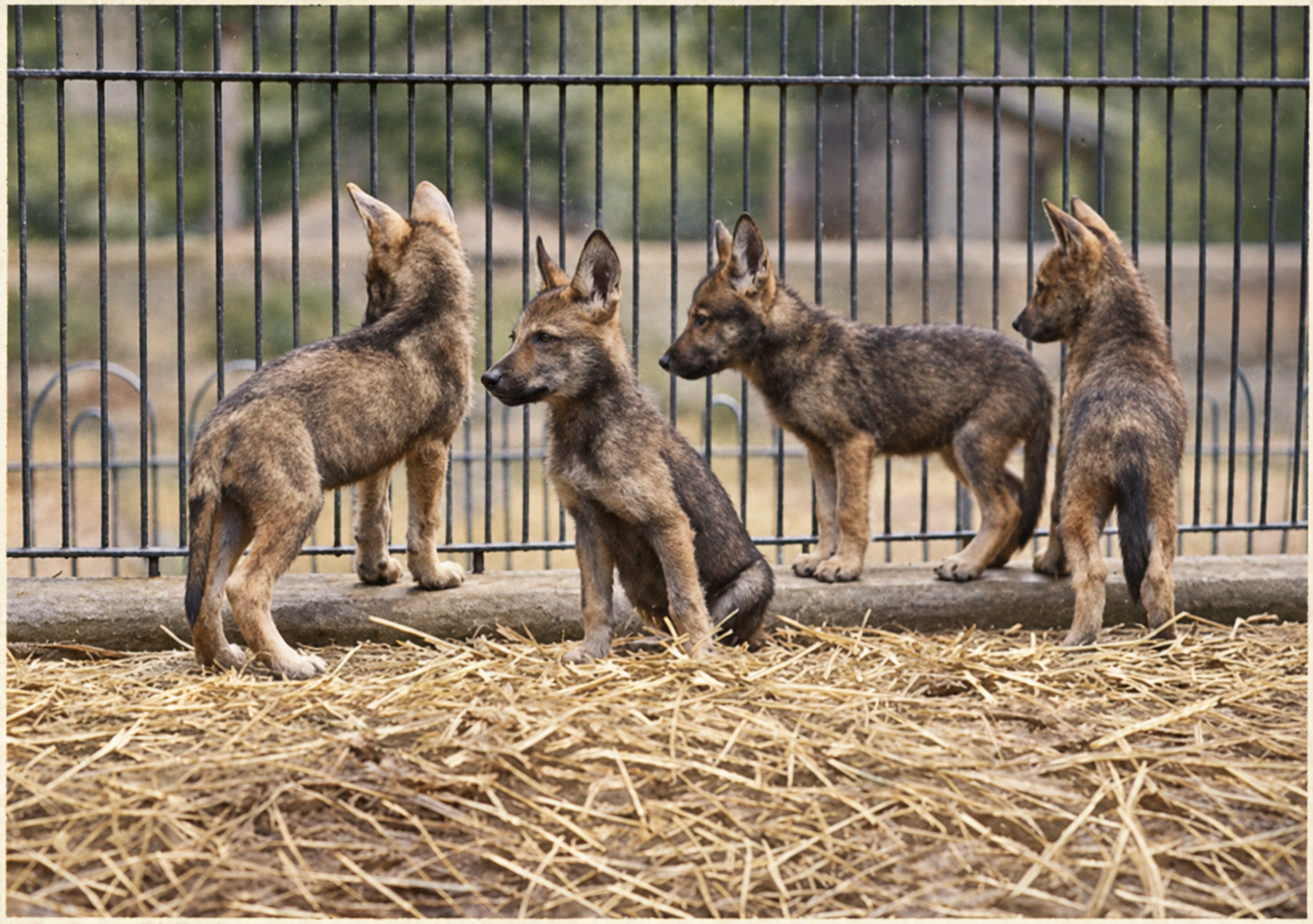
Photo by Scholastic Photo. Co., Parson's Green. cunning, though, as there are no long winters, it does is still so common in parts of A GROWING CUB. not gather in packs. It wolf cub the Note how develops pasterns, the long the Eocky Mountains that the cattle and sheep of the before and in pro- feet, grows its body longlarge jaw portion. ranch-holders and wild game of the National Yellowstone Park suffer severely. In Switzerland the ancient organisations of wolf clubs in the cantons are still maintained. In Brittany the Grand Louvetier is a government official. Every very hard winter wolves from the Carpathians and forests of the Ardennes and ofRussia move across the frozen rivers of Europe even to the Fontainebleau. In Norway they ravage the reindeer herds of the Lapps. Only a few years ago an artist, his wife, and servant were all attacked on their way to Budapest, in Hungary, and the man and his wife killed. The last British wolf was killed in 1680 by Cameron of Lochiel. Wolves are common in Palestine, Persia, and India.
Without going back over the well-known history of the species, we will give some anecdotes of the less commonly known exploits of these fierce and dangerous brutes. Mr. Kipling's " life of the Indian wolves. There is Jungle Book " has given us an " heroic " picture of the a great deal of truth in it. Even the child-stealing by wolves is very probably a fact, for native opinion is unanimous in crediting it. Babies laid down by their mothers when working in the fields are constantly carried off and devoured by them, and stories of their being spared and suckled by the she-wolves are very numerous.
Indian wolves hunt in combination, without assembling in large packs. The following is a : " When returning with a friendremarkable instance, recorded by General Douglas Hamilton from a trip to the mountain caves of Ellora, we saw a herd of antelope near a range of low rocky hills; and as there was a dry nullah, or watercourse, we decided on having a stalk. left.While creeping up the nullah, we noticed two animals coming across the plain on our We took them at first for leopards, but then saw that they were wolves. When they were 84
The Dog Family 85 about 500 yards from the antelope, they lay down quietly. After about ten minutes or so, the smaller of the two got up and trotted off to the rocky hills, and suddenly appeared on the ridge, running backwards and forwards like a Scotch collie dog. The larger wolf, as soon as he saw that the antelope were fully occupied in watching his companion, got up and came as hard as he could gallop to the nullah. Unfortunately he saw us and bolted; and his companion, seeing there was something Photo by Scholastic Photo. Co.\ [Parson's Green. wrong, did the same. Now, WOLF CUBS. it is evident that these wolves had regularly planned These are evidently the foster-brothers of Romulus and Remus. this attack. One was to occupy the attention of the antelope, the other to steal up the watercourse and dash into the midst of them. At another time a brother-officer of mine was stalking a herd of antelope which were feeding down a grassy valley, when suddenly a wolf got up before him, and then another and then another, until fourteen wolves rose out of the grass. They were extended right across the valley in the shape of a fishing-net or jelly-bag, so that as soon as the herd had got well into the jelly-bag they would have rushed on the antelope, and some must have fallen victims to their attack." They have been known to join in the chase of antelopes by dogs. Captain Jackson, of the Nizam's service, let his dogs course an antelope fawn. A wolf jumped up, joined the dogs, and all three seized the fawn together. He then came up, whipped off the dogs and the wolf, and secured the fawn, which did not seem hurt. The wolf immediately sat down and began to howl at the loss of his prey, and in a few moments made a dash at the officer, but when within a few yards thought better of it, and recommenced howling. This brought another wolf to his assistance. Both howled and looked very savage, and seemed inclined to make another dash at the antelope. But the horse-keepers came up, and the wolves retired.
The Indian wolf, if a male, stands about 26 inches high at the shoulder. The length of head and body is 37 inches; tail, 17 inches.
The same species practically haunts the whole of the world north of the Himalaya, It varies in colour from almost black to nearly pure white. In the Hudson Bay fur-sales every variety of colour between these may be seen, but most are of a tawny brindle. The male grows to a very great size. One of the largest ever seen in Europe was for years at the London Zoo. It stood 6 feet high when on its hind legs, and its immense head and jaws seemed to occupy one-third of the space from nose to tail. Horses are the main prey of the NORTHERN WOLF. It will kill any living creature, but horseflesh is irresistible. It either attacks by seizing the flank and throwing the animal, or bites the hocks. The biting power is immense. It will tear a solid mass of flesh at one grip from the buttock of a cow or horse. In the early days of the United States, when Audubon was making his first trip up the head-waters of the Missouri, flesh of all kinds was astonishingly abundant on the prairies. Buffalo swarmed, and the Indians had any quantity of buffalo-meat for the killing. Wolves of very large size used to haunt the forts and villages, and were almost tome, being well fed and comfortable. Far different

was the case even near St. Petersburg at the same period. A traveller in 1840 was chased by a pack of wolves so closely that when the sledge-horses reached the post-house and rushed into the stable, the doors of which were open, seven of the wolves rushed in after them. The driver and traveller leaped from the sledge just as it reached the building, and horses and it. The men wolves rushed past them into then ran up and closed the doors. Having obtained guns, they opened the roof, expecting to see that the horses had been killed. Instead
Photo by L. MeMand, F.Z.S.] [JXorth Finchley. all seven wolves were slinking about beside WHITE WOLF. the terrified horses. All were killed without White wolves are quite common in North America. Recently two resistance. white wolves were brought to the Zoological Gardens from Ilussia. In Siberia and Russia the wolves in winter are literally starving. Gathering in packs, they haunt the roads, and chase the sledges with their unfaltering gallop. Seldom in these days does a human life fall victim; but in very hard winters sledge-horses are often killed, and now and then a peasant. Rabies is very common among wolves. They then enter the villages, biting and snapping at every one. Numbers of patients are sent yearly from Russia and Hungary to the Pasteur Institutes, after being bitten by rabid wolves. In Livonia, in 1823, it was stated that the following animals
: 15,182 sheep, 1,807 oxen, 1,841 horses, 3,270 goats, 4,190 pigs,had been killed by wolves 703 dogs, and numbers of geese and fowls. They followed the Grand Army from Russia to Germany in 1812, and restocked the forests of Europe with particularly savage wolves. It is said that in the retreat freni Moscow twenty-four French soldiers, with their arms in their hands, were attacked, killed, and eaten by a pack of wolves.
From very early times special breeds of dogs have been trained to guard sheep against the attacks of wolves. Some of these were intended to defend the flock on the spot, others to run down the wolves in the open. The former are naturally bred to be very large and heavy; the latter, though they must be strong, are light and speedy. Of the dogs which guard the flocks several races still survive. Among the most celebrated are those of Albania and the mountainous parts of Turkey, and the wolf-dogs of Tibet, generally called Tibetan Blood-hounds. The Tartar shepherds on the steppes near the Caucasus also keep a very large and ferocious breed of dog. All these are of the mastiff type, but have long, thick hair. When the shepherds of Albania or Mount Rhodope are driving their flocks along the mountains to the summer pastures, they sometimes travel a distance of 200 miles. During this march the dogs act as flankers and scouts by day and night, and do battle with the wolves, which know quite well the routes along which the sheep usually pass, and are on the look-out to pick up stragglers or raid the flock. The Spanish shepherds employ a large white shaggy breed of dog as guards against wolves. These dogs both lead the sheep and bring up the rear in the annual migration of the flocks to and from the summer pastures. In the west of America, now that sheep-ranching on a large scale has been introduced, wolf-dogs are bred to