The Living Animals of the World, Volume I: Mammals
The Arab does not appear to have been introduced into England till the seventeenth century; but the result of that introduction, as we shall see presently, has been fraught with tremendous consequences. In its native land it appears to have been bred chiefly for the purposes of warfare. The success with which the breeders' judicious selection has been rewarded is plainly seen in the wonderful powers of endurance on long marches; so that, at the end of a raid, the animal is still fresh enough either for flight, if necessary, or for a final rush on a retreating enemy. Besides, Arabs possess great courage, and are frugal both in the matter of food and drink.
The Horse Tribe 201
As a race-horse, one enthusiast assures us, the Arab is superior to every other natural breed; he is beaten only by his own half-breed offspring—the English Race-horse. But this seems to be rather an over-estimate.
The colour of the Arab varies; white is the most highly esteemed, but bay and chestnut are common, black being rare. Strange as it may seem, the white breed is never born white.
The great affection of the Arab for his horse is proverbial. The following story is certainly worth repeating: “The whole stock of an Arab of the desert consisted of a mare. The French Consul offered to purchase her, in order to send her to his sovereign, Louis XIV. The Arab would have rejected the proposal; but being miserably poor, with scarcely a rag to cover him, his wife and children starving, he was tempted greatly. At length he yielded. He brought the mare to the consul’s house, and stood leaning on her neck, and looking, now at the gold, and now at the horse. The gold was good to look upon; it would make him rich for life. Turning at last to his favourite, he said: ‘To whom is it I am going to yield thee up? To Europeans, who will tie thee close, who will beat thee, who will make thee miserable. Return with me, my beauty, my jewel, and rejoice the hearts of my children.’ At the last of these words he sprang upon her back, and was in a few moments out of sight.”
THE BARB.
This is an African breed, which, like the generality of African horses, is distinguished from those of Asia by its long limbs and small girth at the loins, thus resembling the foals of other breeds. It displays great powers of enduring hunger and
Photo by the Duchess of Bedford] [Woburn Abbey.
PERCHERON HORSE.
A Continental breed. This horse is believed to be the only one of its kind in England.
Photo by T. Fall] [Baker Street.
HACKNEY AND FOAL.
A specimen of the English carriage-horse.
26
thirst; and is fleet, with a high and graceful action. The barb takes its name from its native land— Barbary. It is a larger breed than the Arab. Levant anpD Perstan Horses. These are very closely allied to the Arab, but generally of larger size; and in Southern Persia, at least. less delicately framed. The Turkoman horses are related to those of Northern Persia. Tne ENGLISH RACE-n0RSE. This animal is the product of very careful selection and gradual improvement of an original native : breed, extending over several centuries. Long since, so long ago as the reign of James I., it had reached a high degree of excellence.
Photo by C. Reid. [Wishaw, N.B.]
LADAS.
A perfect English thoroughbred. With this racer Lord Rosebery won the Derby in 1894.
Upon this native stock there has been built up, by the infusion of Arab blood, the swiftest horse which the world has ever known—the Brirish THoroucusrep. “Of this’ breed, it may be stated,” says Mr. Allison, “that every such animal in the stud-book of the present day, in this country or any other, descends... from one of three original Eastern sires—the Darley Arabian, the Byerley Turk, or the Godolphin Arabian.” This is an extremely interesting fact, and constitutes a lasting monument to the enterprise and acumen of the British horse-breeder. The Byerley Turk hailed from the Levant, and was introduced by Captain Byerley about 1689. From the Byerley Turk came Herod, the most celebrated of his descendants, who has given rise to the Herod line, which to-day is but feebly represented. The Godolphin Arabian, or the Godolphin Barb, was born about 1724. From his grandson Matchem is derived the Matchem line, which is also to-day bordering on extinction. The Darley Arabian carries us back to the reign of Queen Anne. Flying Childers and Bartlett’s Childers are directly descended from him; and from the latter is descended Eclipse, the fastest horse which the turf has 6 ever known. It is interesting to note Bs fs ‘ Siting tS that the descendants in the Eclipse Photo by C. Rei) iIFishene, line enormously outnumber those of FLORIZEL 11. the other two lines which we have con- One of the King’s racing-stud. sidered. Of his descendants, one of the
The Horse Tribe 203 most illustrious is Stockwell, who has been described as the most extraordinary sire of all time, whose blood is coming more than ever to the front.
THE TROTTIXG-HORSE.
This is an American breed. The trotting-horse is a combination of barb and Arab on an English stock. Most if the trotting- and pacing-horses of America may be traced to an English thoroughbred Messenger who was imported into America in 1780. This horse became the founder of the greatest trotting family in the world. The speed attained by some of the fastest trotters is wonderful,
J''ali]a mile being covered in some f/tolo by T. three or four seconds over two SHETLAND POXY AND FOAL. minutes. These ponies belong to Lady Mary Hope and her sister, who have been very successful in
Eussia is the only Euro- breeding them. pean country with a distinct breed of trotter the ORLOFF. This breed was made by crossing Arab and English horses with the native races. The Orloff has not the speed of the American horse, but has greater powers of endurance. The trotting-season in Russia is winter, the races taking place on the ice. The PACER is not a distinct breed, but so called on account of its curious method of trotting. In trotting the left fore and right hind leg strike the ground at the same moment; in pacing the fore and hind leg of the same side move in unison. Some wild animals as the giraffe are pacers. " Many American horses," says Mr. Winans, "are able to move with either action, a set of lighter shoes often
bit T. t\sufficing to convert a trotter Photo is CHAMPION SHIRE STALLION.into a pacer." Pacing a swifter mode of motion One of Sir Walter Gilbey's celebrated cart-horses.
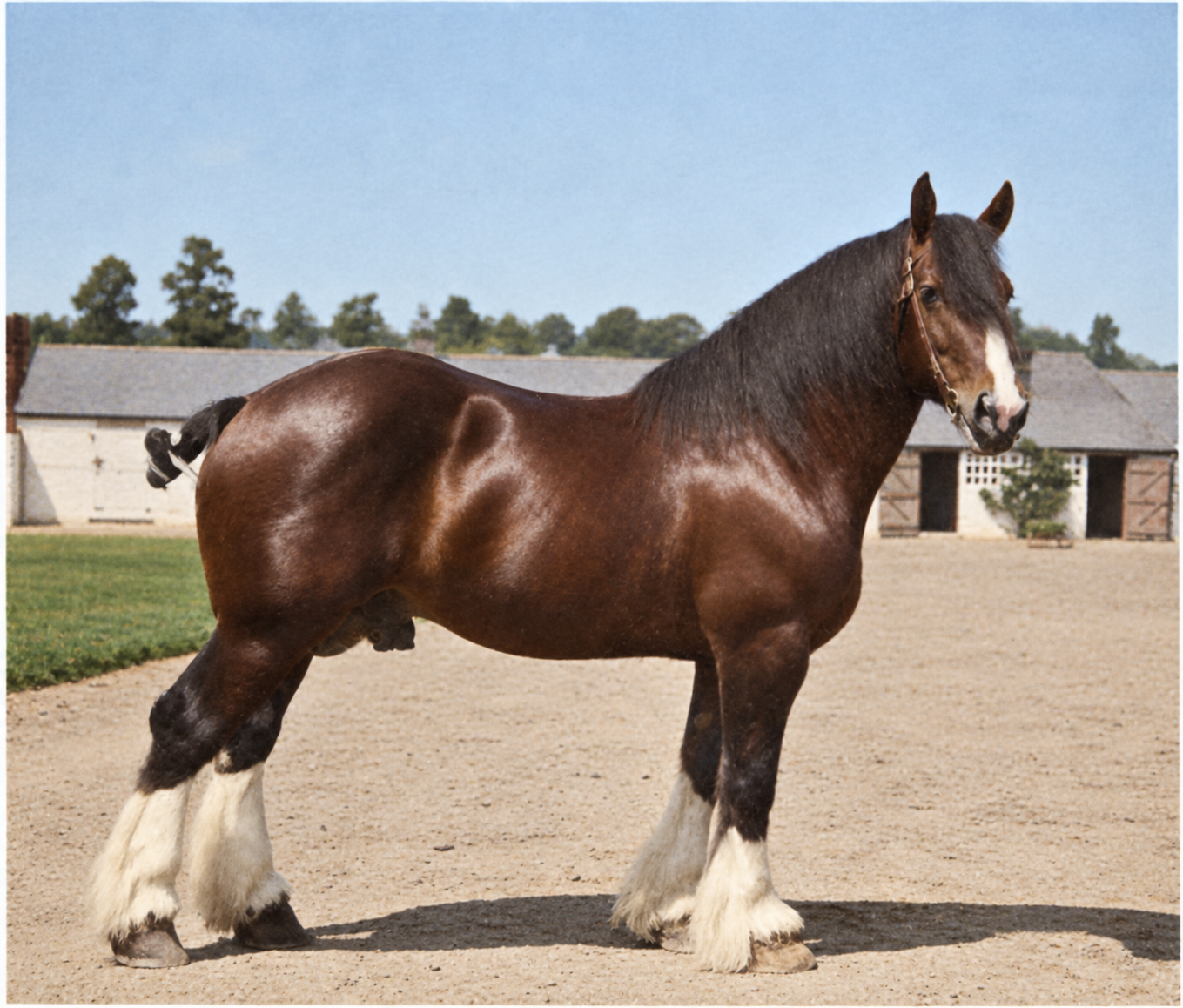
[Baker Street.
SHIRE MARE AND FOAL.
Another of Sir Walter Gilbey’s champion cart-horses showing mother and young. Photo by T. Fall) {Baker street.
WELSH PONY.
This photograph shows the Duchess of Newcastle with one of her white Welsh ponies, 204
The Horse Tribe 205
than trotting. The record time stands at one mile in 1 minute 39 seconds, as against the trotting record of one mile in 2 minutes 3| seconds.
THE HUNTER.
This also is not a distinct breed, as some suppose. Any good riding-horse may be used as a hunter. " Hunters " have been made by infusing the blood of the race-horse with native breeds. The chief requirements are a muscular neck and chest, with a rather short body, and shorter and stouter legs than the race-horse. From the half-bred hunter we pass by insensible gradation to the ordinary saddle- and carriage-horses. The ideal carriage-horse, however, is more of a distinct breed than the hunter, and [ irishair, X.B.known as the CLEVELAND BAY. It has been produced by mingling the blood POLO-PONY. of the thoroughbred with that of a presentVariousday breedsare theofEnglish-bredponies are usedXewin Forest,this game,Dartmoor,but the ormostExmoor,esteemedor Welshat the horse of stouter make than that of the ponies. hunter type. is variously stated The record broad jump for the hunter, we might mention in passing, to be from 33 to 37 feet!
THE SHETLAND PONY.
This is a native of the Shetland Islands, and remarkable for its small size, docility, and hardihood. It is allowed to run nearly wild, and made to forage almost entirely for itself. In the winter it grows a coat of great length, which, soon becoming matted, forms a most effective protection against cold and wet. The DARTMOOR, EXMOOR, and NEW FOREST are likewise small breeds, but lack the symmetry and beauty of the Shetland.
CART-HORSES. Under this head are included all the large, heavily built draught-horses. These are of European origin, and without intermixture of foreign Asiatic or African blood. In England the most important breeds are the BLACK or SHIRE
Photo by T. Fall] [Baker Street. HORSE, the CLYDESDALE, and the SUFFOLK DONKEY. PUNCH. These are wonderful instances Uhis is a typical English coster s dockey, and won the first prize at the Southwark show. of the results of selective breeding
2O6 The Living Animals of the World
towards a definite end large size, accompanied by great physical strength and powers of endurance. To accomplish this, speed has had to be sacrificed.
ASSES AND MULES.
ASSES. THE DOMESTIC Ass, so common to-day in these islands, is of African origin, and has, moreover, departed but little in either form or colour from the wild race. This is probably due to the fact that the ass has not been subjected in this country to that process of rigorous and careful selection that the horse has undergone. We have no record of its first introduction to these islands, but it was certainly it known in the reign of Ethelred, though was a rare animal. Later it appears to have died out, and to have been reintroduced in the reign of Elizabeth; but it has never become popular. This is unfortunate; its sterling qualities have never been really appreciated by us. Spain, Italy, and Malta have all succeeded in raising some fine breeds. The United States has, however, produced