The Living Animals of the World, Volume I: Mammals
WILD OXEN.
THIS group consists of the GAUR of India; the GAYAL of Assam, which is possibly a domesticated form of the gaur, but rather smaller in size, with skull and horns different in character; and the BANTING, a lighter and more slender wild ox, of which different varieties are found in Burma, in Java (where it is kept in a half-domesticated condition), and in Manipur.
THE GAUR.
The GAUR, the so-called INDIAN BISON, is probably the largest of all the wild bovine animals. It is found at the foot of the North-eastern Himalaya, in the Central Provinces of India, the forests of Madras and Mysore, and in parts of Burma and the Malay Peninsula, isbut not in Ceylon. Its range eastward is not accurately known. In habits the gaur mainly a forest animal, retiring always at daybreak into the depths of the jungle. It sometimes attains a height of over 6 feet at the shoulder, and a length of 9 feet 6 inches
The Hollow-horned Ruminants 211
from the nose to the tail. The colour of the full-grown gaur is dark brown, turning to black; the legs from above the knees and hocks to the hoofs are white, the hair being short and fine. Its horns are upturned, and tipped with black, with white hair covering the junction on the top of the skull. The cows are much smaller than the bulls, standing about 5 feet high at the shoulder. This species feeds both on grass and on the young shoots of trees and of bamboos. The calves are dropped in August and September. The pure-bred animal does not appear capable of domestication.
Hunting gaur by tracking in the jungle has long been a favourite sport of Anglo-
:Indians. General Douglas Hamilton says "I have killed bulls measuring 6 feet at I'hutu by York & Son] [Netting JIM. the shoulder, and the average height of the COW GAYAL. male is from 5 feet 8 inches to 5 feet 10 This animal is not at all dissimilar to the gaur. Its chief points of differ-inches. An old bull gaur ence are in the horns and:n the colour of its skin. is a magnificent animal. The normal colour is a brownish black, sometimes in very old specimens almost quite black. The white stockings reach from the hoof to above the knee, and are very I was out early,conspicuous. When on the Anamalies, I had a grand fight with a big bull. and came on the spoor of bison, and soon saw two, one a very large bull. To my disgust he lay down, and was completely covered by creepers and bushes. After a bit I attempted to left was a cow bison staring at me. She at oncemove to get a better view; but there to my gave the alarm, and I waited for the large bull to rise. This he did so quickly, and disappeared so suddenly, that I only got a snapshot. As I stopped to load, I saw a young calf squatting at the foot of a tree like a hare, intently watching me. I put the rifle down, crept up behind the tree, and suddenly threw myself on the little calf, and managed to get hold of its hind legs, but it got from under me. I managed, however, to tie its fore legs securely by means of some slender stems from the creepers. All this time it continued to bellow and to I went backmake a great row, and I fully expected to see the mother come charging down. little captive home. After breakfast I startedto the bungalow, and got some men to bring my again, and got on the track of the bison.... I saw some branches move, and on looking carefully perceived a large bull bison; but he was among the thick bushes, and I could not see his outline. I guessed as nearly as possible the position of the shoulder, and fired the for me to give himbig rifle at him. He g ave a bound forward, and then stopped long enough a shot with the other barrel.... The next moment I saw the bull standing on the high ground above us. I fired again, and hit him well behind the shoulder. He dashed off, but only went fifty yards, and then stopped. I walked up, thinking to finish him, when he made rifle into my hands and then bolted, and Ia fearful rush at me. My man put the double thought it prudent to retire and await my opportunity. But he only moved a few paces forward, and then stopped. Then began a regular siege of his position." The result of the siege was that the bison received four more bullets, charged and routed the hunter twice, and then walked off. It was shot twice more, charged again, and was finally killed by General Hamilton with his hunting-knife tied to a bamboo spear-pole.
Considering the size and tenacity of life of the gaur, it is rather wonderful that more accidents do not occur in the pursuit of this animal; but as it lives mainly in thick jungle, where large trees grow, the sportsman has more chance of getting out of sight of a wounded animal than when attacked by the Indian buffalo, which generally haunts jungles of high grass.
the World212 The Living Animals of
THE GAYAL.
I The doubt whether this animal is found in a wild state has recently been considerably increased. It is well known in a semi-domesticated condition, in which it is kept by the tribes in and around the Assam Valley, where the wild gaur is also found. These herds roam during the day freely in the jungle, and return to be fed at the villages. It has been stated that wild gayal are enticed to join the tame herds by feeding them with balls of meal and salt; but these " wild " specimens may be only those which have belonged to or have descended from
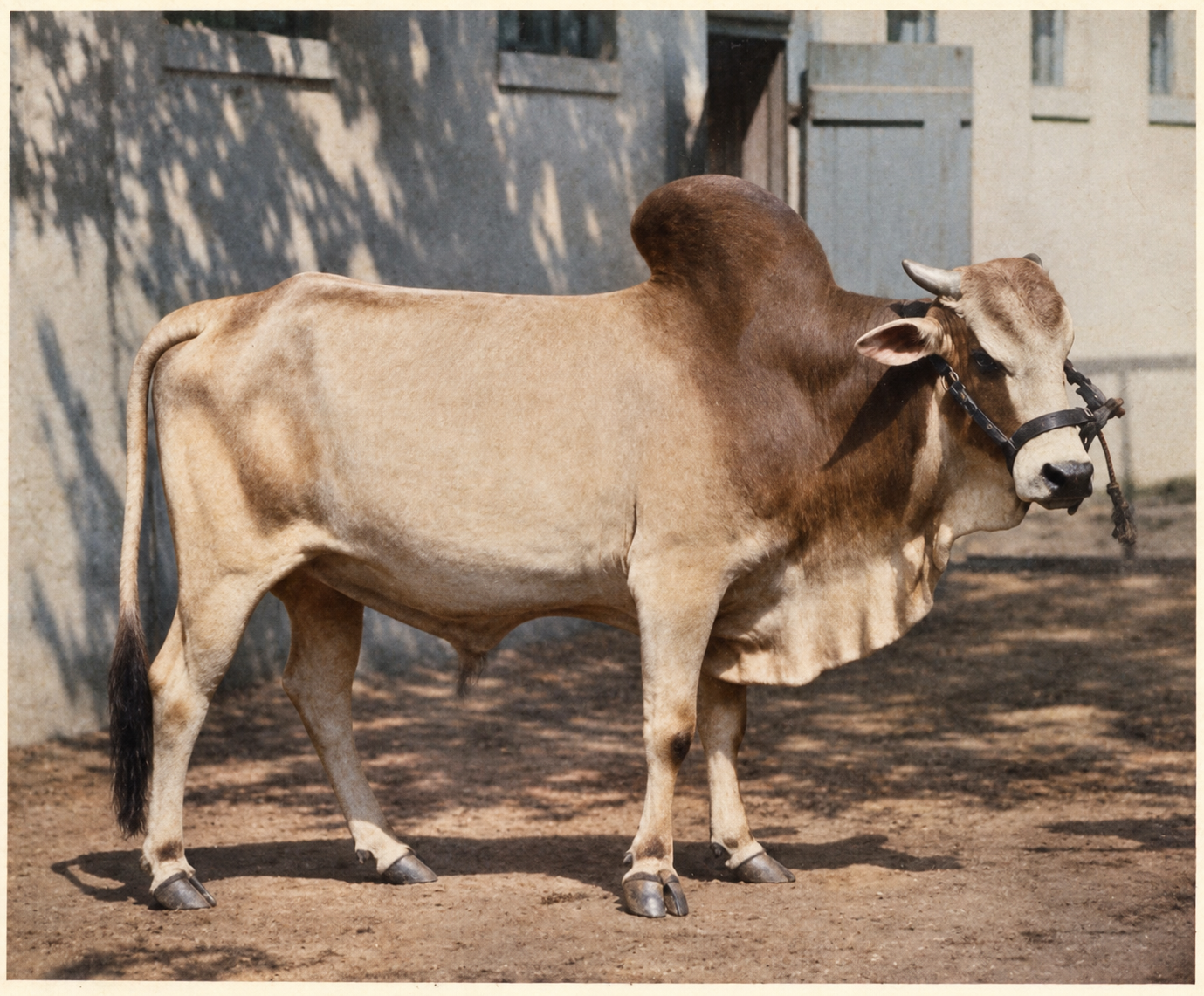
Cy ptnnusion oj Herr Carl Hagenbeck\ the domesticated herd. Gayal have INDIAN HUMPED BULL. been kept in England not only in Oriental cattle. The hump and dewlap mark the The ears are often more drooping the Zoological Gardens but in some in this than specimen. parks, and crossed with English cattle. The offspring furnished excellent beef, but were rather wild and intractable. The horns of the gayal are thicker and flatter than those of the gaur, and placed lower on the skull and farther apart. The domesticated gaval stands lower than the gaur, but is a very massive animal.
THE BANTING.
The common wild ox of the Malay countries of Borneo, Java, Eastern Burma, and northwards, in Manipur resembles the European oxen rather more than does the gaur. In size the bulls sometimes reach 5 feet 9 inches. The old bulls are black, the younger bulls is marked with a large whitechocolate-red, and the cows a bright reddish brown. The rump patch, and all have white stockings from above the knees and hocks down to the hoofs. The tail is considerably longer than in the gaur, coming well below the hocks. As might be expected from its distribution, the size of this animal and the shape of the horns vary considerably in the different districts which it inhabits. In Borneo the horns often curve forwards; in Java they spread outwards. In the latter island large herds of this species are live in small herds, and in Burmakept in a state of domestication. When wild, banting feed from early morning until ten o'clock, when they retire into the jungle for shelter. The Manipur race is smaller than that of Burma (of which the males are not black), and the bulls have not the white rump.
THE YAK.
THE YAK is naturally an inhabitant of the very high plateaux and mountains of Tibet, where the climate is cold and the air excessively dry. Lower down on the Indian side of the Himalaya a smaller race is found domesticated, which is the only one able to stand the
- The tamedclimate of India, or of Europe, where it is now kept in some parks as a curiosity. yaks are usually much smaller than the wild; these sometimes reach a weight of between 1,100 and 1,200 Ibs. In form they are long and low, very massive, and with hair almost entirely black; this falls off along the sides into a long sweeping fringe. The tail is thickly tasselled with fine hair, and is employed by Indian princes for fly-flaps. The wild yak has large, massive black horns, curved upwards and forwards in the male. In Ladak and Chinese Tibet the yaks inhabit a desolate and barren country, in which their main food is a dry,

The Hollow'horned Ruminants 213
coarse grass, on which they nevertheless contrive to keep themselves in condition, feeding in the mornings and evenings, and lying down by day to rest among the rocks.
THE BISON.
THE BISON form a marked group, differing from others of the Ox Tribe. They possess fourteen pairs of ribs, while the oxen have only thirteen (the yak has fourteen); and have very heavy, massive heads, broader and more convex foreheads than the oxen, longer spinal processes on the vertebrae of the front part of the back, and larger muscles to hold the ponderous head, causing a hump, which in the American bison is very marked. There are two living species of bison, one of which is found in Europe, the other in North America.
THE EUROPEAN BISON.
still This is the most interesting survival of the primitive fauna of the Old World. It is found wild, though protected, in a large forest in Lithuania, the property of the Czar of Eussia, called the Forest of Bielowitza. A few are also left of the purely wild stock in the Caucasus. Those in Lithuania have been protected for several centuries, and the herd is numbered from time to time. In 1857 there were 1,898 of these bison left; in 1882 there were only 600; in 1889 the herd had sunk to 380, but in 1892 it had risen to 491. The presence of the bison in the Caucasus had been almost forgotten till Mr. Littledale and Prince Demidoff it is called, only survivesgave accounts of hunting it there quite recently. The ZUBR, as in some very inaccessible parts of the mountains, preserved by the Grand Duke Sergius Michaelovitch, in the Kouban district. There it exists as a really wild animal. The dimensions of one recently shot were 10 feet from the muzzle to the end of the last vertebra of the tail. The Grand Duke has to obtain special permission from the Czar to shoot one whenever he goes to the Caucasus. This bison seems to have been an inhabitant of most of the forests of Europe and Northern Asia; its remains show that it existed in Britain, and it was plentiful in the Black Forest in the time of Csesar. It is the largest of all European quadrupeds, measuring as much as 10 feet 1 inch from the nose to the root of the tail, and standing nearly 6 feet high at the shoulder. Prince Demidoff states his belief that it is found on the southern slopes of the Caucasus Range between the hills and the Black Sea. The weight of this bison reaches 1,700 Ibs. It is now rare to see more than five or six together. Though the animal is so massive, its horns are rather small and slender, and curve upwards. The mane which, like the rest of the coat, is of a uniform rich brown is thick and curly, but not developed like that of the American bison.