The Living Animals of the World, Volume I: Mammals
The SIBERIAN ROE, found from the mountains of the Altai and Turkestan to Siberia, is a somewhat larger species than its European cousin, measuring from 28 to 34 inches at the shoulder. The antlers are also larger, extending to as much as 16 and even 18 inches in measurement. As beseems its habitat, the coat of this species is also thicker and rougher than is the case with the European roe. Mr. Lydekker gives some interesting particulars : " When the snows of November fall, the roe themselves commence toregarding this animal collect in herds, which may number from 300 to 500 head, and soon after migrate southwards into Manchuria, whence they return about the end of March or beginning of April. On the Ussuri, which they must cross, they are at this season slaughtered in thousands by the hunters, without regard to age or sex."
One other species, the MANCHURIAN ROE, found chiefly in mountainous habitats, whence it never descends, should be noted. This is a smaller deer than the Siberian roe, and approximates in size and length of horn to the European race.
PERE DAVID'S DEER.
This remarkable animal, which apparently bears little or no resemblance to any of the other deer of the Old World, has been placed by some naturalists between the roe deer and the American deer. Its habitat is North China, and, strangely enough, it seems to be unrecognised
of the World 296 The Living Animals
in the wild state, being apparently only known in China in the Imperial Park at Pekin. This deer approaches in size the red deer of Europe. The general colouring is greyish brown, white about the eyes, ears, rump, and under-parts; the horns, which lack the brow-tine, are very singular in shape, and measure as much as 32 inches in length; the tail is long, reaching to the hocks; the gait is " lolloping " and mule-like. This is a marsh-loving species, and at Woburn Abbey, where specimens are kept, "they may be seen wading far into the lakes and even swimming in the deeper water."
THE AMERICAN DEER.
Excepting always the elk, wapiti, and reindeer, which have been already described, the deer of North and South America stand quite apart from those of the Old World, and are placed in a genus of their own. Usually the tail is
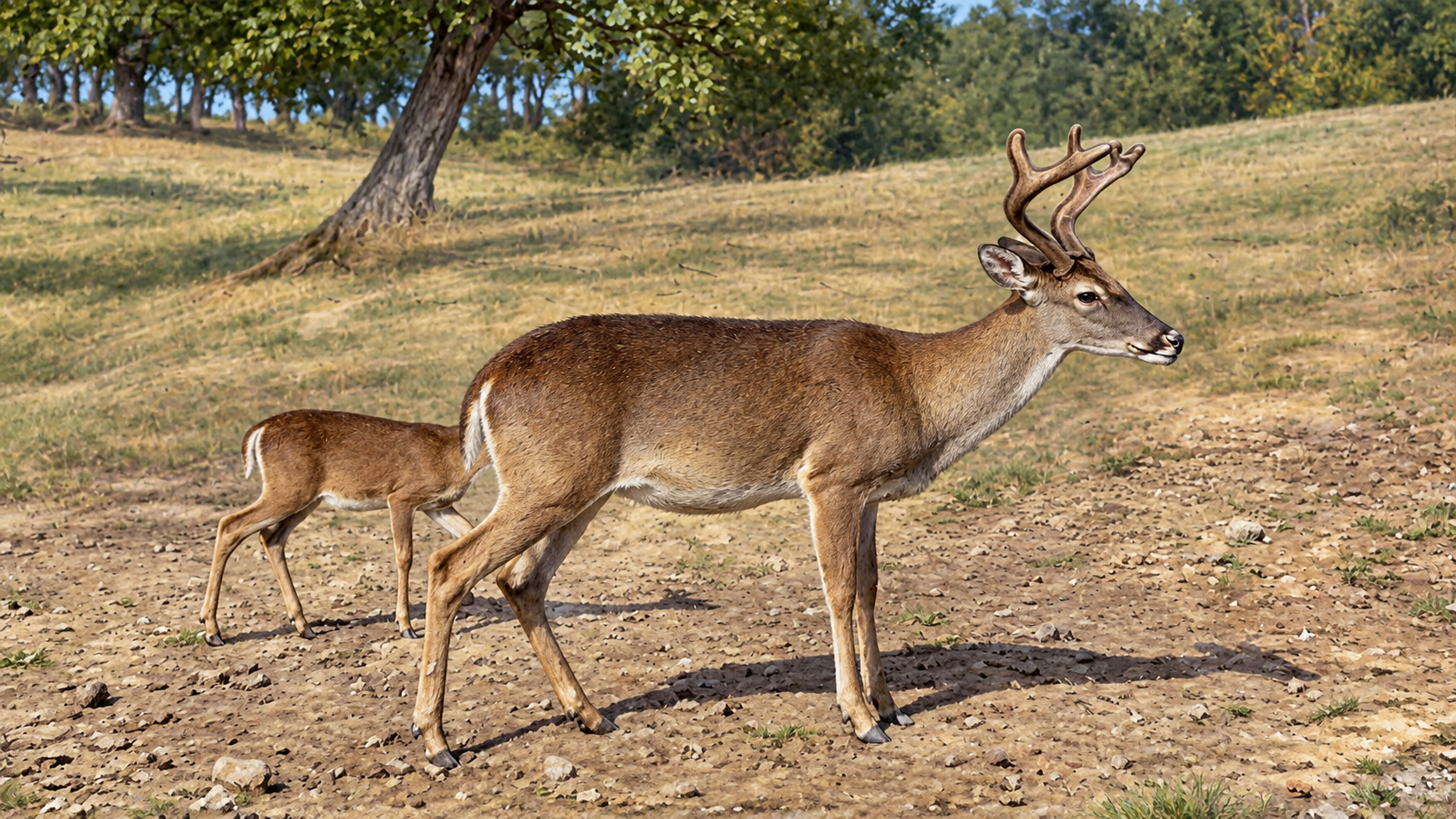
By permission of Professor Bv.mpu*] York. long, and the brow-tine is always wanting. is the common A MULE-DEER FAWX. The most familiar species The large ears, from which the American species takes its name, are noticeable AMERICAN DEER, of which the VIRGINIAN even in the young. or WHITE-TAILED DEER is the type. This deer is found in varying forms in both continents, and was regularly hunted by the ancient Mexicans with trained pumas.
The well-known VIRGINIAN DEER, found in Eastern North America, and believed to range as far south as Louisiana, stands a trifle over 3 feet in height, and weighs, clean, about 12 stone 7 Ibs. The coloration is chestnut in summer, bluish grey in winter. The antlers are of good size, and measure as much as 27| inches in length. As a sporting animal the white-tailed little beast,"deer is not popular. Mr. Clive Phillipps-Wolley describes him as " an exasperating possessing every quality which a deer ought not to, from the sportsman's point of view. "His haunts are river-bottoms, in choking, blinding bush, and his habits are beastly. No one could ever expect to stalk a white-tail; if you want to get one, you must crawl." Mr. Selous, in 1897, bagged one of these deer somewhat curiously. "He was coming," he writes, "through in a series of great leaps, rising, 1 think,the scrubby, rather open bush straight, towards me quite four feet from the ground at every bound. I stood absolutely still, thinking to fire at him just as he jumped the stream and passed me. However, he came so straight to me that, little more thanhad he held his course, he must' have jumped on to or over me. But when the width of the stream separated us when he was certainly not more than ten yards from me he either saw or winded me, and, without a moment's halt, made a prodigious leap sideways. I fired at him when he was in the air, and I believe quite six feet above the ground." The deer, an old buck with a good head, was afterwards picked up dead. In different parts of America, as far south as Peru and Bolivia, various local races of this deer are to be found.
TRUE'S DEER is a small species, not unlike the Virginian deer, found from South Mexico to Costa Eica. The antlers are "in the form of simple spikes directed backwards," and the is at presentbody-colouring is in summer light chestnut, in winter brownish grey. Little known of this species. The MULE-DEER, found in most parts of North America west of the Missouri, as far south
The Deer Tribe 297
as Southern California, stands about 3 feet 3 inches at the shoulder, and weighs over 17 stone is tawny red inclean. It carries good antlers, measuring as much as 30 inches, and in colour summer, brownish grey in winter. It is a far better sporting animal than the sneaking white-tailed deer, and affords excellent stalking. These deer are still abundant in many localities. : " Some idea of the numberMr. Phillipps-Wolley writes thus of them in " Big Game Shooting " of these deer in British Columbia may be gathered from the fact that in one district I have had a chance of killing seventeen separate stags in an hour's still hunt, whilst one settler in the Similkameen country fed his hogs on deer-meat through a whole winter." Four races of mule-deer the TYPICAL, the CALIFORNIAN, the LA PAZ, and the WESTERN DESERT race have been identified by naturalists.
The BLACK-TAILED DEER is another well-known cervine of Western North America, closely allied to the mule-deer, but distinguished from that species by its inferior size and its much blacker tail. The antlers, as a rule, run somewhat smaller than in the case of the mule-deer. This, too, is a very abundant species, affording fairly good sport (considering its liking for timber and dense bush) and excellent venison.
In South America are to be found several kinds of marsh-deer, of which the best known is the handsome MARSH-DEER, having its range from Brazil to the forest country of the Argentine Republic. Little is known of this and other South American deer by British sportsmen. The marsh-deer is almost equal in size to the red deer of Scotland, but somewhat less stout of ; the coat is long andbuild; the colouring is bright chestnut in summer, brown in winter coarse, as befits a swamp-loving creature; the antlers usually display ten points, and measure in fine specimens as much as 23 or 24 inches.
The PAMPAS-DEER, a species closely allied to the marsh-deer, is of small size, standing about 2 feet 6 inches at the shoulder. The antlers, usually three-pointed, measure no more than from 12 to 14 inches in fine specimens. This deer is found from Brazil to Northern Patagonia. The PERUVIAN and CHILIAN GUEMALS are small deer, found on the high Andes, and are somewhat inferior in size to the Virginian deer. The males carry simple antlers forming a single fork, and measuring about 9 inches. The coat, yellowish brown in hue, is coarse, thick.
ermission of Professor Bumpus\ [New York.
VIRGINIAN DEER.
This deer is the best-known representative of a species displaying extraordinary local variation in size and colour. 38

of the World298 The Living Animals and brittle. The Chilian guemal is found also in most parts of Patagonia; unlike its congener of Peru, which delights in altitudes of from 14,000 to 16,000 feet, its habitat lies chiefly in deep valleys, thick forest, and even the adjacent plains, to which it resorts in winter. The BROCKETS, of which seven species are found in South and Central America and Trinidad, are small deer, having spike-like antlers and tufted crowns. The largest is the KED BROCKET, found in Guiana, Brazil, and Paraguay, which stands 27 inches at the shoulder. The body-colouring is brownish red. Like most of the group, this brocket is extremely shy; although fond of dense covert, it is found also on open campos. The PYGMY BROCKET, a tiny dark brown deerlet, less than 19 permission of the New York Zoological Society. inches in height, found in MULE-DEER STAG. Central Brazil, is the smallest
Shows the large blackish-brown patch on the forehead, so distinctive of the species. of these very small deer. Two other diminutive deer, known as PUDUS, closely allied to the brockets, are found in South America. These are the CHILIAN and ECUADOR PUDUS, of which the former is no more than 13| inches in height, the latter about 14 or 15 inches. Little is known of the history and life habits of these charming little creatures, one of which, the Chilian species, has occasionally been seen in the Zoological Society's Gardens.
THE MUSK-DEER.
This brief account of the deer of the world closes with the MUSK-DEER, which differ from almost all others of their kind the Chinese water-deer being the sole exception in the absence of antlers. In place of these defensive and offensive weapons, nature has provided the musk-deer with long canine tusks, projecting downwards from the upper jaw. The musk, from which these curious deer take their name, is secreted during the rutting-season in the male only in a pouch or gland contained in the skin of the stomach. its size, measuring The well-known HIMALAYAN MUSK-DEER is a stout, heavily made deer for 20 inches at the shoulder, about 2 inches higher at the rump, and having a coat of coarse, brittle hair of a dark brown colour. This musk-deer, which is nowadays by no means common is found in the forests of the Himalaya, Tibet, Siberia, and Western China, often at altitudes of about 8,000 feet. These animals are extraordinary mountaineers, active, daring, and apparently quite unconscious of or indifferent to danger.
Another species, the KANSU MUSK-DEER, found in the province of Kansu, China, has only been discovered within the last ten years. Concerning this deer very little is at present known. In general characteristics it resembles its more familiar congener of the Himalaya.
The Deer Tribe 299 A WORD should be said upon the subject of the acclimatisation of various members of the Deer Tribe in countries which are distant from their native ground, but in which they are found to thrive and breed, some with greater and some with less success. It will be seen that several of the illustrations in this chapter are taken from deer living in natural conditions at Woburn Abbey, the seat of the Duke of Bedford. Others were photographed out of doors in zoological parks or private menageries. There is a Photo by the Duchess of Bedford] [ Woburn Abbey. considerable degree of YOUNG MARSH-DEER. colour The the with main South American species. chestnut, lower part is a bright eleganttransferability among A very filled are of the ears like silver The insides with white of the filigree. legs black. hair, looking deer, not only among those found in temperate or northern regions, but also those which inhabit the tropical jungles of Southern India. The Axis, or Chital Deer of India, is the most striking example. It lives in the hot jungles, where it is the usual food of the tiger. Yet it has been transferred to the forests of France and to English parks, and not only lives, but breeds and increases in numbers. It is kept in this country mainly at "Woburn Abbey, and at Haggerston Castle, in Northumberland. In France and Germany herds of axis deer have been maintained long enough to observe a curious and noteworthy incident in acclimatisation. The axis deer breeds naturally in October, after the Indian rainy season. This habit, if persisted in in Europe, would expose the fawn to the rigours of the French or English winter. Gradually and after some time the herds become irregular in the time of reproduction, and later produce the fawns in June, at the time which is best suited to their survival. This is a real instance of acclimatisation.