The Living Animals of the World, Volume I: Mammals
!on the dining-room floor
Photo by C, Reid] [Wiiliav:, N.B.
A YOUNG LEOPARD
opard oib is far more cat-like in appearance than the young tiger or lion.
of the World48 The Living Animals
The Chinese leopard ranges as fur north as the Siberian tiger, and, like the latter, seems to grow larger the farther north it is found. The colour of these northern leopards is very pale, the spots large, and the fur very long. At the March fur-sales of the present year, held at the stores of Sir Charles Lampson, there were Siberian leopard-skins as large as those of a small tiger. Leopards are essentially tree-living and nocturnal animals. Sleeping in trees or caves by day, they are seldom disturbed. They do an incredible amount of mischief among cattle, calves, sheep, and dogs, being especially fond of killing and eating the latter. They seize their prey by the throat, and cling with their claws until they succeed in breaking the spine or in strangling the victim. The largest leopards are popularly called PANTHERS. In India they sometimes become man-eaters, and are always very dangerous. They have a habit of feeding on putrid flesh; this makes wounds inflicted by their teeth or claws liable to blood-poisoning. Nothing in the way of prey comes amiss to them, from a cow in the pasture to a fowl up at roost. " In every country," says Sir Samuel Baker, " the natives are unanimous in saying that the leopard is more dangerous than the lion or tiger. Wherever I have been in Africa, the natives have declared that they had no fear of a lion, provided they were not hunting, for it would not attack unprovoked, but that a leopard was never to be trusted. I remember when a native boy, accompanied by his grown-up brother,
Photo by J. W. McLellan] [Highbury.
SNOW-LEOPARD, OR OUNCE.
This is a striking portrait of a very beautiful animal. Note the long bushy tail, thick coat, and large eyes.
was busily employed with others in firing the reeds on the.opposite bank of a small stream. Being thirsty and hot, the boy stooped down to drink, when he was immediately seized by a leopard. His brother, with admirable aim, hurled his spear at the leopard while the boy was in his jaws. The point separated the vertebrae of the neck, and the leopard fell stone-dead. The boy was carried to my hut, but there was no chance of recovery. The fangs had torn open the chest and injured the lungs. These were exposed to view through the cavity of the ribs. He died the same night."
In the great mountain-ranges of Central Asia the beautiful SNOW-LEOPARD is found. It isis a large creature, with thick, woolly coat, and a long tail like a fur boa. The colour white, clouded with beautiful grey, like that of an Angora cat. The edges of the cloundings and spots are marked with black or darker grey. The eyes are very large, bluish grey or smoke-coloured. It lives on the wild sheep, ibex, and other mountain animals. In captivity it is far the tamest and gentlest of the large carnivora, not excepting the puma. Unlike the latter, it is a sleepy, quiet animal, like a domestic cat. The specimen shown here belonged to it for some time as a pet. It was then brought to the Zoologicala lady in India, who kept Gardens, where it was more amiable and friendly than most cats. The writer has entered its cage with the keeper, stroked it, and patted its head, without in the least ruffling its good-it died of consumption.temper. The heat of the lion-house did not suit it, and
“SFR Photo by Ottomar Anschiitz] [Bertin, CHEETA, A cheeta is a hunting-leopard; this one is a particularly large specimen. The cheetas are dealt with later on in this chapter, 49 a
of the World50 The Living Animals
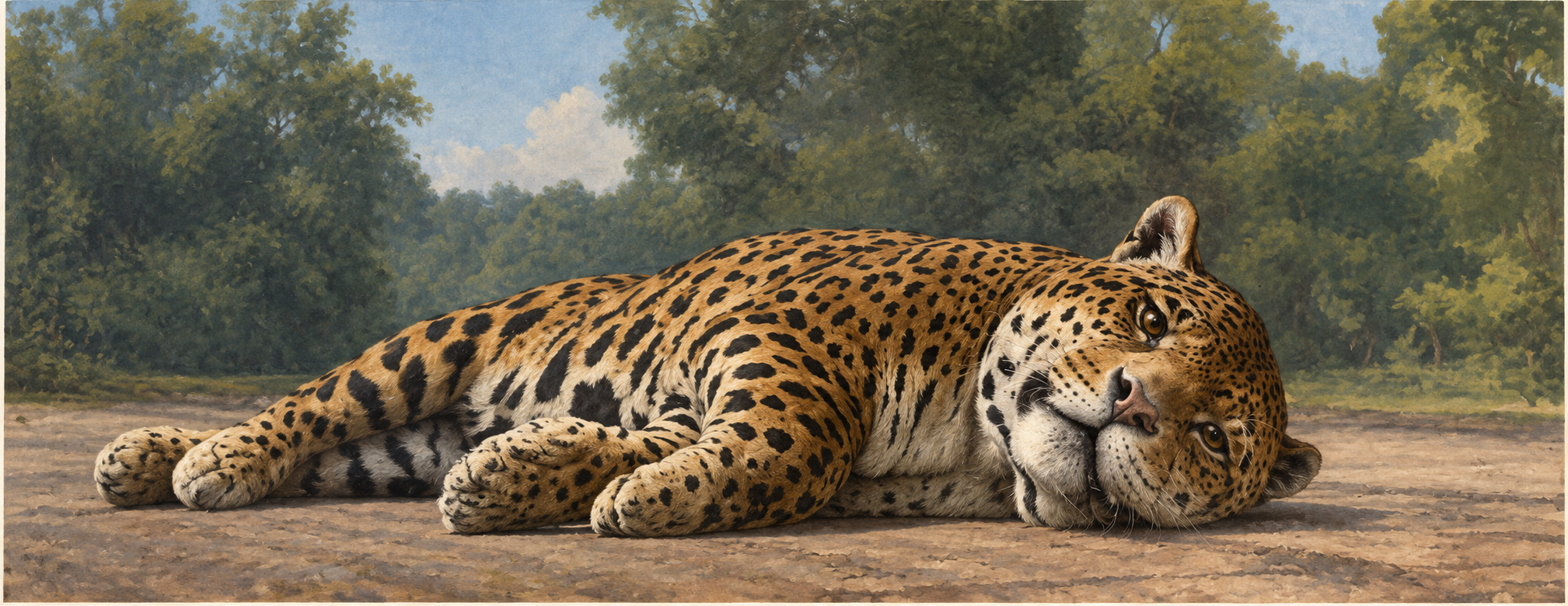
Pltoto by U. W. Wtison On C'o., Ltd.\ JAGUAB. The largest and strongest of the Cats of the Kew World. A South American species.
THE NEW WORLD CATS.
THE cats, great and small, of the New World resemble those of the Old, though not quite so closely as the caribou, wapiti deer, and moose of the northern forests resemble the reindeer. red deer, and elk of Europe. They are like, but with a difference. The Jaguar and the Ocelot are respectively larger and far more beautiful than their counterparts, the leopard and isserval cats. Bat the Puma, the one medium-sized feline animal which is unspotted, in South America; andsomething unique. The jaguar and puma are found very far south though the jaguar is really a forest animal, it seems to have wandered out on to the Pampas of Argentina, perhaps attracted by the immense numbers of cattle, sheep, and horses on these plains.
THE JAGUAR.
it is formidable, The JAGUAR is as savage as but does not often attack men. Its headquarters are the immense forests running from Central America to Southern Brazil; and as all great forests are little inhabited, the jaguar is seldom encountered by white rnen. By the banks of the great rivers it is semi-aquatic; it swims and climbs with equal ease, and will attack animals on board boats anchored in the rivers. As there are few animal* of great size in these forests, its great strength is not often seen exercised, as is that of the lion; but it is the personification of concentrated force, and its appearance is well worth studying from that point of view. The spots are larger and squarer than in the leopard, the head ponderous, the forearms and feet one mass of muscle, knotted under the velvet skin. On the Amazons it draws its food alike from the highest tree-tops and the river-bed; in the former it catches monkeys in the branches,
Photo Uy Scholastic Photo. Co., Parson's Green. fish in the shallows of the rivers, and scoops out PUJJA. turtles' eggs from the sandbanks. Humboldt, who
A puma in the act of lying down, like a domestic cat. visited these regions when the white population

The Cat Tribe 51 was scarce, declared that 4,000 jaguars were killed annually, and 2,000 skins exported from Ihienos Ayres alone. It was clearly common on the Pampas in his day, and made as great havoc among the cattle and horses as it does to-day.
THE PUMA.
The PUMA is a far more interesting creature. It is found from the mountains in Montana, next the Canadian boundary, to the south of Patagonia. Yankee stories of its ferocity may have some foundation; but the writer believes there is no recorded instance of the northern puma attacking man unprovoked, though in the few places where it now survives it kills cattle-calves and colts. It is relentlessly hunted with dogs, treed, and shot. As to the puma
Photo by Ottomar Anschutz] [Berlin.
FEMALE PUMA.
This shows a puma alert and vigilant, with ears pricked forward.
of the southern plains and central forests, the natives, whether Indians or Gauchos, agree with the belief, steadily handed down from the days of the first Spanish conquest, that the puma is the one wild cat which is naturally friendly to man. The old Spaniards called it amigo del Cristiano (the Christian's friend); and Mr. Hudson, in " The Naturalist in La Plata," gives : " It is notorious that where themuch evidence of this most curious and interesting tendency puma is the only large beast of prey it is perfectly safe for a small child to go out and sleep on the plain. is always at heart a kitten, taking unmeasured delight in its... The puma frolics; and when, as often happens, one lives alone in the desert, it will amuse itself for hours fighting mock battles or playing hide-and-seek with imaginary companions, or lying in wait and putting all its wonderful strategy in practice to capture a passing butterfly." From Azara downwards these stories have been told too often not to be largely true; and in old natural
The Living Animals of the World
histories, whose writers believed the puma was a terrible man-eater, " wonderful they also appear as escapes." One tells how a man put his poncho, or cloak, over his back when crawling up to get a shot at some duck, and felt some-it. He thing heavy on the end of crept from under it, and there was a puma sitting on it, which did not offer to hurt him. As space forbids further quotation from Mr. Hudson's experiences, which should be read, the writer will only add one anecdote which was told him by Mr. Everard im Thurn, C.B., formerly an official in British Guiana. He was going up one of the big rivers in his steam-launch, and gave a passage to an elderly and respectable Cornish miner, who wanted to go up to a gold-mine. The visitor had his meals on the boat, but at night went ashore with the men and
Photo by Ottomar Ansdiiitz] [.Berlin. OCELOT. slung his hammock between two Note the elongated spots, and their arrangement in chains. trees, leaving the cabin to his host. One morning two of the Indian crew brought the miner's hammock on board with a good deal of laughing and talking. Their master asked what the joke was, whereupon, pointing to the trees whence last night." Theythey had unslung the hammock, one said, "Tiger sleep with old man were quite in earnest, and pointed out a hollow and marks on the leaves, which showed that if he had noticeda puma had been lying just under the man's hammock. When asked anything in the night, he said, " Only the frogs croaking wakened me up." The croaking of the frogs was probably the hoarse purring of the friendly puma enjoying his proximity to a sleeping man. Mr. Hudson quotes a case in which four pumas played round and leapt over a
! for some time, and then went to sleepperson camping out on the Pampas. He watched them Many of those brought to this country come with their tempers ruined by ill-treatment and hardship; but a large proportion are as tame as cats. Captain Marshall had one at Marlow which used to follow him on a chain and watch the boats full of pleasure-seekers at the lock. is always a beautiful creature, the fur cinnamon-coloured, tinged with gold; the The puma belly and chest white; the tail long, full, and round. Though friendly to man, it is a desperate cattle-killer, and particularly fond of horse-flesh, so much so that it has been suggested that the indigenous wild horses of America were destroyed by the puma.
There are two other cats of the Pampas the GRASS-CAT, not unlike our wild cat in appearance and habits, and the WOOD-CAT, or Geoffrey's.Cat. It is a tabby, and a most elegant creature, of which there is a specimen, at the time of writing, in the London Zoo.