Beyond Earth: The Making of Deep-Space Exploration, 1958-2016
Beyond Earth: The Making of Deep-Space Exploration, 1958-2016
Asif A. Siddiqi presents deep-space exploration as a cumulative human enterprise: spacecraft gradually became better at leaving Earth, reaching other worlds, surviving hostile environments, returning data, and working together across national boundaries. The book’s value lies not only in the discoveries, but in showing how engineering setbacks, institutional choices, and persistent operations made those discoveries possible.[1][2]
The Book’s Central Argument
The chronicle is primarily a history of missions and capabilities rather than a catalogue of scientific results. Siddiqi emphasizes launches, trajectory changes, orbital insertion, atmospheric entry, landing, surface operations, communications, and mission recovery, stating that the focus is on “what happened rather than what was discovered.”[3]
This approach reveals exploration as an engineering system. Launch vehicles, guidance, power, thermal control, software, instruments, communications, and human operations had to work together, often across enormous distances and with little opportunity for repair. A failure in one apparently minor component could determine whether an entire mission succeeded, partially succeeded, or failed.[4][5]
- Capability accumulated over time. Later achievements depended on earlier tests of propulsion, navigation, communications, instruments, and mission operations.
- Failure produced knowledge. Probes that missed their targets or failed during launch could still return scientific data, validate equipment, or expose weaknesses in design.[6][7]
- Robots became humanity’s advance agents. Robotic spacecraft carried instruments, cameras, samplers, and vehicles to places humans could not yet reach safely or practically.
- Science and geopolitics were connected. Early missions were shaped by American-Soviet rivalry, while later exploration increasingly depended on multinational partnerships.[8]
- Exploration changed the meaning of a world. Objects once viewed as points of light became mapped landscapes, atmospheres, geological systems, moons, comets, asteroids, and possible habitats.
From Escaping Earth to Reaching the Moon
Between 1958 and 1962, the first challenge was transportation itself. Launchers, upper stages, attitude control, telemetry, and deep-space tracking were still experimental, and many probes failed before reaching Earth orbit or escape velocity. The successful missions established the basic possibility of deep-space operations.[9][10]
| Mission | Historical significance |
|---|---|
| Luna 1 | First probe to reach escape velocity and enter solar orbit.[11] |
| Luna 2 | First human-made object to impact another celestial body.[12] |
| Luna 3 | Returned the first photographs of the Moon’s far side.[13] |
| Mariner II | Became the first fully successful interplanetary mission and returned data from Venus.[14] |
The period also demonstrates why partial success mattered. Pioneer III missed the Moon but returned radiation measurements that helped define Earth’s Van Allen belts. Its result did not satisfy the headline objective, yet it contributed to the knowledge and technical base needed for later missions.[15]
From Reconnaissance to Fieldwork
From 1964 to 1970, spacecraft moved beyond brief encounters. They began taking close images, landing on other worlds, transmitting from hostile surfaces, collecting samples, and moving across another celestial body. This was a decisive change: other worlds became places where instruments could perform sustained work rather than distant targets seen only during a flyby.[16][17][18]
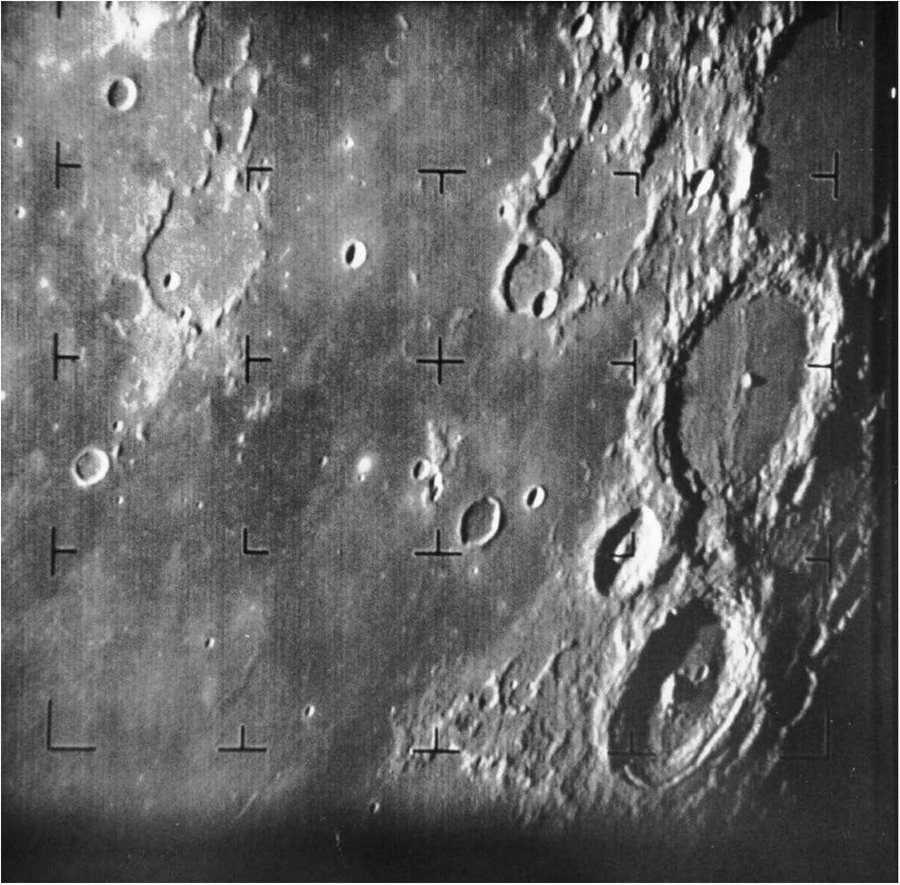
- Mariner IV returned the first close photographs of Mars, replacing romantic ideas about an inhabited or civilization-bearing planet with direct evidence of a stark, cratered world.[19][20]
- Luna 9 and Surveyor I achieved survivable soft landings on the Moon.[21]
- Venera 7 transmitted data from the surface of Venus.[22]
- Luna 16 returned lunar soil to Earth, while Lunokhod 1 became the first wheeled vehicle on another celestial body.[23]
Planetary Systems Come into View
During the 1970s, exploration matured from isolated encounters into planetary-system investigations. Orbiters mapped entire worlds, landers conducted surface experiments, rovers extended mobility, and solar-monitoring spacecraft studied environments far from Earth.[24][25]
Mariner 9’s orbit around Mars was especially important. Its observations revealed volcanoes, vast canyons, and evidence of geological activity, showing that Mars was not simply a Moon-like body. Pioneer 10 and 11 crossed the asteroid belt and explored Jupiter and Saturn, while Viking combined Mars orbiters and landers with biological experiments. Helios 1 and 2 expanded the study of the near-Sun environment.[26][27]
The Voyager missions extended this logic to the outer Solar System. Gravity assists, in which a spacecraft gains or redirects momentum during a close planetary encounter, enabled Voyager 2 to continue from Jupiter to Saturn, Uranus, and Neptune. Together, the Voyagers transformed knowledge of the outer planets, their moons, and their rings.[28][29]
Cooperation, Longevity, and Adaptation
The exploration enterprise became increasingly networked. Orbiters relayed data for landers and rovers, multiple spacecraft observed the same events, and agencies coordinated instruments, tracking, launches, and scientific analysis. The 1985-1986 Halley missions showed how international cooperation could work in practice: Soviet Vega spacecraft, Japan’s Sakigake and Suisei, and ESA’s Giotto contributed to a coordinated comet investigation, with Giotto benefiting partly from tracking data supplied by Vega.[30][31][32][33]
Mission duration also became a major source of scientific return. Pioneer VI operated for about twenty years despite a planned six-month lifetime, Ulysses worked for more than four times its design life, and Mars rovers designed for roughly three months continued operating for years. These extended missions were not merely lucky bonuses: they became important ways to increase the scientific value of existing hardware.[34][35][36]
Adaptability was equally important. Missions such as ISEE-3, Dawn, Deep Impact, and the repurposed THEMIS satellites were redesigned after launch, sometimes turning an original project into a longer or substantially different investigation. Backup systems, alternate trajectories, and improvised operating modes repeatedly helped recover useful science after failures.[37][38][39][40]
The 1990s to 2016: Precision and Habitability
From the 1990s onward, exploration diversified. Smaller and more focused missions, including Discovery-class projects, operated alongside major international programs. Spacecraft increasingly combined high-resolution mapping, atmospheric chemistry, autonomous navigation, electric propulsion, sample return, and targeted searches for water and habitable conditions.[41][42][43][44]
| Period | Representative developments | Broader significance |
|---|---|---|
| 1990-2000 | Ulysses studied the Sun’s polar regions; Galileo reached Jupiter; NEAR Shoemaker orbited and landed on Eros; Mars Pathfinder deployed Sojourner; Mars Global Surveyor mapped Mars; Lunar Prospector found evidence consistent with polar water ice; and Stardust began comet sample return.[45] | Exploration expanded to small bodies, solar-terrestrial science, surface mobility, and sample-return preparation. |
| 2001-2010 | Mars Odyssey mapped minerals and subsurface hydrogen; Cassini-Huygens explored Saturn and landed on Titan; Spirit and Opportunity investigated past water activity; Rosetta began its comet rendezvous; Hayabusa returned asteroid particles; SMART-1 demonstrated solar-electric propulsion; and LCROSS confirmed water at the lunar south pole.[46] | The emphasis shifted toward water, chemistry, planetary evolution, and habitability. |
| 2011-2016 | Juno entered Jupiter orbit; Curiosity investigated Gale Crater; MESSENGER completed the first orbital survey of Mercury; Dawn orbited Vesta and Ceres; New Horizons revealed Pluto’s complex geology; Mangalyaan reached Mars orbit; Chang’e 2 visited an Earth-Moon L2 orbit and an asteroid; Rosetta orbited and landed on a comet; and OSIRIS-REx began its asteroid sample-return mission.[47][48] | Deep-space exploration became a global enterprise focused on complex worlds, small bodies, planetary history, and the origins of the Solar System. |
Key Lessons and Lasting Insights
- Exploration is not risk-free, but it can become more resilient. Progress came from accepting risk, learning from failures, and building systems with redundancy and recovery options.[49][50]
- Direct measurement revises imagination. Mariner IV changed perceptions of Mars, while later missions replaced broad speculation with evidence about water, climate, geology, atmospheric chemistry, and possible habitability.[51][52]
- The field moved from national firsts to shared infrastructure. The early Space Race gave way to partnerships in which agencies contributed spacecraft, instruments, launch services, tracking, or scientific expertise.[53][54]
- Mission success is broader than the original objective. A probe may fail to reach its target yet still return useful measurements, validate technology, or guide a successor mission.[55][56]
- Exploration has both technical and cultural consequences. Spacecraft became durable human artifacts in the Solar System, while their images, names, messages, student projects, and public participation expanded humanity’s sense of place.[57][58]
Conclusion
Taken as a whole, Beyond Earth describes a transformation from experimental attempts to escape Earth into a durable, multinational system for investigating the Solar System. The progression ran from impacts and flybys to orbiters, landers, rovers, sample-return vehicles, gravity-assist trajectories, Lagrange-point operations, and coordinated spacecraft networks.[59][60][61]
The deepest lesson is that exploration advanced through persistence rather than a smooth sequence of victories. By 2016, its achievements rested on accumulated engineering knowledge, extended mission operations, institutional learning, and international cooperation. The result was not simply a larger map of space, but a more capable and more evidence-based understanding of planetary environments, habitability, the Sun, and the origins of the Solar System.[62][63][64]
Create your account to keep this answer and continue from it later.
Let's look at alternatives:
- Modify the query.
- Start a new thread.
- Remove sources (if manually added).