Discover Pandipedia
A growing directory of useful answers selected by the Pandi community. Search the collection or browse the latest discoveries.
3439 entries available
LLM?

LLM stands for Large Language Model, which is a type of AI model. Here's a breakdown of what LLMs are and how they're used, according to the provided sources:
* LLMs are prediction engines that take sequential text as input and predict the subsequent token based on their training data[2].
* They are tuned to follow instructions and have been trained on vast datasets, enabling them to comprehend prompts and generate responses[2].
* LLMs can be used for understanding and generation tasks like text summarization, information extraction, question answering, text classification, language or code translation, code generation, and code documentation or reasoning[2].
* LLMs can understand complex inputs, engage in reasoning and planning, use tools reliably, and recover from errors[1].
* They dynamically direct their own processes and tool usage, maintaining control over how they accomplish tasks[1].
* When using reasoning, to come up with the final answer, there’s likely one single correct answer. Therefore the temperature should always set to 0[2].
* They’re becoming increasingly capable of handling complex, multi-step tasks[3]. Advances in reasoning, multimodality, and tool use have unlocked a new category of LLM-powered systems known as agents[3].
* AI agents: Are engineered to achieve specific objectives by perceiving their environment and strategically acting upon it using the tools at their disposal[4]. The fundamental principle of an agent lies in its synthesis of reasoning, logic, and access to external information[4].
* Key component of AI agents: The model, which pertains to the language model (LM) that functions as the central decision-making unit, employing instruction-based reasoning and logical frameworks[4].
* A key enabler of AI applications where systems can reason through ambiguity, take action across tools, and handle multi-step tasks with a high degree of autonomy[3].
* Can be used in systems where LLMs and tools are orchestrated through predefined code paths[1].
* Can be used in systems where LLMs dynamically direct their own processes and tool usage, maintaining control over how they accomplish tasks[1].
Let's look at alternatives:
- Modify the query.
- Start a new thread.
- Remove sources (if manually added).
Top-K sampling?
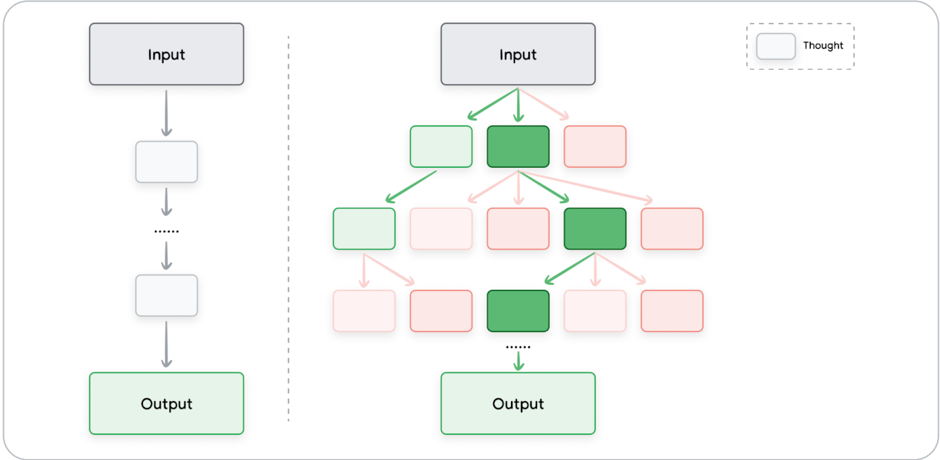
Top-K is a sampling setting used in Large Language Models (LLMs) to restrict the predicted next token to come from tokens with the top predicted probabilities[1]. Like temperature, Top-K controls the randomness and diversity of generated text[1].
Top-K sampling selects the top K most likely tokens from the model’s predicted distribution[1]. The higher the Top-K, the more creative and varied the model’s output; the lower the Top-K, the more restrictive and factual the model’s output[1]. A Top-K of 1 is equivalent to greedy decoding[1].
If temperature, top-K, and top-P are all available, tokens that meet both the top-K and top-P criteria are candidates for the next predicted token, and then temperature is applied to sample from the tokens that passed the top-K and top-P criteria[1]. If only top-K or top-P is available, the behavior is the same, but only the one top-K or P setting is used[1].
If temperature is not available, whatever tokens meet the top-K and/or top-P criteria are then randomly selected from to produce a single next predicted token[1].
If you set temperature to 0, top-K and top-P become irrelevant–the most probable token becomes the next token predicted[1]. If you set temperature extremely high (above 1–generally into the 10s), temperature becomes irrelevant and whatever tokens make it through the top-K and/or top-P criteria are then randomly sampled to choose a next predicted token[1].
If you set top-K to 1, temperature and top-P become irrelevant[1]. Only one token passes the top-K criteria, and that token is the next predicted token[1]. If you set top-K extremely high, like to the size of the LLM’s vocabulary, any token with a non-zero probability of being the next token will meet the top-K criteria, and none are selected out[1].
Let's look at alternatives:
- Modify the query.
- Start a new thread.
- Remove sources (if manually added).
Create your account to shape this feed around what you search for and enjoy.
Comprehensive Report on Generative AI Applications and Effective Agent Design
Generative AI in the Real World
Recent developments in generative artificial intelligence have led to a rapid increase in real-world implementations across industries. As highlighted in one extensive overview, nearly 101 use cases were detailed just over a year ago, and that number has since grown by six times, reflecting the broad reach of AI applications in today’s digital enterprise landscape[1]. Companies ranging in size and sector are now integrating generative AI to improve operational efficiencies, enhance customer experiences, and drive innovation in products and services. This upward trend demonstrates how advanced models such as Gemini, Imagen, and Veo are being transitioned from proof-of-concept experiments to mission-critical solutions in several fields.
Industry Adoption and Practical Examples


The use cases span a wide array of sectors, including retail, finance, healthcare, law, transportation, and more. In retail, companies such as Wendy’s, Papa John’s Pizza, and Uber are leveraging predictive AI tools to manage orders and improve customer service, whether through drive-thru optimizations or app-based ordering systems[1]. In the automotive sector, major players like Mercedes Benz and General Motors have enhanced in-vehicle services, while Samsung has introduced responsive features in its latest phones and home robots. Financial institutions—such as Citi, Deutsche Bank, and Intesa Sanpaolo—are using these innovative solutions not only for fraud detection but also to monitor markets faster and provide new, secure services. The diverse examples also cover areas such as legal document analysis, internal employee productivity improvements through AI-assisted tools in Google Workspace, and even real-time supply chain and inventory management seen in retail and logistics applications[1]. Each instance underscores the goal of reducing manual, repetitive tasks and supporting faster, data-driven decision-making.
Concepts Behind AI Agents

Beyond the broad adoption of generative AI across industries, another crucial development is the design and implementation of AI agents. These agents, powered by large language models (LLMs), have evolved from simple automated responses to sophisticated systems that can dynamically direct their own processes. According to insights from Anthropic, an 'agent' can be defined in various ways. Some implementations are fully autonomous, operating independently to accomplish complex tasks over extended periods, while others function as part of more prescriptive workflows that follow predefined steps[2]. The key idea is that effective AI agents leverage advanced capabilities such as tool integration, retrieval, and memory to generate search queries, select the right tools, and decide what information to retain. This ability allows AI agents not only to process complex inputs but also to interact with external systems in a feedback-driven loop, ensuring that their actions are grounded in real-world results.
Architectural Patterns and Workflow Strategies


Anthropic’s detailed discussion further breaks down agent architectures into several fundamental patterns. One basic pattern is prompt chaining, where a complex task is decomposed into a sequence of simpler steps, each handled by a separate LLM call. This sequential approach is particularly useful for tasks that can be neatly segmented—such as generating marketing copy that is then translated into another language[2]. Another strategy discussed is routing, where incoming tasks are classified and directed to specialized downstream processes. This allows for more tailored responses, as different types of customer queries or technical issues might be optimally resolved by distinct specialized models or workflows[2]. Additionally, parallelization offers methods like voting, where multiple model outputs are generated in parallel and then aggregated to increase accuracy. More dynamic strategies include orchestrator-workers designs, common in complex tasks such as multi-file code changes or comprehensive search operations. There is also the evaluator-optimizer workflow in which one LLM produces an answer, and another provides iterative feedback for refinement. These patterns illustrate that the level of complexity—from simple one-turn implementations to multi-step autonomous agents—should align with the specific requirements of the use case[2].
Best Practices for Designing Effective AI Agents


When developing AI agents, several best practices have emerged. Both sources emphasize starting with simple solutions and progressing to more complex, agentic systems only when necessary. It is advised that developers initially use LLM APIs in a straightforward manner and only adopt additional frameworks if the situation demands extra functionality. While frameworks like Vellum may simplify some low-level tasks—such as orchestrating LLM calls or managing tool definitions—they can also obscure the underlying interactions, making debug efforts more challenging[2]. As a result, understanding the underlying code and prompt engineering techniques is crucial. Developers are encouraged to define clear interfaces for tool usage, provide ample examples within tool documentation, and iterate on tool design to minimize errors, such as ensuring proper formatting and avoiding issues with relative file paths[2]. These careful design considerations help create agent-computer interfaces that are both intuitive and highly effective. Ultimately, the goal is to achieve a balance between the autonomy of the agent and the necessary oversight to avoid compounding errors, thereby ensuring reliability and cost-effectiveness in production environments[1][2].
Let's look at alternatives:
- Modify the query.
- Start a new thread.
- Remove sources (if manually added).
Generate a short, engaging audio clip from the provided text. First, summarize the main idea in one or two sentences, making sure it's clear and easy to understand. Next, highlight one or two interesting details or facts, presenting them in a conversational and engaging tone. Finally, end with a thought-provoking question or a fun fact to spark curiosity!
Transcript
Want to make the most of AI but not sure where to start? Think of AI as your super-assistant that never gets tired. It can take on repetitive tasks, resolve skill bottlenecks, and navigate tricky situations. Instead of approaching a large problem all at once, break it down into manageable pieces. For example, use it to generate first drafts or summarize information. What could a super-assistant do for you?
Let's look at alternatives:
- Modify the query.
- Start a new thread.
- Remove sources (if manually added).
Lighthouse Engineering
Let's look at alternatives:
- Modify the query.
- Start a new thread.
- Remove sources (if manually added).
Life as a Light-keeper

You have, for a season, left the society of your families and friends, to perform a work of high interest to your country and to mankindRev. Walter Traill[1]

Let us remember, that all the affairs of men are dependent on Providence . We may exert talents and industry, but GOD only can bless our exertions with successRev. Walter Traill[1]

The mariner may now navigate those regions with a degree of security and confidence quite unknown to Your Majesty's Royal Ancestor JAMES THE FIFTHRobert Stevenson[1]

The seamen are not only directed to be lodged in the best manner that the circumstances ofthe case will admit, but, in necessitous cases, ship-wrecked mariners have even been allowed a sum of moneyUnknown[1]

From the comparative level of the site ofthe Building ascertained . Full complement of Buoys moored . Floating -light rides out a strong galeUnknown[1]
Let's look at alternatives:
- Modify the query.
- Start a new thread.
- Remove sources (if manually added).
Create your account to shape this feed around what you search for and enjoy.
Generate a short, engaging audio clip from the provided text. First, summarize the main idea in one or two sentences, making sure it's clear and easy to understand. Next, highlight one or two interesting details or facts, presenting them in a conversational and engaging tone. Finally, end with a thought-provoking question or a fun fact to spark curiosity!
Transcript
Ever heard of the Bell Rock Lighthouse? It's an incredible story of Scottish maritime engineering! This lighthouse stands on a dangerous reef about eleven miles from the shore on Scotland's eastern coast. Mariners once greatly feared this location, especially when approaching the Friths of Forth and Tay. But do you know what they originally called it? It was known as the 'Inch Cape', or the island of the Cape, a nautical term linking it to the nearby Red Head. But here's a fun fact: The tradition says that an Abbot of Aberbrothock installed a bell on the rock, connected to a floating device that warned sailors; talk about an early alarm system! What innovative methods would engineers devise today to tackle such maritime challenges?
Let's look at alternatives:
- Modify the query.
- Start a new thread.
- Remove sources (if manually added).
Lighthouse architecture
Let's look at alternatives:
- Modify the query.
- Start a new thread.
- Remove sources (if manually added).
Lighthouse illumination
Let's look at alternatives:
- Modify the query.
- Start a new thread.
- Remove sources (if manually added).
ColPali: Efficient Document Retrieval with Vision Language Models

Introduction
Document retrieval systems have evolved significantly, aiming to efficiently match user queries with relevant documents. Recent advancements introduce Vision Language Models (VLMs) that leverage visual and textual information, enhancing the ability to interact with complex documents. This report summarizes the key findings and methodologies from the recent paper 'ColPaLi: Efficient Document Retrieval with Vision Language Models'[1].
Document Retrieval Challenges
Documents often contain rich visual structures that convey information through various formats such as tables, figures, and layouts. Traditional text-based document retrieval systems struggle to capture this visual information effectively. The paper highlights that while modern systems demonstrate strong performance on query-to-text matching, they often fail to leverage the practical aspects of visual document retrieval, which can limit their effectiveness in many applications, including Retrieval-Augmented Generation (RAG) tasks[1].
Introduction of ColPaLi
To address the shortcomings of existing methods, the authors of the paper propose ColPaLi, a novel architectural framework designed specifically for visual document retrieval. This system utilizes a Visual Document Retrieval Benchmark called ViDoRe, which is comprised of various page-level retrieval tasks across multiple domains and languages. The introduction of this benchmark enables the evaluation of retrieval systems based on both visual and textual features[1].
ColPaLi integrates the capabilities of VLMs to enhance document understanding. Unlike previous models that primarily focused on text, ColPaLi recognizes the importance of visual elements, allowing it to retrieve documents more effectively based on user queries that may include visual contexts[1].
Comparing ColPaLi to Standard Retrieval Methods

ColPaLi outperforms standard retrieval models significantly. The research shows that its integration of visual layouts and use of a specialized framework lead to improved performance metrics, including NDCG (Normalized Discounted Cumulative Gain) and query processing speeds. For instance, while traditional methods typically exhibit slower latencies due to the need for extensive preprocessing and matching, ColPaLi achieves superior performance with a reduced time of around 0.39 seconds per page, as opposed to standard models that take significantly longer[1].
Methodology and Results
The authors conducted a thorough evaluation across multiple benchmarks to compare ColPaLi with other existing systems. The benchmarks focused on various domains including scientific and industrial documents. Results showed that ColPaLi achieved a considerable NDCG improvement, indicating its capability to retrieve more relevant documents in response to complex queries that incorporate visual data[1].
Notably, the paper details a series of experiments that underscored the efficiency of the late interaction mechanism employed in ColPaLi, which allows it to compute similarity scores between user queries and documents in a more streamlined manner. This results in faster retrieval times and a higher accuracy in matching relevant visual and textual elements[1].
Vision Language Models in Retrieval
The key innovation of ColPaLi lies in its use of Vision Language Models, which combine the strengths of visual data processing with language understanding. This fusion is made possible through advanced techniques in embedding vectors that integrate visual features alongside text embeddings. The model was shown to be adaptable across languages and capable of handling rich visual inputs, enhancing its utility in practical settings[1].
Furthermore, the evaluation methodology consisted of various practical industrial scenarios, demonstrating ColPaLi’s robustness in real-world applications where users may query complex visual documents. This aspect is crucial for industries that rely on accurate and efficient document management systems[1].
Conclusion

ColPaLi represents a significant advancement in document retrieval systems, particularly in contexts where visual information is critical. By leveraging Vision Language Models and introducing a novel benchmark like ViDoRe, the framework not only enhances retrieval effectiveness but also streamlines the process by reducing latencies associated with traditional document processing methods. This paper paves the way for future research that could further optimize retrieval systems by integrating greater visual comprehension capabilities, thus revealing the potential of VLMs in the field of information retrieval[1].
Let's look at alternatives:
- Modify the query.
- Start a new thread.
- Remove sources (if manually added).