Discover Pandipedia
A growing directory of useful answers selected by the Pandi community. Search the collection or browse the latest discoveries.
2272 entries available

How does Google customize search results?

Google customizes search results through various methods that consider user context, such as search history, location, and device type. For instance, if you frequently search for specific topics, Google prioritizes similar content in future searches, tailoring results to reflect your interests and past activities[2][4]. Additionally, Google analyzes factors like content quality and usability, meaning relevant content loaded swiftly on mobile devices will perform better[3][5].
These algorithms also account for the intent behind a query, using advanced language models to connect search terms to the most appropriate content, while ensuring freshness for trending topics[3][5]. Ultimately, personalization aims to enhance the relevance of search results for individual users[1][2].
Let's look at alternatives:
- Modify the query.
- Start a new thread.
- Remove sources (if manually added).
The Immortal Jellyfish: An Exploration into Turritopsis dohrnii
The Immortal Jellyfish: An Exploration into Turritopsis dohrnii
Introduction
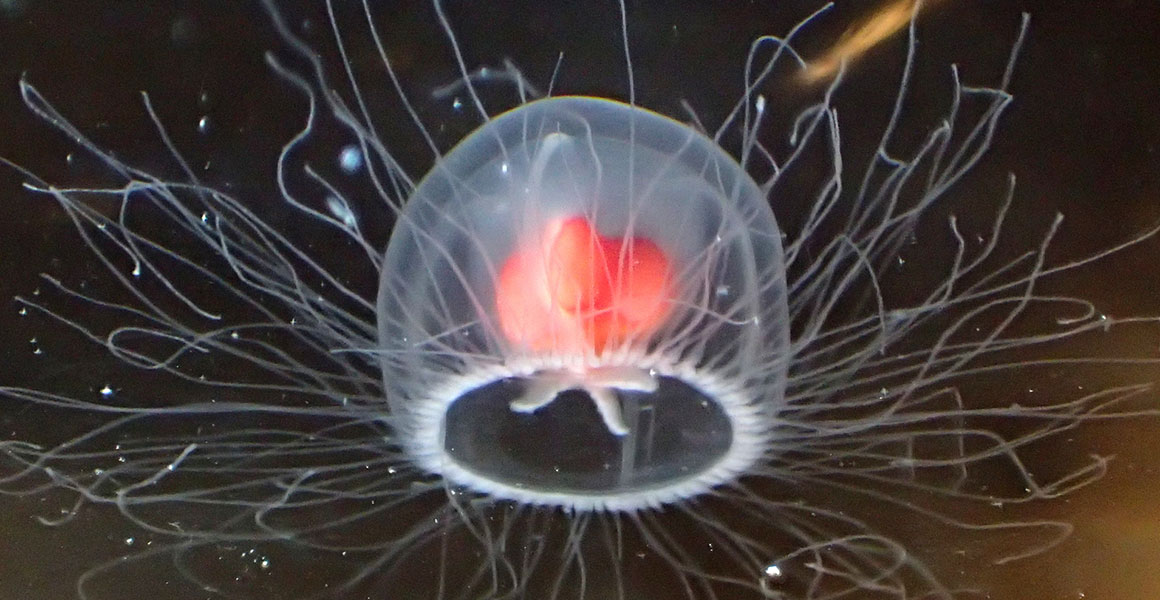
Turritopsis dohrnii, commonly known as the immortal jellyfish, has captivated scientists and the public alike with its remarkable ability to essentially reverse its aging process and escape death under certain conditions. This comprehensive report delves into the lifecycle, the mechanism behind its immortality, scientific studies, and the potential implications of this fascinating organism.
Lifecycle of Turritopsis dohrnii
Early Stages
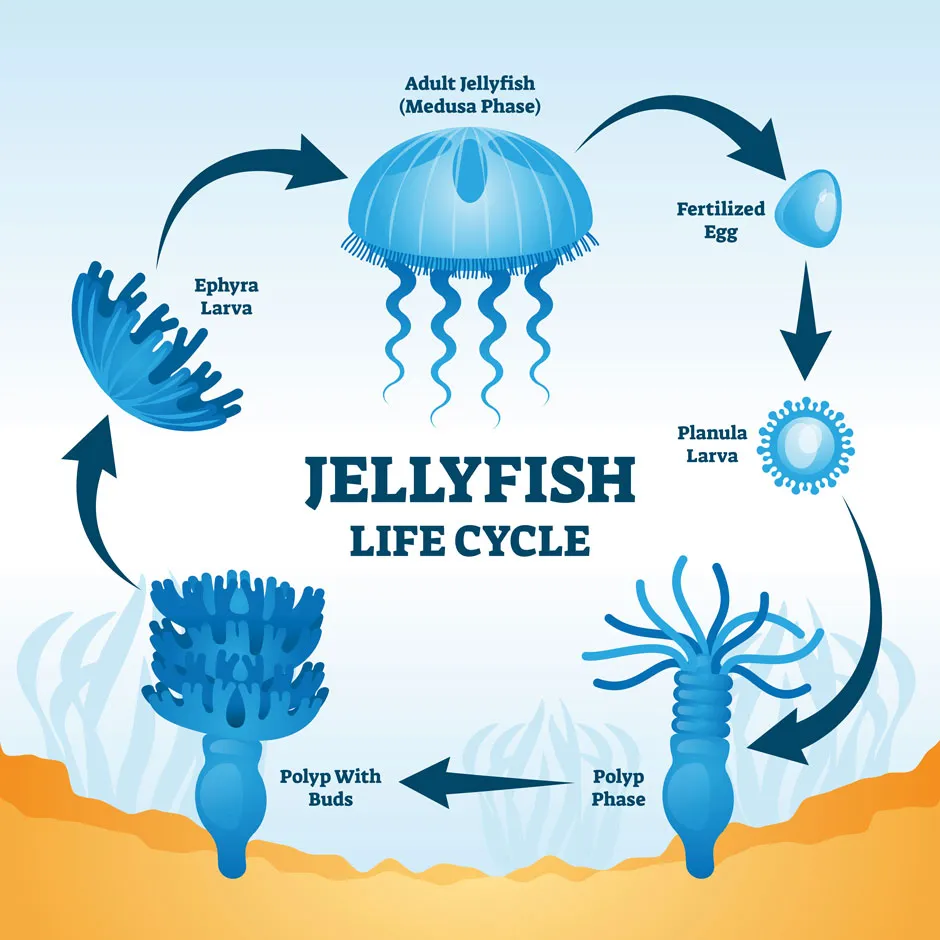
The lifecycle of Turritopsis dohrnii begins similarly to other jellyfish species. The process starts with a fertilized egg from which emerges a small larva called a planula. The planula swims freely until it finds a hard surface on the ocean floor[1][2][6].
Polyp Stage
Once settled, the planula develops into a polyp, a stationary life stage that attaches to the substrate and can reproduce asexually to form a colony[1][2][6]. The polyps bud off into a stage called ephyra, which eventually grows into an adult jellyfish or medusa[1][2].
Medusa Stage
The medusa is the free-swimming, sexually mature form most people recognize as a jellyfish. Medusae can reproduce sexually, generating eggs and sperm that combine to start the lifecycle anew[1][2][6].
Mechanism Behind Immortality
Transdifferentiation
The immortal jellyfish can reverse its lifecycle through a process known as transdifferentiation. When faced with environmental stressors, physical damage, or old age, the medusa transforms back into its earlier polyp stage instead of dying. This involves the deterioration of the jellyfish's bell and tentacles and the reformation into polyp cells[1][2][8][10].
Transdifferentiation allows specialized adult cells to revert to a more primitive state and then transform into different types of cells. This process ultimately enables the jellyfish to start its lifecycle over again[3][4][8][10].
Scientific Discoveries
The phenomenon was first observed in the 1980s by scientists Christian Sommer and Giorgio Bavestrello, who noticed that T. dohrnii medusae could revert to polyps without undergoing fertilization or larval stages[1][3]. Subsequent studies by scientists like Ferdinando Boero and Shin Kubota confirmed and expanded upon these findings, establishing the jellyfish’s unique biological characteristics[3][6][8].
Genetic Insights and Ongoing Research
Genetic Studies
Recent research efforts have focused on understanding the genetic underpinnings of Turritopsis dohrnii’s immortality. Scientists at the University of Oviedo in Spain sequenced the jellyfish's genome and identified specific genes involved in DNA replication, repair, and stem cell renewal. These genes become particularly active during the jellyfish's transdifferentiation process[7][9][10].
One significant finding is that the immortal jellyfish has double copies of genes associated with DNA repair and protection, which may provide it with enhanced regenerative abilities. The species also possesses unique mutations that help to maintain telomere integrity, further contributing to its longevity[9][10].
Implications for Human Aging

While the exact mechanisms remain a mystery and practical applications are still far from realization, the study of T. dohrnii offers promising insights into cellular regeneration and aging. Understanding how these jellyfish manage to regenerate their cells could lead to advancements in treatments for age-related diseases, cancer, and other medical conditions involving tissue regeneration and cellular repair[8][9][10].
Distribution and Ecological Impact
Global Spread
Originally discovered in the Mediterranean, Turritopsis dohrnii has since been found in temperate to tropical waters worldwide. This spread is believed to be facilitated by human activities, such as the discharge of ballast water from ships[1][6][8].
Invasive Species Concerns

Despite their fascinating biological properties, T. dohrnii is considered a 'silent invader' due to their tiny size and the lack of noticeable ecological impact compared to other invasive species[1][7]. Their spread has gone largely unnoticed, offering a reminder of the often unseen ways human activities can alter natural ecosystems[1][6][7][10].
Challenges in Research
Difficulty in Cultivation
Maintaining Turritopsis dohrnii in captivity poses significant challenges. Only a few researchers, like Shin Kubota, have managed to sustain colonies of these jellyfish for prolonged periods, highlighting the difficulty in studying them continuously under controlled conditions[1][6][8].
Overcoming Skepticism
Initial skepticism greeted reports of the jellyfish's transdifferentiation capabilities. However, repeated experiments by multiple researchers have validated these findings, though the mystery behind the exact molecular mechanisms of this process remains unresolved[3][8].
Conclusion
Turritopsis dohrnii, the immortal jellyfish, represents one of nature's most intriguing phenomena. Through the process of transdifferentiation, it can revert to an earlier stage of its lifecycle, offering compelling possibilities for future research into biological aging and regeneration. While practical applications for human medicine are still distant, ongoing genetic studies promise to unlock further secrets of this fascinating organism. The journey to fully understand T. dohrnii continues, providing both profound scientific insights and a humbling reminder of nature's complexities.
The study of the immortal jellyfish not only highlights the potential for biological immortality but also underscores the importance of biodiversity and the often-overlooked impacts of human activities on natural ecosystems. As research progresses, this tiny, seemingly inconspicuous jellyfish may hold the keys to unlocking new frontiers in science and medicine.
Let's look at alternatives:
- Modify the query.
- Start a new thread.
- Remove sources (if manually added).
What is a healthy work-life balance?

A healthy work-life balance is the ability to effectively manage both professional and personal responsibilities without one overwhelming the other. It is generally characterized by a sense of fulfillment and contentment in both areas of life, allowing individuals to meet work deadlines while still having time for personal relationships, hobbies, and self-care[1][2].
Signs of a healthy work-life balance include not feeling constant conflict between work obligations and personal responsibilities, meeting deadlines without overtime, getting adequate sleep, maintaining a balanced diet, and having time for leisure and family[2]. Additionally, a balanced life allows for flexibility, where individuals can integrate personal tasks into their work schedule without feeling guilty[4].
Achieving this balance requires awareness of one's feelings and priorities, as well as the ability to set boundaries around work commitments[5][6]. Regular reflection on one's situation and ongoing adjustments are crucial, as needs and circumstances change over time[3][6]. Ultimately, a healthy work-life balance is about finding harmony that fits individual goals and priorities, recognizing that both work and personal life can coexist supportively[2][4].
Let's look at alternatives:
- Modify the query.
- Start a new thread.
- Remove sources (if manually added).
Contributions of Self-Supervised Learning to AI
Contributions of Self-Supervised Learning to AI

Self-supervised learning (SSL) has emerged as a transformative approach within the field of artificial intelligence (AI), particularly addressing the challenges associated with labeled data dependencies. This report highlights the essential contributions of SSL and examines its implications for various AI applications.
Reducing Dependency on Labeled Data
One of the primary contributions of self-supervised learning is its ability to significantly reduce the reliance on manual labeling of datasets. Traditional supervised learning methods require vast amounts of labeled data, which can be costly and time-consuming to produce. In contrast, SSL generates implicit labels from unstructured data, leveraging the inherent structures and patterns within the data itself. This innovation has made SSL a game-changer for AI, particularly in sectors where annotated data is scarce or difficult to obtain[2].
Applications in Multiple Domains

The versatility of self-supervised learning is evident across several domains, including computer vision, natural language processing (NLP), and healthcare. In computer vision, SSL techniques can enable models to learn quality representations from unlabeled images. For instance, tasks such as image reconstruction, colorization, and predicting future video frames exemplify how SSL can achieve meaningful insights without explicit supervision. As a result, SSL algorithms can accelerate the development of applications like image classification and object detection[2][1].
In NLP, self-supervised learning has facilitated advancements in language models like BERT and GPT. These models have utilized self-supervised objectives to understand and generate language. BERT, for instance, employs techniques such as Next Sentence Prediction, allowing the model to understand relationships between sentences, hence improving various language comprehension tasks[1]. This self-supervised training has led to significant improvements in tasks such as sentiment analysis, translation, and text generation[2].
Cost-Effective and Time-Efficient Solutions
Self-supervised learning addresses several persistent issues in other learning procedures, most notably the high costs associated with labeled data. By mitigating the need for extensive manual annotation, SSL reduces the financial and time burdens normally imposed by model training, thus enabling faster and more cost-effective development of AI systems[1][2]. This is especially relevant in fields like healthcare, where annotating medical images can be prohibitively expensive. SSL can analyze medical imaging data, facilitating the rapid development of diagnostic tools without the need for extensive labeled datasets.
Bridging Supervised and Unsupervised Learning

SSL serves as a vital link between supervised and unsupervised learning techniques, capturing essential features and relationships within data through cleverly designed pretext tasks. In self-supervised learning, models tackle objectives generated from the data itself, transforming unsupervised tasks into supervised learning problems through the generation of pseudo-labels. These tasks can be creative assignments, predictive tasks, or distinctive learning experiences derived from data augmentations, which teach models to recognize patterns without the need for external labels[2][1].
For example, SSL models can learn to reconstruct images or predict elements of sequences, creating robust embeddings that can later be fine-tuned for specific supervised tasks with small amounts of labeled data. This blend of SSL with supervised learning enhances the efficacy and robustness of models, revealing its potential to boost performance in various applications[2][1].
Enhancements in Model Training and Generalization

Self-supervised learning has been pivotal in enhancing model training and generalization. By pre-training models on large unlabeled datasets, SSL allows for robust feature extraction, which is crucial for subsequent fine-tuning on specific tasks. This two-step training process—first generating strong feature representations and then adapting them for particular uses—results in greater model performance and generalization capabilities across different tasks and domains[1][2].
Scalability and Future Potential
The scalability of self-supervised learning presents significant opportunities for future research and application. As SSL models are trained on vast amounts of unlabeled data, the ambition is to continue pushing the boundaries of what AI systems can learn using fewer resources. Future trends may involve integrating SSL techniques with other methodologies, including reinforcement learning and transfer learning, to create adaptable models capable of learning continuously and responding to dynamic environments with minimal supervision[2][1].
Conclusion
Self-supervised learning has undoubtedly reshaped the landscape of artificial intelligence by providing solutions that alleviate the challenges posed by the necessity of labeled data. Its application across various fields highlights the approach's versatility and efficiency. As research and development continue, SSL is set to play a crucial role in the ongoing evolution and sophistication of AI technologies, promising to unlock new capabilities and improve accessibility in a data-driven world.
Let's look at alternatives:
- Modify the query.
- Start a new thread.
- Remove sources (if manually added).
What was the significance of the Salem Witch Trials?
Transcript
The Salem Witch Trials were significant as they highlighted the dangers of mass hysteria and scapegoating, driven by superstition, political tensions, and social divides. They resulted in the execution of 20 individuals, with over 200 accused, underscoring how quickly baseless accusations can escalate. The aftermath fostered distrust in the judicial system and led to changes in legal practices, such as the presumption of innocence and the necessity of reliable evidence in court.
This event has also served as a cautionary tale against persecution, influencing cultural narratives, including Arthur Miller's 'The Crucible' as an allegory for McCarthyism.
Sources
- Why were the Salem Witch Trials so significant?
- Salem Witch Trials ‑ Events, Facts & Victims
- Salem witch trials | History, Summary, Location, Causes, Victims, & Facts
- Salem Witch Trials, Summary, Facts, Significance
- Salem Witch Trials
- Salem witch trials - Hysteria, Accusations, Executions
- A Brief History of the Salem Witch Trials
- The history of the Salem witch trials
Let's look at alternatives:
- Modify the query.
- Start a new thread.
- Remove sources (if manually added).
Summarize the contribution of- Demir, O.O. (2019). DIGITAL SKILLS, ORGANIZATIONAL BEHAVIOR AND TRANSFORMATION OF HUMAN RESOURCES: A REVIEW.

The study by Demir (2019) reviews the integration of digital technologies in organizations and their impact on employment trends. It identifies major technological trends influencing organizational behavior and highlights the transformation of professional skills needed in various industries. The findings suggest that digitalization is significantly reshaping national economies and industrial practices, ultimately impacting organizational structures and employment dynamics globally[2][3].
Moreover, the research emphasizes the necessity for organizations to adapt to these changes by developing relevant digital skills among employees to maintain competitiveness in the market. The study provides valuable insights into how these developments can enhance human resource management and organizational effectiveness[1][4].
Let's look at alternatives:
- Modify the query.
- Start a new thread.
- Remove sources (if manually added).

What is the Trolly Problem?

According to Wikipedia, “the trolley problem is a series of thought experiments in ethics, psychology, and artificial intelligence involving stylized ethical dilemmas of whether to sacrifice one person to save a larger number”[1]. In its most common form, a runaway trolley is headed toward five people tied to the tracks. You have the option to pull a lever that will divert the trolley onto an alternate track—where only one person is in harm’s way—raising the question of whether it is acceptable to actively cause one person’s death in order to save five.
Philosophyterms puts it simply: “Picture a big, heavy trolley … rolling quickly on train tracks. Ahead, there are five people tied up, and if you pull the lever the trolley will switch tracks to hit one person instead”[2]. This contrast forces us to decide between doing something that directly causes harm or not interfering, even though doing nothing results in more deaths.
Britannica adds that the problem “has been used to explore the validity and range of application of the doctrine of double effect and the distinction between doing harm and allowing harm”[3]. In other words, it challenges us to consider whether the moral choice should be judged solely by the outcome (saving more lives) or by the nature of the act itself (the act of deliberately causing harm).
Merriam-Webster explains that the trolley problem “illustrates a trade-off between what is good and what sacrifices are 'acceptable,' if at all”[4]. Philosophers have used various versions of the dilemma—not only the basic switch scenario, but also cases such as pushing a person from a footbridge to stop the trolley—in order to compare utilitarian views (which stress the greatest good for the greatest number) with deontological views (which hold that some actions are inherently wrong regardless of the outcome)[5][6].
Howstuffworks and ThoughtCo clarify that the trolley problem is not merely an abstract puzzle. It provides practical insight into how we make moral choices under pressure and helps inform modern debates—for example, those surrounding the programming of autonomous vehicles when accidents are unavoidable[7][8].
In summary, the trolley problem asks: Is it more morally acceptable to actively intervene and cause one death to prevent five deaths, or to refrain from intervening and allow more harm to occur? This thought experiment continues to be a central issue in both academic moral philosophy and real-world applications such as ethical decision-making in technology[9][10][11].
Let's look at alternatives:
- Modify the query.
- Start a new thread.
- Remove sources (if manually added).
What powers artificial intelligence?

Artificial intelligence (AI) is powered by several key technologies and concepts. At its core, AI utilizes machine learning and deep learning technologies, which involve training algorithms to make predictions or decisions based on data. These algorithms learn from the data using various techniques, such as supervised learning, unsupervised learning, and reinforcement learning[5][6].
Machine learning involves creating models by training an algorithm on data to enable computers to learn from and make decisions without being explicitly programmed for tasks. This includes algorithms like neural networks, which are modeled after the human brain's structure and process complex data[5][6]. Neural networks are especially effective in recognizing patterns and relationships in large datasets.
Deep learning, a subset of machine learning, uses multilayered neural networks called deep neural networks. These networks automate feature extraction from large datasets, enabling machines to learn from unstructured data and make accurate predictions[5][6].
Additionally, artificial intelligence systems incorporate technologies for natural language processing (NLP) and computer vision, allowing machines to understand and respond to human language and identify objects in images and videos[5].
Overall, the development of AI relies on combining these technologies to enable systems to simulate human learning, comprehension, problem-solving, decision-making, and creativity[5][6].
Let's look at alternatives:
- Modify the query.
- Start a new thread.
- Remove sources (if manually added).
How was sleep in the middle ages?
Historical Overview of Sleep Patterns

In the Middle Ages, sleep was commonly divided into two segments known as 'first sleep' and 'second sleep'. People typically went to bed shortly after dusk, around 9 PM, and each sleep phase lasted approximately four hours, followed by a natural waking period which often lasted about an hour. This waking time, referred to as 'the watch', allowed for various activities like prayer, socializing, or tending to household chores[1][7]. Historian Roger Ekirch, who researched these sleeping habits, discovered that this biphasic sleep pattern was not solely a medieval quirk; it was a widespread practice seen globally, from Europe to Africa and Asia, and has roots in prehistoric sleep behaviors[1][2][8].
Activities During the Watch

During the watch, individuals would engage in a variety of tasks. For many, this time was utilized for religious observance, such as reciting prayers. Medical texts from the time even advised that this interval was suitable for reflection and intimate activities between couples, suggesting that it was seen as a 'profitable hour'[5][8][10]. In addition to personal activities, practical tasks were commonplace; people often checked firewood supplies or shared moments of conversation with fellow bedmates, emphasizing the communal nature of sleeping arrangements[3][4][7].
Cultural Influence on Sleep Practices

Cultural factors greatly influenced sleeping habits during the Middle Ages. For instance, religious practices ingrained the idea of waking up to pray, particularly among monks who would rise for Matins around 2 AM[10]. The influence of solar patterns led to sleep strategies aligning with natural light cycles, which differed significantly in preindustrial societies compared to the later industrialized world[1][3]. Additionally, many medieval texts and literature, including Geoffrey Chaucer's "The Canterbury Tales", reflect the regularity of this biphasic sleep practice, indicating its acceptance in society[2][7].
Transition to Continuous Sleep Patterns
By the early 19th century, the Industrial Revolution marked a significant shift in societal sleep patterns. The introduction of artificial lighting, such as gas and later electric streetlights, led to people staying awake longer in the evening, thus condensing the traditional two-phase sleep into a single longer shift. This development gradually phased out the natural waking periods that had defined sleep for centuries[1][8]. The normalization of continuous sleep ultimately shaped modern perceptions of sleep, where uninterrupted rest is now deemed ideal, even amidst rising complaints of insomnia related to these changes[5][6].
Sleep and Social Status

Sleeping arrangements diverged significantly based on social status during the Middle Ages. Wealthier individuals were more likely to enjoy the comfort of feather-stuffed mattresses and private sleeping chambers, while the lower classes often shared beds with multiple family members or slept on less comfortable surfaces like straw[9]. The communal nature of sleeping not only facilitated social bonds but also illustrated the stark contrasts in living conditions based on wealth and social hierarchy[4][7].
Modern Reflections of Historical Sleep Patterns
Interestingly, remnants of biphasic sleep persist in some cultures today. Certain societies in the Mediterranean and Latin America maintain practices akin to "siestas" or daytime naps which share a conceptual lineage with the historical dual-sleep system[6][8]. Research continues to explore the relevance of these ancient sleeping patterns in addressing modern sleep disturbances, suggesting that a return to such natural rhythms could benefit contemporary society, especially for those suffering from insomnia[4][6][7].
Let's look at alternatives:
- Modify the query.
- Start a new thread.
- Remove sources (if manually added).
Why so many coats of arms have lions?

Lions are prevalent in heraldry because they symbolize bravery, valour, strength, and royalty, making them a popular choice for coats of arms. They often appear as charges on shields or as crests, described in heraldic terms by their color and position. The desire for a lion on a coat of arms led to various creative depictions, ensuring that no two coats of arms were the same, especially as heraldry evolved during the Middle Ages to identify noble individuals clearly while they were armored[1][2].
Additionally, the distinction between lions and leopards in heraldry—where a lion rampant is a lion, but a lion passant guardant is a leopard—adds to the complexity and richness of heraldic representation, contributing to the lion's enduring presence in coats of arms[3][4].
Let's look at alternatives:
- Modify the query.
- Start a new thread.
- Remove sources (if manually added).