The Living Animals of the World, Volume I: Mammals
The Living Animals of the World
house, like the Capuchins and spider monkeys. The greater number of these come from tropical America. There, in the mighty forests, so lofty that no man can climb the trees, so dense that there is a kind of upper storey on the interlaced tree-tops, where nearly live without all the birds and many mammals descending to earth, forests in which there is neither summer nor winter, but only the changes from hour to hour of the equatorial day, the exquisite MARMOSETS, whose fur looks like the plumage and whose twittering voices imitate the notes of birds, live and have their being. They are all much alike in shape, is like except that the LION MARMOSET'S mane that of a little lion clad in floss silk; and they all have sharp little claws, and feed on insects. The PINCHE MARMOSET from the Guiana forests has a face like a black Indian chief, with white plumes over his head and in full neck like those worn by a " brave " war-paint. Merchants who do business with
Photo by Scholastic Photo. Co.] [Parson's Ureen. Brazil very frequently import marmosets and PATAS MONKEY. the closely allied tamarins as presents for
Found in West Africa. A large and brilliantly coloured species. friends in England; the Brazilians themselves like to have them as pets also; so there is to some extent a trade demand for them.
Among the most delicate of American monkeys are the OUKARIS, which have somewhat human faces, exquisite soft fur, and are as gentle as most of these forest creatures. They seldom live long in captivity, a few months being as much as they will generally endure, even in Brazil. Perhaps the rarest of all is the white-haired SCARLET-FACED OUKARI. This monkey has long white hair from neck to tail, sandy whiskers, and a bright scarlet face. It lives in a district of partly flooded forest, and is only obtained by the Indians using blow-pipes and arrows dipped in very diluted urari poison. The WHITE-HEADED SAKI is a rare and very pretty little monkey of Brazil; and there are a very large number of other species of this group whose names it would be mere weariness to mention. All these small monkeys are very quick and intelligent, while the rapidity of their movements, their ever-changing expression, and sharp, eager cries heighten the idea of cleverness given by their general appearance. Other little imps of these forests are the SQUIRREL MONKEYS. In the common species the face is like a little furry man's, its arms brilliant yellow (as if dipped in gamboge dye), the cheeks pink, and eyes [ Wishaw, M.B.black. In habits it is a quick-tempered, imperious little Pkoto by V. Reid\ creature, carnivorous, and a great devourer of butterflies and WANDEROO MONKEY. The number of monkeys which have leonine beetles. manes is large. The manes act as capes to keep
The most beautiful and entertaining Of all monkeys the dew and wet from their chests and shoulders.
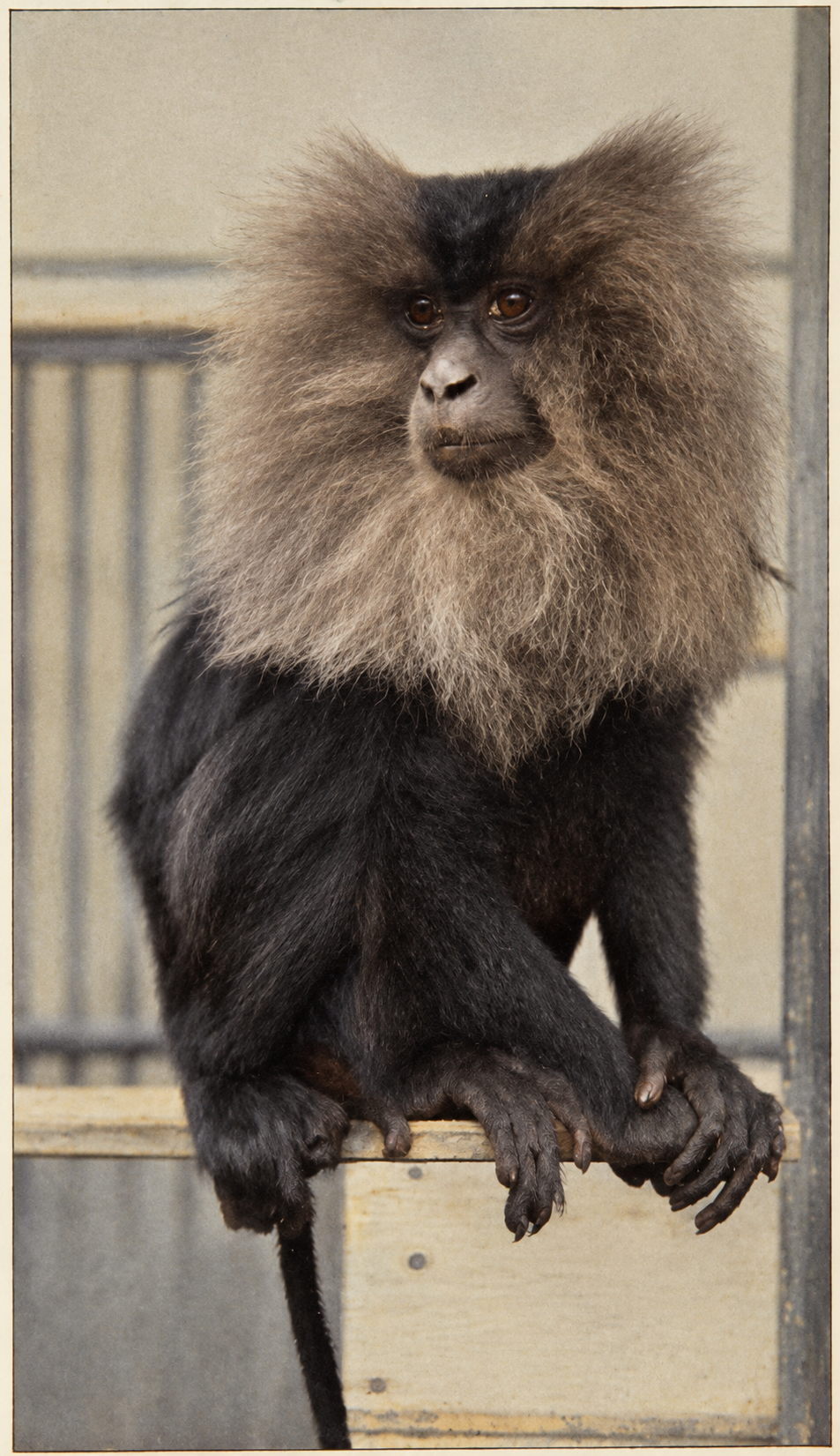
Photo by A. S. Kudtand d: Sons.
COMMON SQUIRREL MONKEY.
The squirrel monkeys have soft, bright-coloured fur, and long, hairy tails. They are found from Mexico to Paraguay.
25
are these New World species. No person clever at interpreting the ways of animals would fail to consider them far more clever and sympathetic than the melancholy anthropoid apes, while for appearance they have no equals. Probably the most attractive monkey in Europe is a South American one now in the London Zoological Gardens. It was first mentioned to Europeans by Baron von Humboldt, who saw it in the cabin of an Indian on the Orinoco. These forest Indians of South America are gentle creatures themselves. Among other amiable qualities, they have a passion for keeping pets. One who worked for a friend of the writer, with F; aiheredohahic tribe, wwastlackedewiniehe These are among the sippaee ti sce ove ea Se the New World. ‘hey would take in payment, which was given in kind. The others chose cloth, axes, ete. This Indian said that he did not care for any of these things. He said he wanted a “poosa.” No one knew what he meant. He signed that he wished to go to the house and would. show them. Arrived there, he pointed to the cat! “Pussy,” to the Arawak Indian, was a “poosa,” and that was what he wanted as a month’s wages. Humboldt’s Indian had something better than a “poosa.” It was a monkey, as black as coal, with a round head, long thickly furred tail, and bright vivacious eyes. The explorer called it the LaGorurix, which means Hare-skin Monkey. The fur is not the least like a hare’s, but much resembles that of an opossum. The more suitable name is the WooLLy Monkey. The one kept at the Gardens is a most friendly and vivacious creature, ready to embrace, play and make friends with any well-dressed person. It dislikes people in working-clothes which are dirty or soiled —a not uncommon aversion’ of clever animals. In spite of all the varieties of temperament in the monkey tribe, from the: genial little Capuchins to the: morose old baboon, they nearly all have one thing in: common—that is, the monkey brain. The same curious: restlessness, levity, and want. of concentration mark them all, except the large anthro-- poid apes. Some of these: have without doubt powers. of reflection and concentra-- tion which the other monkeys: do not possess. But in all Photo by L. Medland, F.Z.S.] [North Finchley. the rest, though the capacity EEL ELON oa? FO for understanding exists, the- This is the most popular monkey in England. He looks for all the world like a Negro, and has a most beautiful, soft, woolly coat. He is very tame, and loves nothing better than being wish to please, as a dog does, petted. and the desire to remember: Photo by A, S. Rudland d: Sons.
BLACK-EARED MARMOSET.
Apes, Monkeys, and Lemurs 27
and to retain what it has learnt, seem almost entirely wanting. Egoism, which is a sign of human dementia, is a very leading characteristic of all monkeys. There is no doubt that the baboons might be trained to be useful animals if they always served one master. Le Vaillant and many other travellers have noted this. But they are too clever, and at the bottom too ill-tempered ever to be trustworthy, even regarded as "watches," or to help in minor manual labour. Baboons would make an excellent substitute for dogs as used in Belgium for light draught; but no one could ever rely on their behaving themselves when their master's eye was elsewhere. are a feeble and Taken no means likeable race. as a family, the monkeys by They " with but noare " as a class, full of promise, performance. undeveloped
THE LEMUES.
THE South American monkeys, with their ~ squirrel-like forms and fur, are followed by a beautiful and interesting group of creatures, called the LEMURS, with their cousins the isLorises, Maholis, and Pottos. Their resem- blance to monkeys mainly in their hands and feet. These are real and very highly developed hands, with proper thumbs, The second toe on the hind foot nearly always terminates in a long, sharp claw. " Elia," the Indian naturalist, who kept them as pets noticed that they used this to scratch themselves with. Some of them have the finger-tips expanded into a sensitive disk, full of extra nerves. Lemur means "ghost." "Unlike the lively squirrels and monkeys, they do not leave their hiding-places till the tropical darkness has fallen on the forest, when they seek their food, not by descending to the ground, but by ascending to the upper surface of the ocean of trees, and again, at the first ap- proach of dawn, seek refuge from the light in the recesses of some dark and hollow trunk. The KING-TAILED LEMUR is as lively by day as night; but most of the race are entirely creatures of darkness that the light seems to stupefy them. When wakened, they turn over like sleeping, children, with the same inarticu- late cries and deep, uneasy sighs,
;But at night most are astonishingly active
;they fly from Photo by Ottomar Anschiitz] [Berlin. tree to tree, heard, but invisible PIG-TAILED MONKEY CATCHING A FLY. so that the natives of Madagascar doubt are as fond as well smaller the of the Most of eating baboons, monkeys, are not true lemures, the un- devoured. flies are and insects. white Beetles, ants, and sought eagerlywhether they quiet ghosts of their departed dead.
Though the lemurs are here treated apart from the other animals of Madagascar, it will be obvious that they are a curious and abnormal tribe. This is true of most of the animals of that great island, which has a fauna differing both from that of the adjacent coast of Africa and from that of India or Australia. In the FOSSA, a large representative of the Civets, it possesses a species absolutely unlike any other. The Aye-aye is also an abnormal creature. Nor must it be forgotten that Madagascar was until recently the home of some of the gigantic ground-living birds. But, after all, none of its inhabitants are more remarkable than its hosts of lemurs, some of which are to be met with in almost every coppice in the island. There are also many extinct kinds.
Exquisite fur, soft and beautifully tinted, eyes of extraordinary size and colour (for the pupil shuts up to a mere black line by day, and the rest of the eye shows like a polished stone of rich brown or yellow or marble-grey), are the marks of most of the lemurs. But there are other lemur-like creatures, or "lemuroids," which, though endowed with the
same lovely fur, like softest moss, have no tails. The strangest of all are two creatures called the SLENDER LORIS and the SLOW LORIS. The slender loris, which has the ordinary furry coat of the lemurs, and no tail, moves on the branches exactly as does a chameleon. Each hand or foot is slowly raised, brought forward, and set down again. The fingers then as slowly close on the branch till its grasp is secure. It is like a slow-working mechanical toy. Probably this is a habit, now instinctive, gained by ages of cautiously insects. But the result is to approaching give the impression that the creature is
Photo by L. Midland, F.Z.S.] [North Finchley. almost an automaton. RING-TAILED LEMUR. is the main home of the Madagascar animal, This lemur is often kept as a domestic and allowed to ran about the lemurs thoUffh Some of the related animals a cat. bouse like are also found in Africa and in the East Indies. But the dense forests of the great island are full of these curious nocturnal beasts, of which there are so many varieties presenting very slight differences of form and habit, that naturalists have some difficulty in giving even a complete list of their species. Add to this that nearly all of them are intensely and entirely nocturnal, and the scarcity of data as to their faces all lack expression that istheir habits is easily accounted for. When seen by us, to say, the eyes, which mainly give expression, seem entirely vacant and meaningless. But this is due to their special adaptation to seeing in the dark tropical night. By day the pupil of the eye almost disappears. If only we could also see in the dark, the eyes of the lemur might have as much expression as those of a faithful dog. The change which night makes in their general demeanour is simply miraculous. By day many of them are like hibernating animals, almost incapable of movement. When once the curtain of night has fallen, they are isas active as squirrels, and as full of play as a family of kittens. The KING-TAILED LEMUR often kept as a pet, both in Madagascar and in the Mauritius. It is one of the very few which are diurnal in their habits. When in a hurry it jumps along, standing on its hind feet, like a little kangaroo, but holding its tail upright behind its back. It will follow people upstairs in this way, jumping from step to step, with its front paws outstretched, as if it were addressing an audience. The French call these day lemurs MAKIS. The ring-tailed lemur lives largely among rocks and precipices. Most of these creatures live upon fruit, the shoots and leaves of trees, and other vegetable food. But, like the squirrel, they have no objection to eggs and nestlings, and also kill and eat any small birds and insects. Some of the smaller kinds are almost entirely insect-feeders. The largest kind of lemur belongs to the group known as the INDRIS. The BLACK- AND-WHITE INDRI measures about 2 feet in length. It has only a rudimentary tail, large ears, and a sharp-pointed nose. The amount of white colouring varies much in different individuals. This variation in colouring a very rare feature Photo by L. Midland, F.Z.S., North Finchley. among wild mammalia, though one of the first changes A DWARF LEMUR. shown when animals are domesticated is also found in the These tiny animals take the place of the Madagascar.next three species, called SIFAKAS. The DIADEMED SIFAKA, dormouse in