The Living Animals of the World, Volume I: Mammals

1O The Living Animals of the World
followed, and the descriptions will, so far as possible, present the habits and appearance of the monkeys specially noticed. This great family of true monkeys contains the Sacred Monkeys, or Langurs, of India, the Guerezas and Guenons of Africa, the Mangabeys, Macaques, and Baboons. Most of them have naked, hard patches of skin on the hindquarters, and the partition between the nostrils is narrow. Some have tails, some none, and they exhibit the most astonishing differences of size and shape. Perhaps the most grotesque and is the astonishing of them all PROBOSCIS MONKEY. It is allied to the langurs, and is a native of the island of Borneo, to which it is confined; its home is the west bank of the Sarawak River. It is an arboreal creature, living in small companies. Mr.
Photo by A. S. Rudland & Sons] [London, Hose, who saw them in their HEAD OF PROBOSCIS MONKEY. native haunts, says that the pro- A native of Borneo. Next to the orang-utan, the most striking monkey in the Malay Archipelago. boscis monkeys kept in the trees overhanging the river, and were most difficult to shoot. "I saw altogether about 150 of these monkeys, and without a single exception all were in trees over the water, either lake, river, or in submerged forest. As long as they are in sight, they are very conspicuous objects, choosing the most commanding positions on open tree-tops. Once I saw thirteen in one tree, sitting lazily on the branches, as is their habit, sunning themselves, and enjoying the scenery." They are very striking animals in colour, as well as in form. The face is cinnamon-brown, the sides marked with reddish brown and white, the belly white, the back red-brown and dark brown. Next to the orang-utan,, these are the most striking monkeys in the Malay Archipelago.
The greater number of the species intermediate between the gibbons and the New World the baboon and a fewspecies are called "DOG-SHAPED" MONKEYS. We wonder why? Only others are in the least like dogs. The various SACRED MONKEYS of India are often seen in this country, and are quite representative of the "miscellaneous" monkeys in general. Most of them have cheek-pouches, a useful monkey-pocket. They poke food into their pouches, which unfold to be filled, or lie flat when not wanted; and with a pocketful of nuts or rice on either side of their faces, they can scream, eat, bite, or scold quite comfortably, which they could not do with their mouths full. The pouchless monkeys have only their big stomachs to rely on. The ENTELLUS MONKEY is the most sacred of all in India. It is grey above and nutty brown below, long-legged and active, a thief and an impudent robber. In one of the Indian cities they became such a nuisance that the faithful determined to catch and send away some hundreds. This was done, and the holy monkeys were deported in covered carts, and released many miles off. But the monkeys were too clever. Having thoroughly enjoyed their ride, they all refused to part with the carts, and, hopping and grimacing, came leaping all the way back
beside them to the city, grateful for their outing. One city obtained leave to kill the monkeys; but the next city then sued them for "killing their deceased ancestors." In these monkey-infested cities, if one man wishes to spite another, he throws a few handfuls of rice on to the roof of his house about the rainy season. The monkeys come, find the rice, and quietly lift off many of the tiles and throw them away, seeking more rice in the interstices. This is not the monkey commonly seen in the hills and at Simla. The large long-tailed hills. " The langur," monkey there is the HIMALAYAN LANGUR, one of the common animals of the " in India," says Mr. Lockwood Kipling in his " Beast and Man is, in his way, a king of the
Photo by A. S. Rudiand & Sons] [London*
CROSS-BEARING LANGUR AND YOUNO.
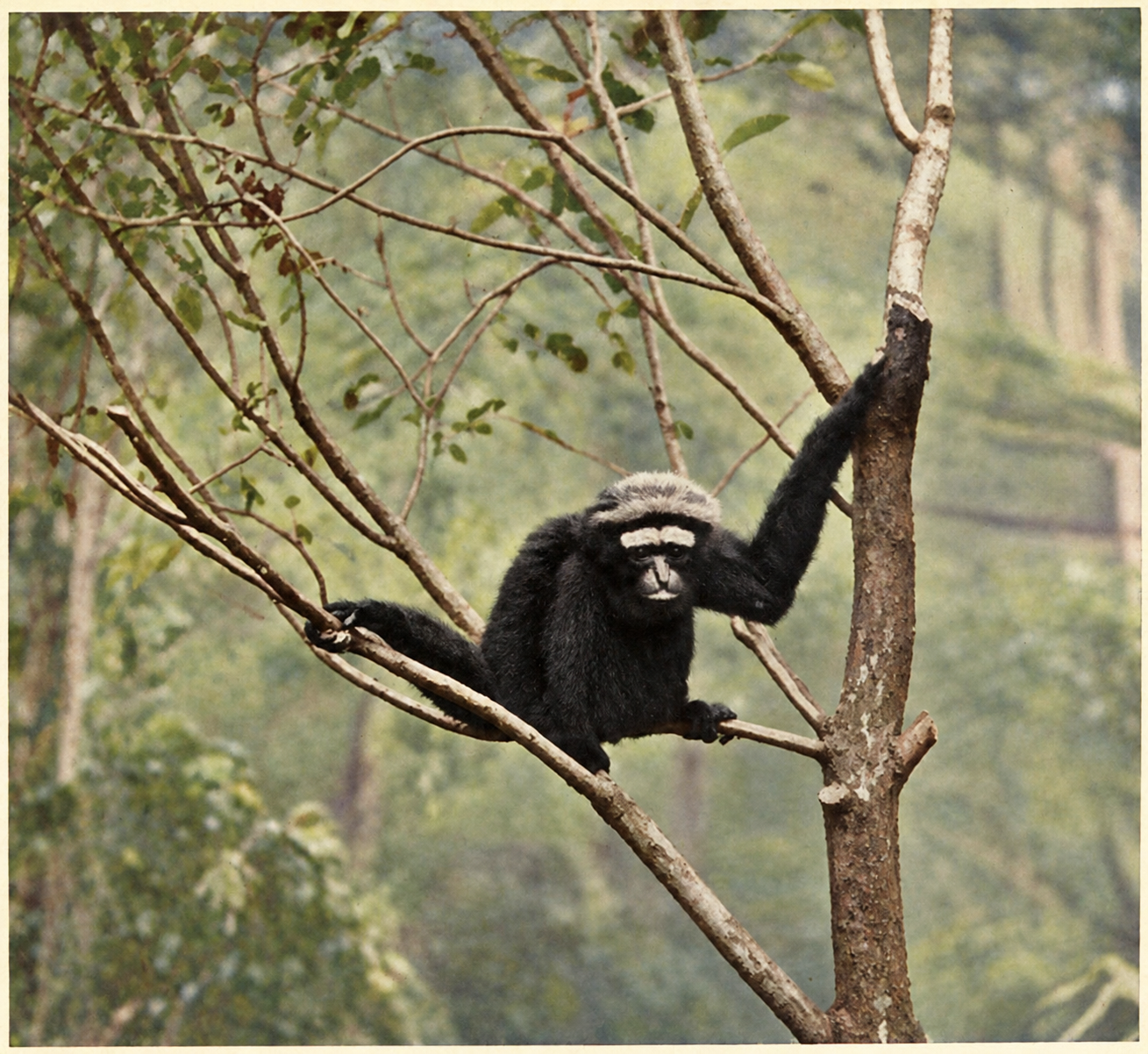
A forest monkey of Borneo.
jungle, nor is he often met with in captivity. In some parts of India troops of langurs come bounding with a mighty air of interest and curiosity to look at passing trains, their long tails lifted like notes of interrogation; but frequently, when fairly perched on a wall or it, and avert their heads with an affectationtree alongside, they seem to forget all about of languid indifference." In India no distinction is made between monkeys. It is ari abominable act of sacrilege and monkeysto kill one of any kind. In the streets holy bulls, calves, parrakeets, sparrows, all rob the shops. One monkey-ridden municipality sent off its inconvenient but holy guests place to which they were consigned.by rail, advising the stationmaster to let them loose at the
The station, Saharanpur, was a kind of Indian Crewe, and the monkeys got into the engine-sheds and workshops among the driving-wheels and bands. One got in the double roof of an inspection-car, and thence stole mutton, corkscrews, camp-glasses, and dusters. Among : " Themany other interesting and correct monkey stories of Mr. Kipling's is the following chief confectioner of Simla had prepared a most splendid bride-cake, which was safely put by in a locked room, that, like most back rooms in Simla, looked out on the mountain-side. It is little use locking the door when the window is left open. When they came to fetch the bride-cake, the last piece of it was being handed out of the window by a chain of monkeys, who whitened the hill-side with its fragments."
From India to Ceylon is no great way, yet in the latter island different monkeys are found. The two best known are the WHITE-BEARDED WANDEROO MONKEY and the GREAT WANDEROO. Both are grave, well-behaved monkeys. The former has white whiskers and a white beard, and looks so wise he is called in Latin Nestor, after the ancient counsellor of the Greeks. is rarer. It livesNice, clean little monkeys are these, and pretty pets. The great wanderoo in the hills. " A flock of them," says Mr. Dallas, " will take possession of a palm-grove, and so well can they conceal themselves in the leaves that the whole party become invisible. The presence of a dog excites their irresistible curiosity, and in order to watch his movements they never fail to betray themselves. They may be seen congregated on the roof of a native hut. Some years ago the child of a European clergyman, having been left on the ground by a nurse, was bitten and teased to death by them. These monkeys have only one wife." Near relatives of the langurs are the two species of SNUB-NOSED MONKEYS, one of which (see figure on page 18) inhabits Eastern Tibet and North-western China, and the other the valley of the Mekong.
THE GUEREZAS AND GUENONS.
Among the ordinary monkeys of the Old World are some with very striking hair and colours. The GUEREZA of Abyssinia has bright white-and-black fur, with long white fringes on the sides. This is the black-and-white skin fastened by the Abyssinians to their shields, and, if we are not wrong, by the Kaffirs also. Among the GUENONS, a large tribe of monkeys living in the African forests, many of which find their way here as " organ monkeys," is the DIANA, a most beautiful creature, living on the Guinea Coast. It has a white crescent on its forehead, bluish-grey fur, a white beard, and a patch of brilliant chestnut on the back, the belly white and orange. A lady, Mrs. Bowditch, gives the following account of [London. a Djana monkey on board ship. MALE HIMALAYAN LANGUID It jumped on to her shoulder. A king of the jungle, not often met within captirity. Stared into her face, and then
GELADA BABOONS AT HOME.
This photograph is probably unique, as a gelada baboon has been rarely seen. It shows them at home looking for food on the ground under the bamboos and palms. It was taken by Lord Delamere in the East African jungle. 13
The Living Animals of the World
made friends, seated itself on her knees, and carefully examined her hands. " He I then tried to pull off my rings, when gave him some biscuits, and making a bed for him with my handkerchief he then settled himself comfortably to sleep; and from that moment we were sworn allies. When mischievous, he was often banished to a hen-coop. Much more effect was produced by taking him in sight of the panther, who always seemed most willing to devour him. On these occasions I held him by the tail before the cage; but long before I reached it, knowing where he was going, he pretended to be dead. His eyes were closed quite fast, and every limb was as stiff as though there were no life in him. When taken away, he would open one eye a little, to see whereabouts he might be; but if he caught sight of the panther's cage it was instantly closed, and he became as stiff as before." This monkey stole the men's knives, tools, and handkerchiefs, and even their caps, which he threw into the sea. He would carefully feed the parrots, chewing up biscuit and presenting them the bits; and he caught another small monkey ! Altogether, he and painted it black must have enlivened the voyage. The
Photo ly A. S. Rudland & Sons] [LornIon. GRIVET MONKEY, the GREEN MONKEY, the MANTLED GUEREZA. MONA MONKEY, and the MANGABEY are This group of monkeys supplies the " monkey muffs " once very fashionable. The other commonly seen African species. species with white plumes is used to decorate the Kaffir shields.
THE MACAQUES.
The MACAQUES, of which there are many kinds, from the Rock of Gibraltar to far Japan, occupy the catalogue between the guenon and the baboon. The COMMON MACAQUE and many others have tails. Those of Japan, and some of those of China, notably the TCIJELI MONKEY, kept outside the monkey-house at the Zoo, and the JAPANESE MACAQUE, at the other entrance, is large and powerful,are tailless, and much more like anthropoid apes. The Tcheli monkey little creatures no bigger than a kitten. Somebut other macaques are of all sizes down to live in the hottest plains, others in the mountains. The COMMON MACAQUE, found in the is a rock-Malay Archipelago, is a strong, medium-sized monkey. The FORMOSAN MACAQUE living creature; those of Japan inhabit the pine- groves, and are fond of pelting any one little beast, verywho passes with stones and fir-cones. The BONNET MACAQUE is an amusing fond of hugging and nursing others in captivity. The BANDAR or RHESUS MONKEY, a common is the MAGOT, orspecies, also belongs to this group. But the most interesting to Europeans it only lives on the Rock ofBARBAUY APE. It is the last monkey left in Europe. There Gibraltar. It was the monkey which Galen is said to have dissected, because he was not permitted to dissect a human body. These monkeys are carefully preserved upon the Rock. Formerly, when they were more common, they were very mischievous. The following story was