Descubre Pandipedia
Un directorio creciente de respuestas útiles seleccionadas por la comunidad de Pandi. Busca en la colección o explora los últimos descubrimientos.
2323 entradas disponibles
Fishes that leave the water



Veamos alternativas:
- Modifica la consulta.
- Inicia un nuevo hilo.
- Eliminar fuentes (si se han agregado manualmente).
Mingo’s fifth hand
Holder first saw a snakelike tip slipping between the doghouses. It curled around a puppy’s leg and gently drew him next door; a kitten followed, tail-first and almost without protest. Then Mingo appeared, tall, slender and spiderlike, holding the puppy while his tail clasped the kitten’s leg. Holder’s point: for some animals, a “hand” is wherever the grip is strongest. Mingo’s fifth hand was his tail.
Veamos alternativas:
- Modifica la consulta.
- Inicia un nuevo hilo.
- Eliminar fuentes (si se han agregado manualmente).

AI Adoption in Manufacturing and Services in Emerging Markets
AI Adoption in Manufacturing and Services in Emerging Markets
Bottom line: The available evidence points to a generally faster, more digitally concentrated adoption pattern in services than in manufacturing, but it does not provide a reliable, economy-wide quantitative comparison for emerging and developing countries. Services therefore face more immediate exposure in some occupations, while manufacturing policy must focus more on foundational digital capability, infrastructure, data quality, and small-firm readiness. These conclusions should be treated as qualified because much of the comparative evidence comes from OECD economies or advanced-economy firms.[1][2][3]
For policymakers, the practical distinction is not simply “services versus manufacturing.” Adoption and workforce effects vary by task, skill level, firm size, and digital readiness. ICT, finance, and professional services are unlike retail or food services, just as high-skill electronics manufacturing is unlike less digitally connected production.[4]
1. Adoption speed and sectoral exposure
In the economies covered by the research, services generally adopt AI earlier than manufacturing. ICT, information and communication, finance, and professional, scientific, and technical services are among the leading adopters. OECD evidence reports adoption rates of 44% in information and communication services and 26% in professional, scientific, and technical services in 2024, while manufacturing trailed the leading service sectors.[5][6]
The available trend evidence also indicates faster adoption growth in ICT and professional services between 2021 and 2024. Manufacturing adoption increased substantially, by roughly 70% in the cited OECD comparison, but from a lower base and with a smaller percentage-point increase than the leading service sectors.[7][8] This supports a services-first pattern, not a universal rule for every emerging market.
| Dimension | Manufacturing | Services |
|---|---|---|
| Adoption pace | Generally slower than leading service sectors in the available OECD evidence; adoption is strongest in selected higher-skill subsectors.[9][10] | Generally earlier and faster in ICT, finance, and professional services, though lower-wage services lag.[11] |
| Exposure | Uneven, with higher exposure in areas such as computer and electronics manufacturing; the sources do not quantify the pattern specifically for emerging economies.[12][13] | More immediate exposure in digitally intensive and language-based activities, but highly skilled services may experience augmentation rather than replacement.[14][15] |
| Firm-level pattern | Adoption is associated with stronger digital readiness; small manufacturers face data, vendor, and business-model constraints.[16][17] | Digitally intensive service firms lead, while the evidence remains insufficient for a systematic emerging-market comparison by firm size.[18] |
2. Capital, infrastructure, and data barriers
The research does not establish that manufacturing or services systematically faces greater financing barriers across emerging markets. It does show that small firms generally have less investment capacity and that financial constraints can delay long-term AI and digital-transformation investment, without proving a sector-specific lending gap.[19][20][21]
The nature of the investment need differs. For services, the evidence more clearly identifies shortages of computing capacity, data centres, connectivity, reliable power, and cooling capacity as constraints on AI workloads. Financing and regulatory reform must make these infrastructure projects bankable.[22][23] For manufacturing, the strongest evidence concerns smaller firms’ weak digital readiness, poor-quality data, difficulty finding suitable vendors, and difficulty adapting business models.[24][25]
This means that “capital barriers” should be interpreted broadly. Services may require investment in shared digital infrastructure and data capacity, while manufacturing firms may need finance and technical assistance for basic digitalisation, usable data, and complementary capabilities. The sources do not support a claim that one sector is universally more capital-intensive or financially constrained than the other.[26][27]
3. Workforce effects
Services face more immediate and uneven workforce exposure because some activities are routine, language-based, or administrative. The IZA evidence specifically identifies the Philippines’ business-process-outsourcing sector as exposed to chatbot substitution, despite its relatively small employment share and substantial economic contribution.[28] At the same time, high-skill services such as medicine may benefit from AI-enabled worker augmentation rather than straightforward replacement.[29]
For manufacturing, the sources do not establish a distinct manufacturing-specific employment effect in developing economies. They do indicate that less digitally connected employment is likely to face slower initial generative-AI disruption because fewer tasks are currently exposed. Evidence from manufacturing firms outside the developing-economy context also cautions against equating AI adoption with immediate factory-floor job loss: reported use was concentrated mainly in functions such as sales and marketing rather than directly in production.[30][31]
The appropriate workforce concern is therefore different by sector. In exposed service industries, the risk is concentrated displacement or rapid changes in work practices. In manufacturing and other lower-exposure activities, the nearer-term challenge may be unequal access to productivity-enhancing technology, alongside the need to build workers’ digital and technical capabilities. These are evidence-based interpretations, not precise forecasts of employment change for all emerging economies.[32][33]
4. Distinct policy priorities
A common national AI strategy is unlikely to be sufficient. The sectoral evidence supports differentiated measures that address both adoption capacity and worker transition.
- Manufacturing: build the base for adoption. Prioritise reliable electricity, internet and digital infrastructure; basic digital skills; training for workers and informal workers; better data practices; and support that helps smaller firms obtain suitable software, vendors, finance, and complementary workforce capabilities.[34][35][36]
- Services: protect and upgrade exposed workers. Target reskilling and upskilling toward changing software, administrative, and professional tasks, while strengthening social protection, labour-market formalisation, regulation, and collective bargaining in vulnerable industries such as BPO.[37][38]
- Both sectors: expand shared infrastructure and firm diffusion. Invest in connectivity, computing capacity, data centres, reliable power, usable data, and privacy protections, while reducing the gap between large early adopters and smaller firms.[39][40][41]
- Measure transitions, not only adoption. Monitor task changes, skill polarisation, access gaps, and displacement among firms losing market share, rather than counting only layoffs at firms that adopt AI early.[42]
Conclusion and evidence boundary
The best-supported comparison is qualified: services generally adopt AI earlier and expose more digitally intensive, language-based, and administrative work, while manufacturing adoption is slower overall and more uneven, with especially important capability gaps among small firms. Capital constraints affect both sectors, but the evidence points to different bottlenecks: computing, connectivity, data-centre capacity, energy, and data governance are more clearly documented for services, while manufacturing evidence centres on digital readiness, data quality, vendors, and business-model adaptation.[43][44][45][46]
The evidence does not justify a precise emerging-market estimate of the manufacturing-services adoption gap, nor a universal claim that AI will reduce manufacturing employment or replace service workers. Policy should therefore combine sector-specific support with better country-level measurement, especially of small firms, informal work, task exposure, and worker transitions.
Veamos alternativas:
- Modifica la consulta.
- Inicia un nuevo hilo.
- Eliminar fuentes (si se han agregado manualmente).
The stickleback that builds the nursery
Holder’s 1899 account flips the usual nest story: the female takes little interest, while the male builds. He gathers soft weed and refuse into an oval pouch, sometimes on the bottom, sometimes suspended like a tiny hammock. Silk-like threads bind it; he butts an opening through the nest for the eggs. The father then guards the eggs and fans water over them to keep fungus from taking hold. Holder watched him suck wandering fry into his mouth and shoot them back into the nest.
Veamos alternativas:
- Modifica la consulta.
- Inicia un nuevo hilo.
- Eliminar fuentes (si se han agregado manualmente).
Ocean swordsmen of Holder's seas




Veamos alternativas:
- Modifica la consulta.
- Inicia un nuevo hilo.
- Eliminar fuentes (si se han agregado manualmente).
How many milliseconds of latency are generally tolerable in VR before motion
Veamos alternativas:
- Modifica la consulta.
- Inicia un nuevo hilo.
- Eliminar fuentes (si se han agregado manualmente).
QKD vs. Post-Quantum Cryptography: Which Should You Deploy?
QKD vs. Post-Quantum Cryptography: Which Should You Deploy?
For most organizations, deploy software-based post-quantum cryptography (PQC) as the default migration path. Reserve hardware-based quantum key distribution (QKD) for narrowly defined, high-assurance links where its theoretical security model justifies specialized optical infrastructure, operational complexity, and network constraints. The practical decision is not simply “quantum security versus non-quantum security”: both approaches still require authentication, trusted endpoints, secure key management, implementation assurance, and availability protections.
This comparison covers QKD against software-only lattice-based and hash-based schemes, focusing on security assumptions, cost, scalability, interoperability, and adoption conditions. The available research supports qualitative guidance, not an apples-to-apples total-cost or performance estimate.
Executive comparison
| Criterion | QKD | Lattice-based PQC | Hash-based PQC |
|---|---|---|---|
| Security basis | Can provide an information-theoretic security claim for idealized key establishment, subject to assumptions about devices, protocols, environment, and implementation.[1][2] | Provides computational security based on mathematical problems believed to resist classical and quantum attacks.[3][4] | Provides computational security based on hash-function assumptions and is generally treated as a conservative option for selected long-term signature uses.[5][6][7] |
| Primary function | Generates shared key material. It does not itself provide complete encryption, authentication, or key management.[8] | ML-KEM is a key-establishment mechanism. ML-DSA and SLH-DSA are signature mechanisms for authentication and integrity, not interchangeable KEMs.[9][10] | SLH-DSA is a signature mechanism, not a general-purpose key-establishment mechanism.[11][12] |
| Infrastructure | May require QKD modules, optical transmitters and receivers, quantum channels, key-management systems, and application interfaces.[13] | Usually fits existing computing, communications, software-library, and protocol infrastructure, although migration requires engineering work.[14][15] | Uses the same broad software-integration model, but large signatures can create bandwidth and operational costs.[16] |
| Scalability | Point-to-point and constrained by optical loss, distance, key-generation rates, and possible reliance on trusted relay nodes.[17][18][19] | Can fit enterprise, cloud, TLS, IPsec, PKI, and application architectures without a QKD-specific physical topology.[20][21] | No equivalent QKD-specific fiber or secret-key-rate constraint is identified in the supplied evidence, but comparable large-scale performance evidence is limited.[22][23] |
| Cost and operations | Infrastructure-intensive, with continuing hardware assurance, physical security, testing, relay control, monitoring, and specialized upgrades.[24][25] | Generally more cost-effective where QKD would require dedicated links, specialized equipment, trusted relays, or secure facilities.[26] | Avoids QKD-specific optical infrastructure, but signature size and integration support can impose indirect costs.[27] |
Security and threat-model differences
QKD’s strongest claim applies to an idealized key-establishment protocol against an attacker with unlimited computational power. That claim is conditional: it depends on correct protocol operation, parameter estimation, device behavior, the operating environment, and implementation security. It should not be interpreted as unconditional security for the entire communications system.[28][29]
QKD does not authenticate communicating parties or classical messages by itself. Its classical sifting, error correction, and privacy-amplification steps require an authenticated classical channel; without authentication, a man-in-the-middle can impersonate the endpoints. QKD also does not automatically protect applications, private keys, key-management systems, or trusted relay nodes.[30][31][32][33]
PQC instead assumes that selected mathematical problems or hash functions remain hard for classical and quantum attackers. This is a computational, not information-theoretic, security model. It can protect against “harvest now, decrypt later” attacks on stored ciphertext, but future cryptanalytic discoveries could weaken a scheme, and a compromised endpoint can still expose private keys or plaintext.[34][35][36][37]
The implementation risks differ rather than disappear. QKD requires characterization of optical and detector behavior, including photon statistics, timing, spectral behavior, detection efficiency, dark counts, and after-pulsing. PQC deployments must address ordinary software and systems risks such as faulty randomness, parameter-handling errors, timing leakage, identity-binding failures, certificate problems, and private-key compromise. The supplied research does not provide a scheme-specific side-channel assessment for every ML-KEM, ML-DSA, or SLH-DSA implementation, so these should be treated as engineering threat-model considerations rather than universal findings.[38][39][40][41]
Cost, scalability, and interoperability
Cost: QKD is usually the more infrastructure-intensive choice because it adds specialized quantum-optical equipment, suitable physical links, key-management components, and potentially trusted relays. PQC can generally reuse existing platforms and networks, although larger keys or signatures may increase bandwidth, memory, latency, retransmission, or constrained-device costs. The available evidence does not justify a universal price premium or a precise total-cost comparison.[42][43][44][45]
Scalability: QKD is naturally constrained by the physical network. Optical loss and key-generation rates limit distance and capacity, and larger deployments may require hop-by-hop distribution, central sites, or trusted nodes. PQC avoids a QKD-specific physical topology and can be integrated across conventional enterprise, cloud, internet-facing, TLS, IPsec, and application environments, though cryptographic migration remains a substantial systems project.[46][47][48][49][50]
Interoperability and lifecycle: QKD requires coordination among quantum links, conventional networks, key managers, application interfaces, and encryption systems. The reviewed material reports proprietary key managers, vendor-specific integration, multiple protocol families, and continuing integration difficulty. PQC is more compatible with software-based migration and hybrid designs, but organizations still need cryptographic discovery, application changes, certificate and PKI work, and crypto-agility so algorithms can be replaced if assumptions change.[51][52][53][54]
The supplied maturity search was insufficient to support a detailed, current ranking of ML-KEM, ML-DSA, and SLH-DSA implementation maturity or standardization status. The evidence does establish their broad roles, but it does not justify unsupported claims about universal vendor readiness, comparative deployment maturity, or cross-vendor interoperability.
Deployment guidance
Use software PQC as the default when the objective is broad protection across existing networks, cloud services, applications, certificates, or stored data. Begin with cryptographic inventory and data-lifetime analysis, prioritize long-lived sensitive information, design for algorithm replacement, and use authenticated key establishment plus signatures appropriate to the protocol. A hybrid migration can provide continuity while systems and counterparties are upgraded, but the exact hybrid design should be validated for each protocol and implementation.
- Choose software PQC when you need organization-wide scale, conventional network compatibility, remote or cloud deployment, or protection against harvest-now-decrypt-later exposure.[55][56][57]
- Consider QKD only for a small number of fixed, high-value links where the information-theoretic security objective is material, dedicated optical connectivity is feasible, endpoint and relay trust can be controlled, and the organization can fund specialized operations and availability planning.[58][59][60]
- Do not deploy QKD as a substitute for authentication, endpoint security, encryption, key management, or resilience. Those controls remain necessary because QKD does not cover the complete system.[61][62][63]
- Treat hash-based signatures as a signature choice, not as a replacement for a key-establishment mechanism. Compare their signature size, tooling, PKI, HSM, and operational consequences for the intended use case.[64][65][66]
Bottom line
For a normal enterprise or public-sector migration, deploy software PQC first because it scales through existing infrastructure and avoids QKD’s specialized physical network and operational burden. QKD is a targeted defense for exceptional links, not a general replacement for authenticated, software-integrated cryptography. The final choice should follow the threat model: QKD may be justified when physical-link assurance and an information-theoretic objective dominate, while PQC is the practical default when coverage, scalability, interoperability, and lifecycle flexibility matter most.
Veamos alternativas:
- Modifica la consulta.
- Inicia un nuevo hilo.
- Eliminar fuentes (si se han agregado manualmente).
Can You Spot the More Anti-Inflammatory Choice?
Veamos alternativas:
- Modifica la consulta.
- Inicia un nuevo hilo.
- Eliminar fuentes (si se han agregado manualmente).
Direct answer
Direct answer
The ISO standard number most commonly associated with collaborative robot safety is ISO 10218. ISO 10218-1 covers robot safety requirements, while ISO 10218-2 covers system integration and collaborative applications.[1]
Current versus legacy context
Historically, professionals also searched for ISO/TS 15066:2016, whose collaborative-robot requirements were incorporated into ISO 10218-2:2025.[2]
Veamos alternativas:
- Modifica la consulta.
- Inicia un nuevo hilo.
- Eliminar fuentes (si se han agregado manualmente).
What is the standard unit used to measure AI training energy consumption?
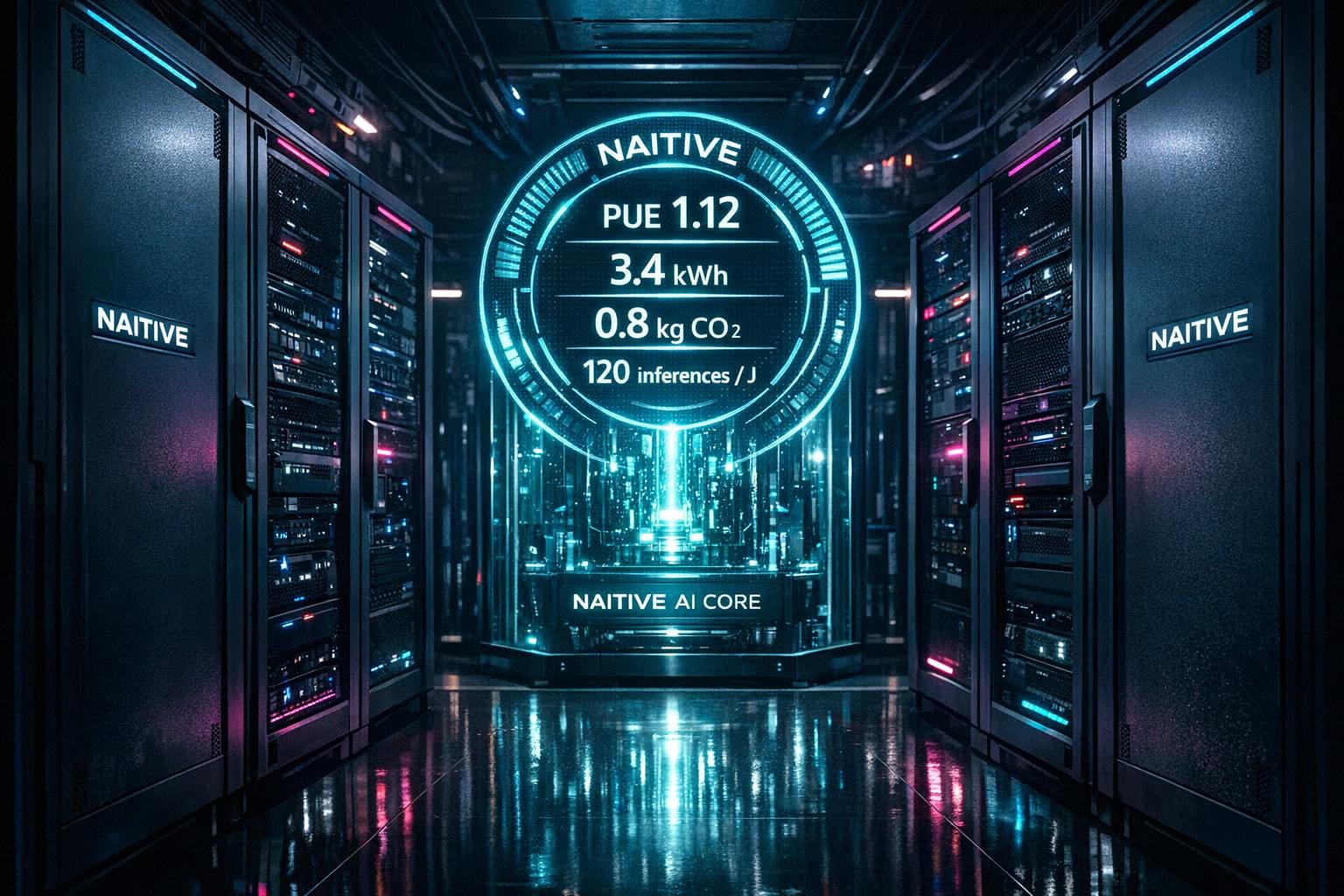
The standard unit used to measure AI training energy consumption is kilowatt-hours (kWh) [1]. Kilowatt-hours serve as the primary unit for tracking electricity usage during computational tasks [2].
In addition to kilowatt-hours, energy consumption and environmental impact are frequently expressed through emerging metrics such as carbon equivalents, measured in kilograms of CO₂ equivalent (\(\text{kg CO}_2\text{eq}\)), which translates electricity usage into environmental impact based on the carbon intensity of local energy grids [3]. Other metrics used to evaluate energy efficiency include inferences per joule and Power Usage Effectiveness (PUE) [4]. Would you also like to know how kilowatt-hours are used to calculate carbon emissions for AI training?Respuesta completa. Hay una opción de seguimiento disponible.
Veamos alternativas:
- Modifica la consulta.
- Inicia un nuevo hilo.
- Eliminar fuentes (si se han agregado manualmente).