The Living Animals of the World, Volume II: Birds, Reptiles and Amphibians, Fishes, Jointed Animals, Molluscs, etc.
722 The Living Animals Photo by J, Peat Millar] (Beith,
DEATH’S-HEAD MOTH.
Remarkable for the skull-like pattern on the back. upon the mulberry-trees, people were to prepare the trays.and frames.for the purpose. of rearing the silkworms. “In the spring season, when the empress and her ladies had fasted, they proceeded to the east, and personally engaged in picking the mulberry-leaves. On this occasion the married and single ladies were forbidden to wear their ornaments, and the usual employments of females were lessened, in order to encourage attention to the silkworms. When the rearing of the silkworms was completed, the cocoons were divided (for reeling) and the silk weighed (for weaving), each person being rewarded Photo by J. Peat Millar]
CONVOLVULUS HAWK-MOTH.
A grey moth, witb pink bands on the body. of the (Beith. World Museum,” may not be uninteresting to our readers:— “In the first month of spring orders were issued to the forester not to cut down the mulberry-trees; and when the cooing doves were observed fluttering with their wings, and the crested jays alighting Photo by W, Saville-Kent, F.Z.S., Milford-on-Sea.
DAY-FLYING MOTH OF
MADAGASCAR. Remarkable for the brilliancy of its colours—green and black, with the hind wings brilliant coppery red towards the extremity., according to her labour, in order to provide dresses for the celestial and ancestorial sacrifices. In all this none dared indulge in indolence. “In the last month of summer the order was given to the female officers to dye the silk of various
Photo by C. N. Mavroyeni}; LSmyrna.
GREAT PEACOCK-MOTH.
Brown with pale borders. The largest moth found in Europe. Photo by Dr. R. W. Shufeldt] [ Washington,
POLYPHEMUS MOTH.
On leaves of linden-tree, just out of cocoon. A native of North America. 723
colours, in order to weave chequered sarcenets, comprising black and white, black and green, green and red, with red-and-white checks all of which was to be done according to the ancient rule, without the least variation; the black, yellow, azure, and red tints were all to be correct and good, without the least fault, in order to provide dresses for the celestial and ancestorial sacrifices, and standards for distinguishing the high and low degrees. "In ancient times the emperor and his princes had a public mulberry garden and a silkworm establishment erected near some river. On the morning of the first day of Photo by W. Saville-Kent, F.Z.S.] [MilJ'ord-on-Sen. the third month of spring, the sovereign, WHITE PLTJME-MOTH. wearing a leather cap and a plain garment, A very delicate insect. The wings are cleft almost to the base into separate ascertained by lot the chief of his three feathers, two on the fore wings and three on the hind wings. queens, with the most honourable amongst his concubines, and caused them to attend to the rearing of the silkworms in the above-named establishment. They then brought the eggs of the worms, and washed them in the river above alluded to, after which they picked the mulberry-leaves in the public garden, and aired and dried them, in order to feed the worms. " When the season was over, the royal concubines, having completed the business of rearing the silkworms, brought the cocoons to show them to the prince, when he presented the cocoons again to his consort, whereupon his consort said, 'This is the material of which your highness's robes are to be formed.' Having said which, she covered herself with her robe, and received the cocoons. On this occasion the ladies of the court were honoured with the present of a sheep. This was the mode in which the presentation of the cocoons was anciently conducted." In the reign of Justinian eggs of the Chinese mulberry-silkworm were smuggled into Europe by two monks, and the culture of silk rapidly spread through Southern Europe, where it has continued to form a staple industry ever since. In the Pelo-ponnesus especially such large plantations of mulberry-trees were grown for the purpose of rearing silkworms as to give the peninsula its modern name of Morea. Silk is obtained in different parts of the world from the cocoons of various other moths, chiefly belonging to the group of Emper6r-moths; but these pro. INDIAN SWALLOW-TAILED MOTH. ducts are Qnly importance? and are not * Qf^ likely to compete with the mulberry-silkworm. fc**
Half'Winged Insects 725
HALF-WINGED INSECTS. OR BUGS AND FROG-HOPPERS.
BY W. F. KIRBY, F.L.S.
is divided into two sub-orders. There are THE order including the Bugs and Frog-hoppers also one or two small groups, sometimes treated as separate orders, and sometimes regarded as aberrant sections of the order, to which we shall allude later.
The TRUE BUGS have their fore wings of a horny texture, but generally overlapping, and the extremities form a transparent membrane, resembling that of the hind wings. They have a long sucking-proboscis curved down beneath their bodies, and their antennae usually consist of only four or five long joints. Most are vegetable-feeders, but some species feed on the juices of other insects, while a few attack warm-blooded animals, either casually or habitually. The first family includes the SHIELD- BUGS. These derive their name from the unusual development of a part of the thorax called the " scutellum." In most insects it is only a small plate of no great Photos by W. P. Dando, F.Z.S.] [Regent's Park. importance, attached to the end of the SHIELD-BUG. JUNIPER-BUG. thorax; but in the Shield-bugs it forms In tropical countries these bugs are Some species of this family are as well as herbivorous.a great solid arch, covering the whole of often as large as cockchafers. carnivorous the wings, and protecting them as the wing-cases protect the wings of beetles. There are only a few small species in England, but a great number of beautiful species inhabit warm countries, some of a brilliant blue or green or yellow, or spotted. Many of them are comparatively large insects, nearly an inch long, and resemble brilliantly coloured beetles, from which, however, they can easily be distinguished by the antennae, the proboscis, and the shield, the latter- of which is not divided down the middle like the wing-cases of beetles.
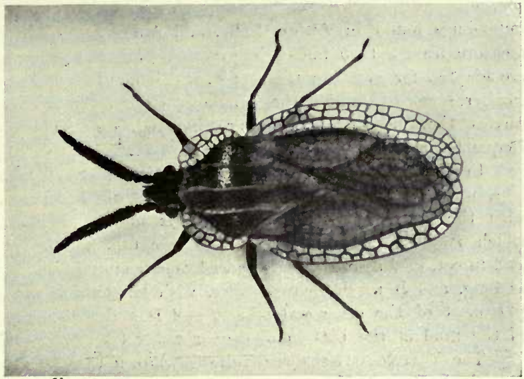
Next to the Shield-bugs, and considered by many entomologists as belonging to the same group, are the PENTAGONAL SHIELD-BUGS, so called because the scutellum, though much smaller than in the Shield-bugs, is often half as long as the abdomen, and forms a broad triangle, sometimes broken at the sides, so as to make a five- sided plate, lying above the bases of the wings. Several green or brown species of this family, about half an inch long, are common in England among bushes. Many have a very disagreeable smell, and hence they are called STINK-BUGS in America. They inioio by /. Edmu-ds\ feed on- vegetable juices, and also LACE-WING BUG. insect, injurious to pear-trees. frequently on soft-bodied insects. An elegant little

of the World726 The Living Animals
Several species (chiefly foreign) among the Shield-bugs and the present group have a strong spine, or else a blunt protuberance, projecting from each shoulder.
The remaining plant-bugs are much more numerous at least in England than those already mentioned, and form several families, which cannot be noticed in detail. Many species are rather small and delicate creatures, narrower and softer than the Shield-bugs and Pentagonal Shield-bugs, and are adorned with various colours, black and red predominating. Some have more transparent wings than the others, such as the beautiful little LACE-WINGED BUGS, one species of which is often very destructive to pear-trees.
The BED-BUG is a reddish-brown, somewhat oval insect, common in many old houses, hiding in cracks and crevices in walls and woodwork, and' coming out at night to suck the blood of sleepers with its sharp proboscis. There are allied species, sometimes found in hen-houses, pigeon-houses, and places where bats congregate. The bed-bug has only been all parts of the world,known in England for a few centuries, and though now a great pest in was probably a native of Africa originally.
The bed-bug, notwithstanding its offensive odour, is preyed upon by several other insects, is a black-wingedamong which are the common cockroach and the MASKED BUG. The latter bug about three-quarters of an inch long, and remarkable for the habits of its larva, which conceals itself with dust or fluff, so that it may steal upon its its larva feed on soft-bodied prey unobserved. The masked bug and insects of various kinds, and are more frequently found in outhouses than in dwelling-rooms. This bug occasionally attacks warm-blooded animals; and a short time ago a great deal of nonsense was published in the newspapers about a mysterious insect-pest in North America, called the KISSING-BUG, which seems to have been nothing more unusual than this insect. There are, however, some much larger species belonging to the same family, which are formidable pests in the Southern States of North America, Chili, and various other countries. After these insects come the WATER-BUGS, of which there are several families, though the number of species is comparatively Photo by W. P. Dando, F.Z.S., Regent’s Park. small. Some are very slender insects, with long, slender legs,
MASKED BUG. and may be seen running on the surface of ponds in England; insects these cover of The larvae while others, . which are tropical species, are. marine, and are met in order to withthemselves., creep dust, upon their prey unnoticed. with running on the surface oi the water in the open sea. The largest members of the group are some of the great water-bugs found in Africa, India, and America. Their fore wings are of a light brown, and measure from 3 to 5 inches in expanse. Their legs are short and strong, and the front legs are adapted for grasping their prey, which consists of insects and small fishes. There are some smaller species in which the female lays her eggs in a cluster on the back of the male, which carries them about till they are hatched. These bugs fly about in the evening, and are frequently attracted by electric light.