The Living Animals of the World, Volume II: Birds, Reptiles and Amphibians, Fishes, Jointed Animals, Molluscs, etc.

GOLIATH BEETLE, BRAZILIAN .BEE
eit Africa. (Half natural size.) (Enlarged one-third.)
GRASSHOPPER CANDLE FLY.
From Somali Land and Aden. (Slightly reduced.) From Ceylon. (Slightly reduced.)
AUSTRALIAN ROBBER-FLY
(Slightly reduced.) Photos by W. P. Dando F. Z 5. Regents Park.
UNIV. OF
CALIFORNIA
Photo by W. Saville-Kent, F.Z.S.] [Milford-on-Sea.
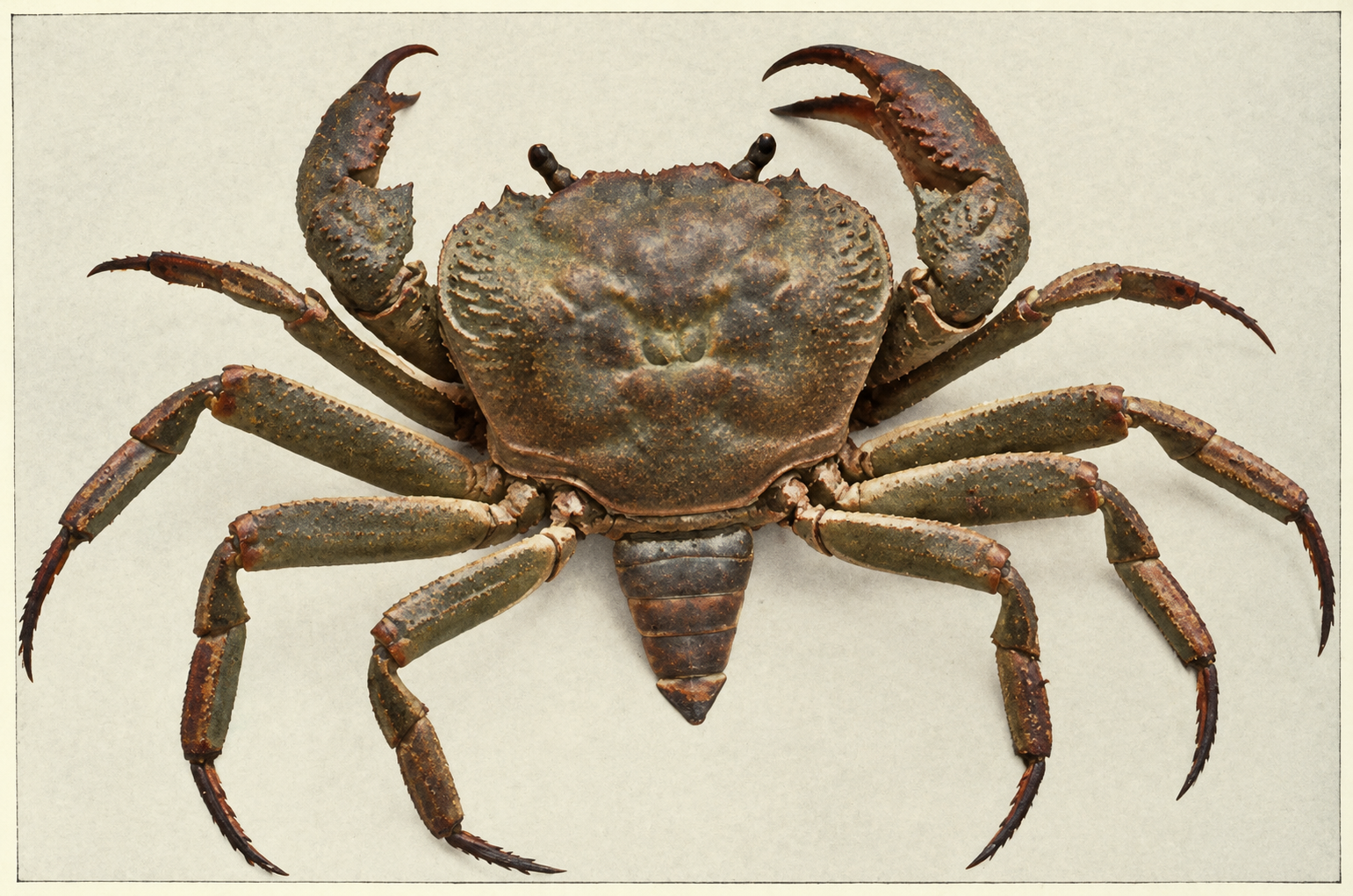
SPIDER-CRAB.
An active sea-scavenger.
Photo by W. Saville-Kent, F.Z.S.] [Milford-on-Sea.
BLUE CRAB.
Much esteemed for the table.
673
85
of the World674 The Living Animals
have seen numbers of the little greenish SHORE-CRABS, running about on the sand, or over seaweed-covered rocks, at low tide. These small crabs are harmless, but large kinds are able to give a very severe pinch. It is related that when the great chemist Sir Humphry Davy was a boy he used to maintain that pain was no evil, until a large crab gripped his toe one day when he was bathing, after which he changed his opinion.
Some crabs are smooth and shining, but others are covered with bosses, excrescences, and spines, which give them a very formidable appearance, and must be a useful protection against any enemies to whose attacks they are exposed. In many species one of the two great claws-is always much larger than the other. Some have round bodies, others are oval or nearly square; some have short legs, and others very long ones. The species differ much in their habits; and in tropical countries there are land-crabs which live entirely on shore, and others-which are amphibious, and climb cocoanut-trees, to get at the nuts. As a general rule r however, crabs are carnivorous and marine, and play the part of sea-scavengers.
The KING-CRABS differ very much from any now living in the British seas, but to-are generally considered to be allied to the Trilobites, an extinct family which appears have been extremely numerous in very ancient seas. King-crabs are 2 or 3 feet long from the front of the body to the end of the tail. The front part of the body is entirely covered by a curved oval shield, while the hinder part of the body is much narrower, and armed at the sides-with strong teeth directed backwards, and also with a long and strong spear, something like that of a sword-fish on a small scale, as long as the rest
Photo by W. SaviUe-Kent, F.Z.S [Milford-on-Sea. of the body. The few FIGHTING CRABS. known exhibit an The males are remarkable for having one large scarlet claw, the other being rudimentary (the females species possess two small claws only). The eyes also are seated at the end of long stalks. instance of what is called " discontinuous distribution," since they are found only, on the coasts of the Moluccas, East Indies, and the Southern United States and West Indies.
SCORPIONS, SPIDERS, AND MITES.
These creatures form a peculiar group in which there are only two principal divisions of the body, the head and thorax being fused into one mass, and the abdomen forming a separate division. In the Mites, however, the body forms a single round or oval mass, even the division between the thorax and the abdomen having disappeared. The members of the group have no antennae, but two pairs of jaws and a pair of palpi, frequently very long, and armed with a pincer-like arrangement at the end, in which case they are called "foot-jaws." Except in some of the mites, which have only four or six, all the group have eight legs. They pass-through no metamorphosis, but moult several times after quitting the egg before attaining their full growth. They have frequently several pairs of simple eyes, but no compound eye* like the large pair on the head of most insects.
In the SCORPIONS, of which there is a considerable variety in different parts of the world.
Scorpions, Spiders, and Mites 675
the united head and thorax are comparatively short; but the abdomen is very long, and divided into a broad half, consisting of seven segments, and a narrow tail of five very movable segments, besides a sharp, curved sting at the extremity. There are from three to six pairs of eyes on the head and thorax, and in front of the body projects a pair of very large pincer-bearing foot-jaws. Scorpions are generally of a yellowish or black colour; and the largest
black scorpions of Africa and India sometimes measure as much as 9 inches in length. They are nocturnal creatures, hiding under stones, or in holes in the ground, or in crevices in walls during the day. They kill the insects and other small animals on which they feed with their stings, the sting of one of the large black scorpions, like that of the large tropical centipedes, being as painful and dangerous as that of a snake. There are a few small and comparatively harmless species found on the shores of the Mediterranean, but most of the scorpions inhabit warmer countries.
The JOINTED SPIDERS are creatures 1 or 2 inches long, remarkable for having the head and the
segments of the thorax separated from each other, so as to form distinct divisions of the body. They have rather long and very hairy legs, and only one pair of well-developed eyes, another pair being rudimentary. Some species are diurnal and others nocturnal in their habits. They feed on insects, and sometimes on small birds, etc., and can inflict a very painful bite. They are found in South-eastern Europe, Africa, Southern Asia, and from the Southern States of North America south to Chili and Argentina.
The FALSE SCORPIONS,
or BOOK-SCORPIONS, are
Photo by Highley.
EGYPTIAN SCORPION.
A fairly large and venomous representative of the group.
Photo by Highley.
EGYPTIAN SCORPION.
Shows the sting uplifted for attack.
small animals resembling scorpions in shape, but with no sting, and the abdomen not narrowed into a tail. They are sometimes found in houses among dusty old books, as well as out of doors among moss, or under stones or bark. Sometimes they cling to the legs of flies; they are believed to feed on mites and other small creatures, but not to injure the flies, only employing them as a convenient method of being conveyed from one place to another. The WHIP-SCORPIONS are not unlike scorpions, and have large claws, but the front legs are very long, slender, and whip-like, and there is either no tail, or else a long, slender, whip-like one without a sting. They are inhabitants of warm countries, and, rightly or wrongly, are reputed to be venomous. Different species measure from 1 inch to 4 or 5 inches in length. The curious HARVEST-MEN have two eyes, a small, compact, oval body, large pincers, and very long, slender legs, longer and more slender in proportion to their size than those Pho of crane-flies, and equally liable to be broken TREE TEAP-DOOK SPIDER OP BEAZIL. i s only Off, if the OWner is rOUghlyJ handled. They* TraP-do r ersoneare Britishplentifulrepresentativein some paitsof oftheEurope,family. but there feed on plant-lice and other small insects.
We now come to the large and important group of SPIDERS, which more frequently attract is not usually dividedattention in England than any others of the group. The abdomen into distinct segments, and is connected with the thorax by a short stalk. Spiders have strong, poisonous jaws, which make some of the larger species formidable even to man, and several pairs of eyes; while many possess an apparatus for spinning a strong silken web, in which they entangle their prey, consisting in England chiefly of flies and other winged insects. The largest known spiders are usually placed first in the series. These are the great BIRD-CATCHING SPIDERS of South America, some of which have bodies 3 inches long, and strong, hairy legs. These large spiders have now been proved not only to feed on insects, but occasionally on humming-birds, and even sometimes on larger birds, such as finches. The TRAP-DOOR SPIDERS are allied, but smaller, perhaps averaging about an inch in
Photo by Highley. length. They construct a silken gallery in the HOUSE-SPIDER. ground, with a round door, which they shut
Exhibits the four pairs of legs characteristic of the group. behind them when they enter. There is only one species in England, which does not form a trap-door, but a silken tube. If any insect settles on it, the spider clutches it from within, tears a hole in the tube, drags its prey inside, and then repairs the rent.
Scorpions, Spiders, and Mites 677
Different spiders have many curious methods of capturing their insect-prey. Some catch insects by running after them, and others by leaping on them, while those which spin webs are also very dissimilar in their habits and in their abodes. The brown HOUSE-SPIDERS spin webs in any room left undisturbed long enough to allow them to construct them. On the other hand, the ORB-SPINNERS, or GARDEN-SPIDERS, construct elaborate webs out of doors. One of the most beautiful of these is the DIADEM-SPIDER, which is nearly an inch long, and of a is verygreen or reddish colour, with a white cross bordered with black on the back. The web regularly constructed, the principal threads radiating in all directions from a common centre, where the spider generally sits in fine weather, ready to rush out upon any insect which may become entangled in the web.
The GOSSAMER-SPIDERS spin light webs, which are easily carried up into the air, and upon which the spiders are borne from one place to another. Sometimes on an autumn morning the air may be seen to be full of these floating webs, which also cover the grass and bushes where they have settled. The WATER-SPIDERS, again, construct a habitation of water-tight silk under water, like a diving-bell, and inflate it by carrying down bubbles of air from the surface, entangled in the hairs of the body.