The Living Animals of the World, Volume II: Birds, Reptiles and Amphibians, Fishes, Jointed Animals, Molluscs, etc.
of the World572 The Living Animals
the heloderm is the arid, sandy, and stony region on the western side of the Cordillera mountain-range. It is at the same time said to be rarely seen in those parts except during the rainy season, and also to be for the most part nocturnal in its habits. The family group of the MONITORS includes the largest of existing lizards, notably the semi-aquatic form common to North Australia and the Malay Peninsula and adjacent islands, which attains a length of 8 or 10 feet, and is not infrequently
Photo ly W. Samlle-Kmt,, F.Z.S.] _Mllford-on-Sea. mistaken, as it rushes, on being
A GROUP OF MOUNTAIN-DEVILS OF CENTRAL AUSTRALIA. disturbed, through the reeds and other rank herbage to the The spines of these lizards are so sharp that they will pierce a tender hand. water, for a young crocodile. An exceedingly fine and well set-up example of these huge water-monitors, shot by Captain Stanley Flower in the neighbourhood of Singapore, is placed in the Reptile Gallery of the Natural History Museum. Another species, indigenous to the Southern Australian States, and having essentially arboreal habits, commonly attains to a length of 5 or 6 feet. The skin of one example of this species, obtained for the writer from the eucalyptus forests in Gippsland, Victoria, measures no less than 7 feet long. With reference to the elegant lace-like pattern of its skin -markings, this species is frequently associated with the suggestive title of the LACE-LIZARD. Among the more illiterate settlers it is generally known as a Gooana, the name being obviously a corruption of Iguana, and being, as a matter of fact, applied promiscuously, and in all cases incorrectly, to a number of the larger Australian lizards.
All the members of the Monitor Tribe are inveterate egg-eaters. An Egyptian species, the NILE MONITOR, renders service to humanity through the gratification of this propensity in seeking out and devouring the eggs of the crocodile. The larger water-monitor of the North Australian and Malay regions has been reported to the writer to be particularly partial to the eggs of the turtle, digging them out of the sand in which the parent deposits them, and destroying them wholesale. The more strictly arboreal Southern Australian species.. preys to a very large extent on birds' eggs, climbing to the holes in the trunks and branches in which so many Australian birds build their nests, and not infrequently capturing and devouring also the parent birds and young. In the " bush " settlements this monitor is notorious for its depredations among the hen-roosts, both eggs and young chickens falling victims to Photo ly w. saviiie-Kent, F.Z.S.I its insatiable appetite. It is conse- HORNED TOAD. regarded With but SCant faVOUr A spiny lizard, somewhat resembling the Australian mountain-devil.
Lizards 573
for its special destruction. Ifby poultry-farmers, who frequently organise a " gooana " hunt surprised out in the open, the quarry at once rushes for a tree, and manifests the most remarkable agility in "swarming" up the smooth, massive trunk, and in dodging round to the side opposite to that on which the sportsman approaches. Not infrequently, trees being remote, its apprehension the best substitute for onethe monitor will make for what appears to " viz. the upright figure of the nearest sportsman. Should this happen to be a "new chum will undoubtedly experience a newenjoying his maiden essay in " gooana " hunting, he sensation as the animal, with its sharp cat-like claws, unceremoniously scrambles up to his head and shoulders. Brought to bay, a monitor possesses a more formidable weapon than its teeth and claws wherewith to repulse the onslaught of the enemy. The long, tough, thong-like tail not brittle and replaceable, as in many other lizards is converted, for the time being, into a veritable stock-whip, wherewith it will most severely punish incautious aggressors who venture too near. The potency of this offensive and defensive weapon is fully recognised by the reptile-keepers at the Zoo, who freely admit their reluctance to enter the cage of one of these large, long-tailed, but conversely very short-tempered monitors. All of the monitors, in consonance with their pre-eminently carnivorous habits, are more or less savage and intractable. The several species Photo by W. SaviUe-Kent, F.Z.S.] [MilJ'ord-on-Sea. which have fallen within the writer's HOKNED TOAD.
is highly prized for its insect-destroying proclivities.cognisance proved no exception to This species the rule. An Egyptian example, injudiciously introduced to the select society of his extensive miscellaneous collection in fold, killing several of thea heated greenhouse, proved to be a veritable wolf in the choicest specimens before its vindictive propensities were detected and arrested. A comparatively small and rare spiny-tailed monitor, brought by the writer, in company with the frilled lizards, to England from North-west Australia, would harass and bite any other lizard placed with it, and resent every friendly overture on the part of its owner, even it. Another, theafter so much as a whole twelvemonth's persistent attempts to tame South Australian monitor, or lace-lizard, was no exception to the rule, and had to be maintained in solitary confinement. This particular specimen, nevertheless, evinced, as the Onefollowing anecdote will show, a very pronounced affection for its provided quarters. day it effected its escape from the wire-enclosed cage with which it was accommodated in the writer's Brisbane garden, and after prolonged but unsuccessful searchings it was given for lost. Considerable astonishment was naturally experienced some ten days later,up when the animal was discovered in the garden making frantic attempts to regain access to its former prison-house. During its ten days' absence it had evidently fallen upon evil times, for not only was it in a very emaciated condition, but also bereft of its long and tribe, it had been manifesting a too warmhandsome tail. Apparently, after the manner of its
of the World574 The Living Animals
interest in some neighbour's henroost, and received across its tail a stroke with a spade or other cutting instrument that was intended for a more vital region. Disgusted by such unfriendly treatment, it evidently determined that free board and lodging at the hands of its former owner, albeit with the sacrifice of freedom, was a pleasanter line of life than liberty and a precarious commissariat, with added bodily risks. An almost identical episode of the voluntary return to captivity of an escaped monitor has been reported to the TUBERCULATED IGUANA. writer of a species from Borneo by This species is esteemed for food by American Indians. Dr. G. D. Haviland. The monitors, as a rule, are not distinguished for brilliancy of colouring, shades and mottlings of brown or black being usually dominant. The male of the Australian lace-lizard, after newly changing its coat, is, however, an exception. In addition to the highly ornate lace-like reticulated pattern of its skin-markings, previously referred to, the throat of the animal is resplendent with mingled tints of sky-blue and lemon-yellow. It is necessary, however, to observe that its natural surroundings and the ardent rays of a sub-tropical sun are requisite to bring these brighter tints to their full development. Examples kept in close confinement in the London Zoological Gardens yield little or no indication of their colour potentialities. Photo by E. C. Atkinson. is not represented on the SMALL VIVIPAROUS LIZARD. While the Monitor Family American Continent, we find there another group of lizards Occurs on heaths and commons in the South of whose members are of considerable size, and agree in their England. carnivorous propensities and general habits in a marked manner with the Monitors. These " "are the GREAVED LIZARDS, named with reference to the peculiar skin-folding on their is thelegs. One of the largest and most familiarly known representatives of this group TEGUEXIX, or DIAMOND-LIZARD, indigenous to the greater portion of tropical South America, and also to the West Indies. This lizard attains to a total length of a yard or more, and is of a robust and thick-set build, with the hind limbs much longer and stouter than the front ones.
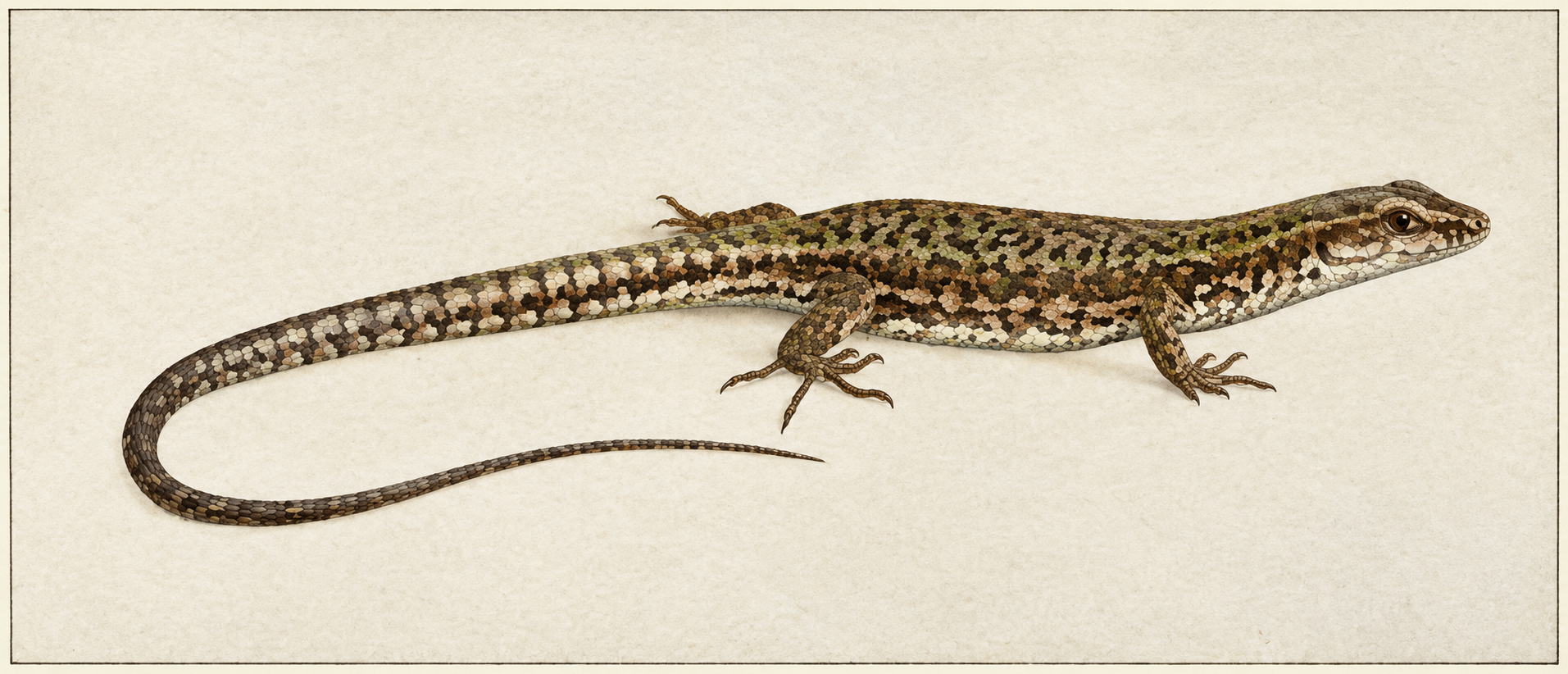
is The colour of the teguexin also notable, the ground-tint being olive or tawny yellow, upon which are superimposed black bands and markings which for the most part take a transverse direction. Like the Monitors, the teguexin Photo ly H. G. F. Spurrell, Esq.~\ [Eastbourne. WALL-LIZARD. in captivity exhibits a sulky This species is particularly abundant in Italy. and aggressive disposition,

Lizards. 575
Photo ly W. Saville-Kent, F.Z.S.j [Mi
BANDED IGUANAS.
A rare species from the Fiji Islands, Male to the right; female without bands to the left. The example crouching between them is a bearded lizard. and cannot be safely kept in company with other less powerful species. The attribute of bipedal locomotion is possessed by the teguexin. That this singular method of progression was an accomplishment possessed by one of the larger tropical American lizards was first reported to the writer from first instance,Trinidad. Some species of iguana was, in the anticipated to be the acrobatic performer. Several examples of this family group were accordingly put' through their paces at the Zoo, to ascertain if they could lay claim to the distinction. None of the iguanas available, however, rose (on their hind legs) to the occasion, and it was only on experimenting, as a derniere ressource, with the teguexin that a successful demonstration was accomplished. This lizard was found, in fact, to run bipedally more freely and persistently, when sufficient space was allotted it, than the Agamas. It seems singular that this bipedal power of locomotion should have so long remained undiscovered, and yet is possessed by lizards which have for a number of years been the denizens of many zoological gardens and other menageries. The fact that a comparatively large level area is a sine qua non for the exhibition of this phenomenon affords no doubt the explanation of this anomaly; but the anomaly itself at the same time serves to accentuate the desirability, in the interests of both science and the animals' comfort, that exists for providing them in captivity with a more liberal and reasonably sufficient space for their indulgence in those methods of i locomotion that are natural to them in their native land. Photo i,y w.saviiie-Kent, F.z.x.} \uuford-on.&a. The Greaved Lizard Family includes some-