What was Ulloa’s Circle?. Explain Ulloa’s Circle as a rare fog-bow effect observed on Pambamarca, where a traveler saw his own image reflected in the air within colored rings. Keep the focus on the eerie personal nature of the apparition and the role of fog, sunlight, and tiny water drops.
Ulloa’s Circle on Pambamarca
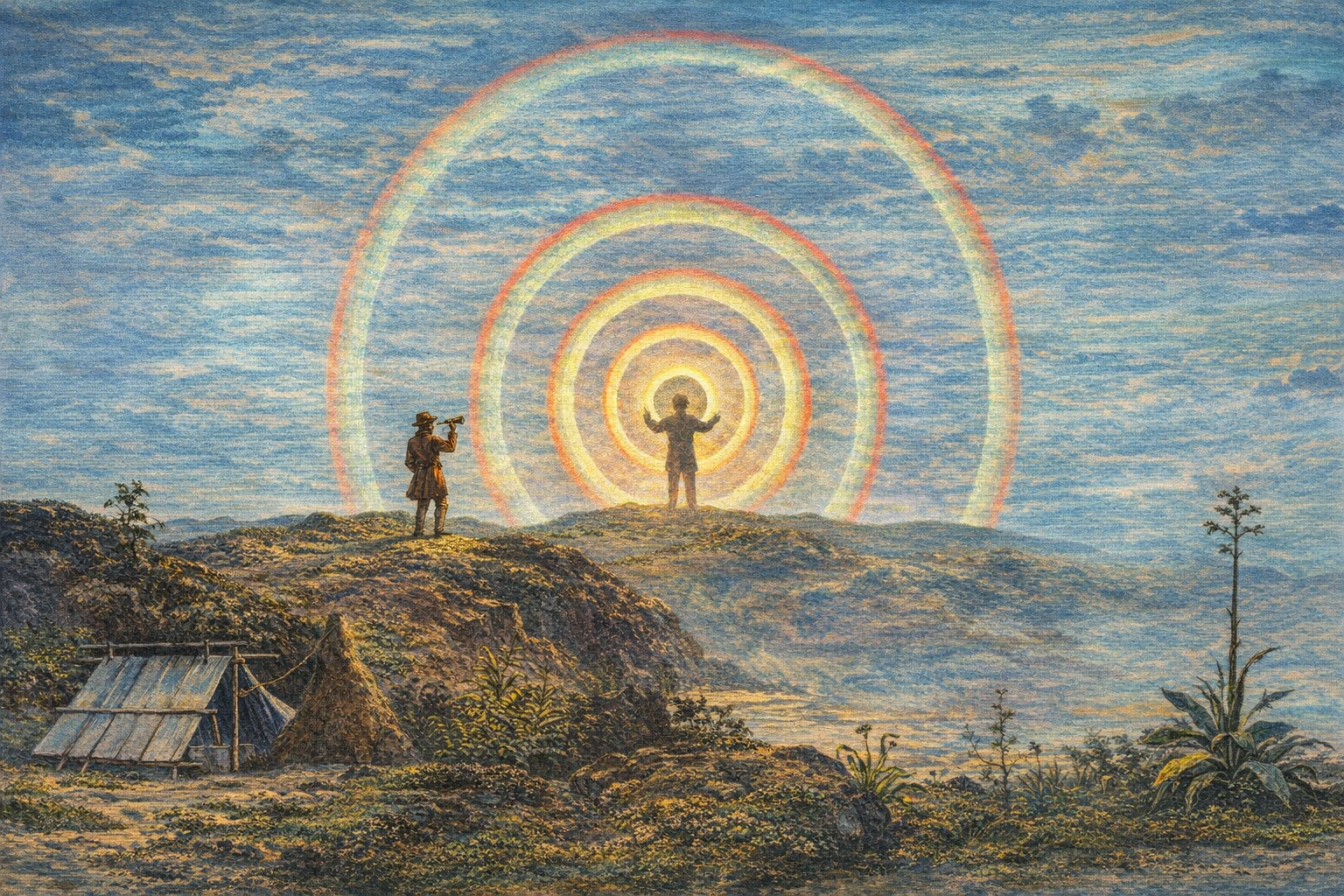
Ulloa’s Circle was a rare, unusually faint or nearly white fog bow. On the summit of Pambamarca at daybreak, a traveler facing away from the rising Sun saw his own image apparently reflected in the air, about twelve feet away, enclosed by colored rings. The apparition was an optical effect created by sunlight interacting with tiny water droplets in the surrounding fog and vapor, not a separate person or physical object.[1][2]
What the travelers saw
Dense fog initially surrounded the travelers. As the Sun rose, it dispersed, leaving only thin, vaporous clouds. When one traveler turned toward the part of the sky opposite the rising Sun, he saw a figure that copied his posture and movements. The figure appeared inside three concentric, multicolored rings, with a fourth, single-colored ring around them.[3][4]
The rings stayed centered on the observer’s own image. Each traveler experienced the same effect individually: each saw a reflection of himself, rather than an image of one of his companions. This behavior is consistent with the phenomenon being tied to the observer’s position relative to the Sun and the fog droplets in front of him.[5]
How fog and sunlight produced the apparition
The source explains that the size of the water droplets determined how strongly the rainbow colors appeared. Larger drops, such as those found after a heavy shower, produce vivid rainbow colors. Fog, by contrast, consists of minute droplets, so the colors are extremely faint. Ulloa’s Circle was therefore associated with the very small droplets in the thin fog and vapor present on Pambamarca that morning.[6]
Sunlight supplied the illumination. With the observer looking opposite the rising Sun, the light encountered the tiny droplets suspended in the fog and was redirected toward the observer’s line of sight. The resulting faint, colored rings appeared around the observer’s antisolar direction, visually enclosing the observer’s shadow or image and making it seem like a self-reflecting figure in the air. This is the optical meaning of the “reflection”: the droplets formed the luminous background and rings, while the observer’s own position determined whose figure appeared at their center.[7][8]
- Dense fog provided the suspended water droplets.
- The droplets were extremely small, making the colors pale and nearly white.
- The rising Sun illuminated the fog from behind the observer.
- The geometry of the light and droplets centered the rings on the observer’s own image.
- As the fog thinned and sunlight strengthened, the effect weakened and vanished.
Why the circle changed and disappeared
As sunlight increased, the rings changed from somewhat oval forms into nearly perfect circles and grew larger. Their colors then faded, the reflected figure became less distinct, and the entire apparition disappeared. The changing appearance linked the event to transient conditions in the fog and vapor: once those conditions altered, the droplets could no longer produce a visible ringed image.[9]
Summary
Ulloa’s Circle was a fleeting fog-bow phenomenon in which an observer saw his own silhouette within faint colored rings. At Pambamarca, the combination of a low Sun, a viewpoint opposite the Sun, and a cloud of exceptionally tiny water droplets created the pale rings and centered them on the observer. As the Sun rose and the fog dispersed, the rings expanded and became more circular, then faded along with the eerie self-image.[10][11][12]
Create your account to keep this answer and continue from it later.
Let's look at alternatives:
- Modify the query.
- Start a new thread.
- Remove sources (if manually added).