What caused the failure of the Mariner I mission to Venus?. Explain the technical glitch involving a software error and a guidance antenna that led to the destruction of NASA's first Venus probe. The answer will detail the 'most expensive hyphen in history' and the range safety signal that ended the mission.
The Mariner 1 Mission and the Most Expensive Hyphen in History
The history of robotic deep space exploration is a complex narrative filled with both monumental triumphs and devastating setbacks. A comprehensive and detailed record of these early and modern endeavors is meticulously documented in the NASA publication, "Beyond Earth: A Chronicle of Deep Space Exploration, 1958 to 2016"[1]. Authored by Asif A. Siddiqi, this extensive chronicle serves as an updated and revised edition of a monograph that was first published in 2002[1]. The book aims to provide brief, factual descriptions of all robotic deep space missions, listing them chronologically by their respective launch dates[1]. The scope of this historical record is vast; it covers any probe launched to encounter a specific target, such as planets, moons, or comets, as well as those spacecraft sent into solar orbit or positioned at a libration point in space[1]. Siddiqi's chronicle includes both the successful missions that expanded our understanding of the universe and the failed attempts that provided harsh but necessary lessons for future engineers[1].
Mariner 1 Launch Vehicle
Historical photograph of the Mariner 1 spacecraft or its Atlas launch vehicle on the launch pad in 1962.
The documented missions range from early probes that tragically exploded on the launch pad to advanced spacecraft that are currently heading beyond the boundaries of our solar system[1]. The descriptions within the book concentrate heavily on dynamic mission events, such as course corrections, orbital insertions, and planetary landings, rather than focusing solely on the scientific results obtained[1]. As the author explicitly notes, the book is designed to be more about what actually happened during the mission rather than what was scientifically discovered[1]. It is within this meticulously documented historical context that we examine the fate of Mariner 1. Launched on July 22, 1962, Mariner 1 was an ambitious mission with the primary objective of reaching the planet Venus. As the first Venus probe developed by NASA, the mission represented a significant technological leap in early planetary exploration efforts. However, the mission did not achieve its intended goal. Instead, it became a famous and highly scrutinized example of how minor technical oversights can lead to catastrophic outcomes in the unforgiving environment of spaceflight.
A Fatal Combination of Errors
The destruction of the Mariner 1 spacecraft was not the result of a single, isolated catastrophic explosion, but rather a cascading sequence of technical glitches that doomed the vehicle shortly after liftoff. The ultimate failure of the mission was caused by a fatal combination of two distinct issues: a hardware malfunction and a critical software error. First, the mission experienced a significant hardware issue involving a malfunctioning guidance antenna located on the Atlas booster. This antenna was a critical component of the launch vehicle, responsible for maintaining communication with ground control and receiving essential guidance commands during the highly dynamic ascent phase of the launch. The malfunction of this antenna severely compromised the ability of the launch vehicle to receive accurate and timely guidance data, leaving the rocket vulnerable to deviations from its planned flight path.
The Missing Superscript Bar Concept
A conceptual illustration representing the software error that doomed Mariner 1.
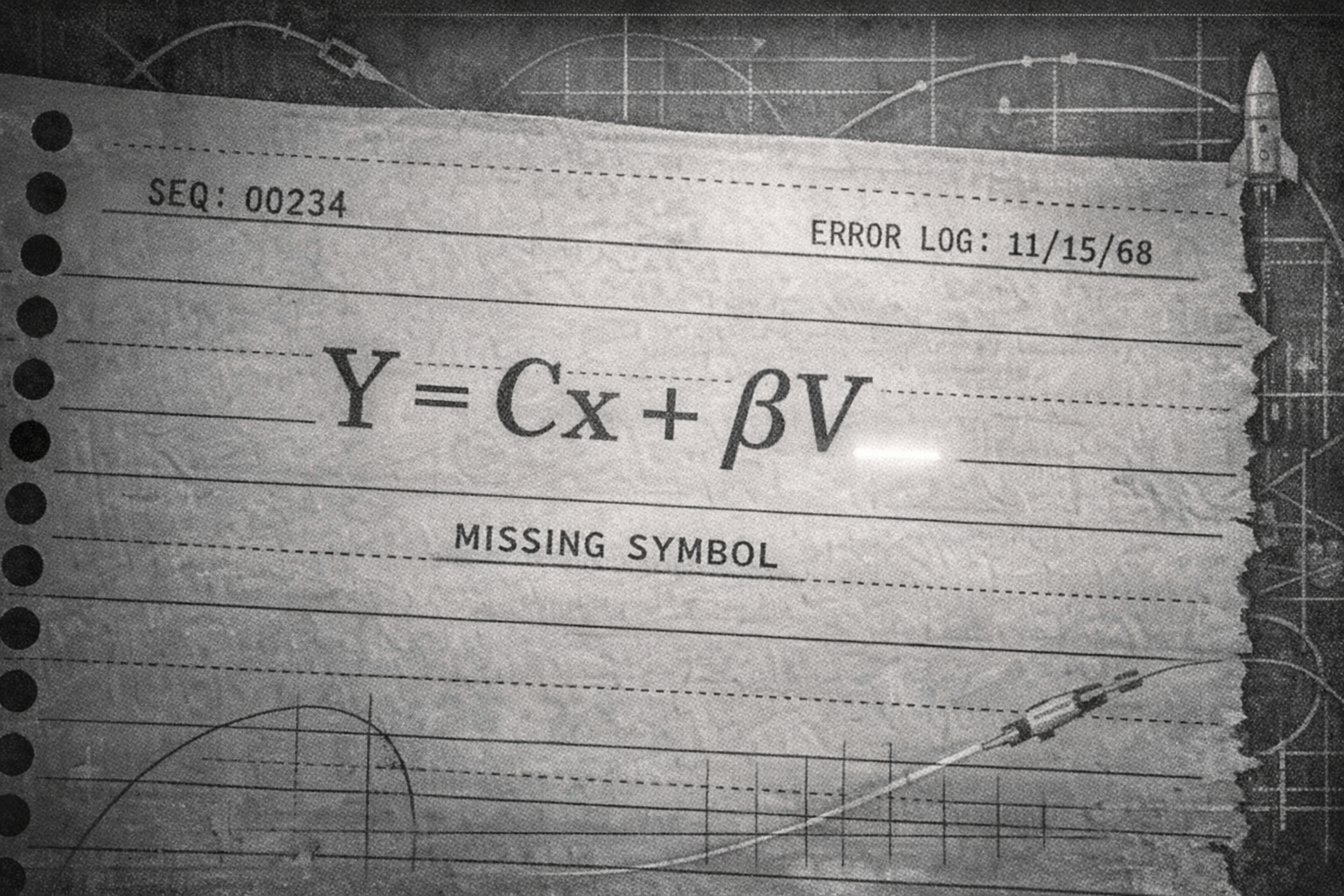
Compounding the hardware failure of the guidance antenna was a critical software error embedded in the onboard guidance program. The software glitch was eventually traced back to a seemingly insignificant typographical error in the mathematical equations used to program the system: a missing superscript bar. This missing symbol fundamentally altered the mathematical instructions provided to the guidance system. Under normal circumstances, the software might have functioned adequately, but when the guidance antenna malfunctioned, the flawed software program was unable to correctly compensate for the loss of the radio signal. Instead of stabilizing the rocket, the erroneous code led to erratic and uncontrollable behavior. This tiny omission in the programming code has since been famously described in aerospace history as "the most expensive hyphen in history" due to the immense financial cost associated with the loss of the sophisticated spacecraft and its massive launch vehicle.
The Range Safety Signal and Mission End
As a direct result of the malfunctioning guidance antenna on the Atlas booster and the flawed onboard guidance program, the launch vehicle and the Mariner 1 spacecraft began to veer dangerously off their planned flight path. The incorrect trajectory posed a significant and immediate risk to safety. An out-of-control rocket of that size, fully loaded with highly volatile rocket propellant, could potentially crash into populated civilian areas or busy commercial shipping lanes, causing unacceptable damage and loss of life. Faced with an unrecoverable trajectory and a rapidly deteriorating situation, the Range Safety Officer monitoring the launch was forced to take decisive and final action to prevent a potential disaster.
At exactly T+294.5 seconds after launch, a deliberate range safety signal was transmitted to the vehicle. This command intentionally detonated the explosive charges on the rocket, destroying both the Atlas booster and the Mariner 1 probe, bringing an abrupt and explosive end to the mission. The loss of Mariner 1 is one of many failed attempts documented in the extensive history of deep space exploration, a record that includes numerous probes that exploded on the launch pad or failed shortly after liftoff[1]. The chronicle of these missions, drawn from original NASA sources and official Russian language documents to avoid errors found on unofficial websites, focuses heavily on what happened during these dynamic events rather than the scientific data that might have been discovered[1]. In the case of Mariner 1, what happened was a harsh and expensive lesson in the unforgiving nature of space exploration, where a single missing superscript bar can lead to the total loss of a mission and earn the infamous title of the most expensive hyphen in history.
Create your account to keep this answer and continue from it later.
Let's look at alternatives:
- Modify the query.
- Start a new thread.
- Remove sources (if manually added).