The Pitcher Plant With Lodgers
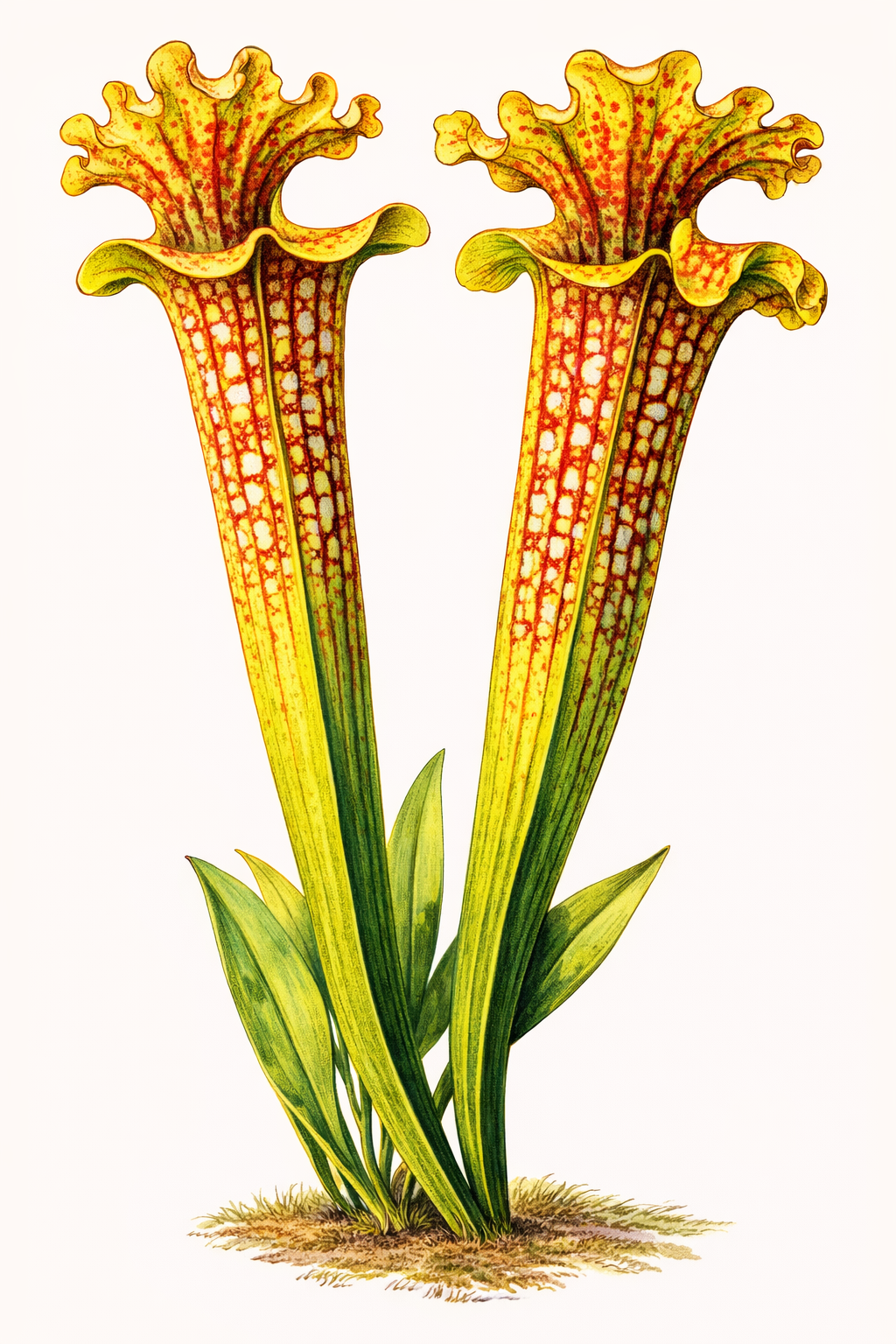
A trap that feeds more than the plant
Cooke's side-saddle flowers, the North American Sarracenias, turn a whole leaf into an upright trumpet.[1] A honey-baited path leads insects up to the mouth,[2] and inside, downward-pointing hairs stop them climbing back until they drown in the fluid at the bottom.[3]
The catch attracts freeloaders. A writer Cooke quotes says insects “too wary to be entrapped themselves” drop their eggs into the open pitchers, so old pitchers hold living larvae and maggots.[4] Barton even reported insect-eating birds slitting pitchers open with their beaks to get at the contents.[5]
Professor C. V. Riley studied two of these lodgers. In his summary, as Cooke gives it, the parasitic moth is “a mere intruder, its larva sharing the food obtained by the plant,” while the fly that breeds there has no other connexion with the plant “than that of a destroyer.”[6]
Too much food could be a problem too. In 1879 the Royal Horticultural Society's Scientific Committee heard of a cultivated species whose pitchers drew so many flies that they became gorged and were destroyed, until the grower blocked their mouths with cotton-wool.[7] To Cooke, this suggested that animal food is not essential to at least one species.[8]
His own verdict was cautious. With no digestive secretion yet demonstrated, the Sarracenias “can only be charged with destroying insects, and not with devouring them.”[9] Riley, by contrast, called Sarracenia “a truly insectivorous plant.”[10] Both are Victorian judgements, reported here as Cooke recorded them.
Let's look at alternatives:
- Modify the query.
- Start a new thread.
- Remove sources (if manually added).