The Future of Information Retrieval: Search Engines vs. Personal Assistants
The Future of Search: Will Personal Assistants Displace Traditional Search Engines?
For decades, the search engine has been the undisputed gateway to the internet, a digital library where users type queries to navigate a vast ocean of information. This paradigm, dominated by titans like Google, is now facing a significant evolutionary challenge. The rise of intelligent personal assistants, powered by advancements in artificial intelligence and natural language processing, presents a new, conversational model for information retrieval. These assistants, embedded in our smartphones, smart speakers, and other devices, offer a more integrated and often hands-free way to access data, manage tasks, and control our digital environment.
This report examines the critical question of which modality is more likely to become the primary place for information seeking in the future. By analyzing current market share, user adoption trends, and expert predictions on technological convergence, we will explore the probable trajectory of both search engines and personal assistants. The analysis will determine whether one is poised to replace the other or if a more complex, hybrid future awaits, fundamentally altering how we interact with information.
Convergence of Search and Conversation
An abstract visualization illustrating the merging of a traditional search bar with the fluid, conversational interface of an AI personal assistant, symbolizing the future of information retrieval.

Current Market Dynamics: A Tale of Two Metrics
When comparing the current standing of search engines and personal assistants, it becomes clear they are measured by different yardsticks. Traditional search engines continue to command an overwhelming majority of user interactions for information retrieval. Google's dominance is particularly stark, holding approximately 90.04% of the global search engine market, a figure that climbs to 94.35% on mobile devices[1]. Other competitors like Bing, Yahoo!, and DuckDuckGo occupy the remaining single-digit percentages, highlighting the entrenched user habits surrounding conventional search[1].
In contrast, the influence of intelligent personal assistants is not typically measured by the percentage of search queries they handle but rather by their economic footprint and projected growth. The Intelligent Personal Assistant Market was valued at approximately USD 12.55 billion in 2024 and is forecast to expand dramatically to USD 268.26 billion by 2035, demonstrating a compound annual growth rate of about 32.1%[3]. This indicates that while they may not yet rival search engines in query volume, their integration into the broader technology ecosystem represents a rapidly growing and highly valued market segment[4].
| Metric | Search Engines | Personal Assistants |
|---|---|---|
| **Primary Measure of Dominance** | Market Share (Percentage of user queries) | Market Valuation (Economic growth and potential) |
| **Current User Interaction Model** | Keyword-based queries, list of links (SERP) | Conversational, voice- or text-based commands |
| **Market Leader (Example)** | Google (~90% market share)[1] | Multiple players (Amazon, Google, Apple, Microsoft)[4] |
| **Growth Trajectory** | Mature, stable market with incremental innovation | Emerging, high-growth market with rapid expansion[3] |
This disparity in metrics shows that search engines currently own the act of searching, while personal assistants are capturing value through integration, convenience, and expanding use cases beyond simple information retrieval. The innovations in generative AI are making search more conversational and assistive, but this has not yet translated into a direct challenge to the market share of established search engines[2].
The Rise of Conversational Search: Usage and Adoption Trends
The growth in personal assistant usage is most evident in the rapid adoption of voice search. This conversational method of querying is becoming a significant channel for information retrieval. In 2025, voice search reportedly accounted for 20.5% of all global internet queries[5]. This trend is fueled by increasing user comfort and the proliferation of enabled devices. The percentage of smartphone owners utilizing voice search capabilities rose from 45% in 2024 to 60% in 2025, indicating a substantial shift in user behavior[5][8].
Voice Assistant Interaction
A person interacting with a smart speaker in their living room, illustrating the seamless integration of voice assistants into daily life and the connected home environment.
The adoption rates are particularly high among younger demographics and are predominantly mobile-driven. Data reveals several key trends:
- More than 50% of global searches are now conducted through voice interfaces[6].
- Among adults aged 18–34, 77% use voice assistants on their smartphones[6].
- An overwhelming 91% of voice assistant interactions occur on mobile devices[6].
- In the United States, half of all mobile users engage with voice assistants daily for search tasks, and 92% use them for online searches in general[7].
This momentum is largely driven by the widespread deployment of personal assistants on billions of smart devices. As these assistants become more deeply integrated into connected homes and mobile operating systems, their convenience and utility increase, further encouraging users to adopt voice as a primary method for quick searches and hands-free tasks[8].
Future Projections: Convergence and Transformation
Looking ahead, experts predict not a replacement but a fundamental transformation and convergence of both technologies. By 2026, traditional search engines are expected to be reshaped by AI, evolving from their classic 'ten blue links' format into conversational interfaces that provide direct, contextually rich answers[10][12]. In this new paradigm, the AI-powered search result is the destination, synthesizing information and answering queries immediately within the interface[10]. This shift will redefine success metrics, moving away from clicks and impressions toward the quality and directness of the answer provided.
Simultaneously, AI personal assistants are projected to become more sophisticated and proactive. Their role will expand beyond handling simple commands to interpreting context and anticipating user needs, much like a human assistant[9]. They will manage routine tasks like scheduling and information retrieval while also offering support for more complex, higher-value work, thereby freeing up human capacity[13]. This evolution effectively merges the functions of search with broader personal and professional management.
The Proactive AI Assistant
A futuristic depiction of an AI personal assistant proactively organizing a user's day, with holographic interfaces showing calendar events, synthesized news briefings, and suggested tasks, all without direct user queries.
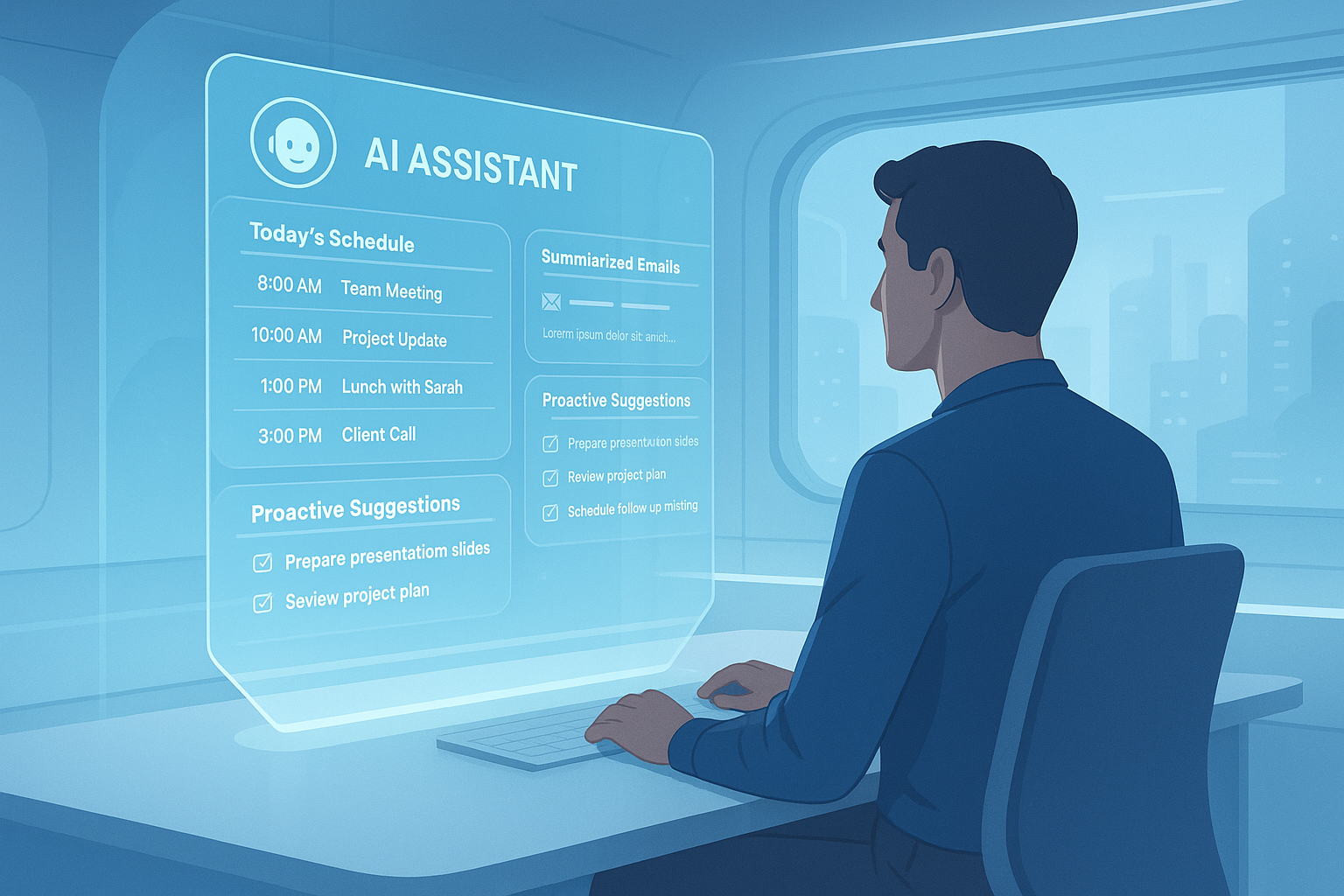
This convergence means the lines between searching for information and managing one's digital life will become increasingly blurred[12]. AI assistants are poised to become the primary gateway through which users discover products, services, and information, making it essential for brands and content creators to optimize their digital presence for both human queries and AI agents[10][11]. The future of search appears to be an ambient, integrated experience woven into various devices and platforms.
Conclusion: A Symbiotic Future Rather Than a Replacement
The evidence suggests that the future of information retrieval is not a zero-sum game where personal assistants will simply replace search engines. Instead, we are witnessing a profound evolution and convergence of both. Search engines are shedding their traditional form, incorporating AI to become more conversational, direct, and assistant-like in their delivery of information[10]. They are moving from being a directory to being an answer machine.
At the same time, personal assistants are expanding their capabilities far beyond simple search. They are becoming proactive, context-aware agents designed to manage and simplify our digital lives[9][13]. While search is a core function, it is just one component of a much broader feature set that includes task management, device control, and personalized recommendations.
Therefore, it is most probable that neither will be the sole 'main place' for search. Instead, the concept of a single destination for search will dissolve. The future points toward a symbiotic relationship where the underlying technology of search engines powers the information-retrieval capabilities of personal assistants, which in turn serve as the primary, conversational user interface. The act of searching will become an ambient, integrated experience, initiated through voice or text depending on the context, with the distinction between 'using a search engine' and 'asking an assistant' becoming functionally irrelevant to the end-user.
References
Get more accurate answers with Super Pandi, upload files, personalized discovery feed, save searches and contribute to the PandiPedia.
Let's look at alternatives:
- Modify the query.
- Start a new thread.
- Remove sources (if manually added).
 Curated by Joan