Humans to Mars: Fifty Years of Mission Planning, 1950-2000
Humans to Mars: Fifty Years of Mission Planning, 1950-2000
David S. F. Portree's history shows that Mars mission planning was never simply an engineering exercise. Across five decades, designers repeatedly found technically credible ways to reach Mars, yet politics, cost, changing priorities, scientific discoveries, and institutional continuity usually determined whether those plans advanced. [1][2]
The central lesson is practical: successful human exploration would require a clear purpose, disciplined mission scope, sustained political support, intelligent cooperation between robots and astronauts, and technologies that reduce dependence on Earth. [3][4]
Why Mars remained compelling
Mars attracted planners because it is relatively Earth-like, preserves evidence of past water and climate, may contain signs of ancient life, and offers resources that could support exploration or eventual settlement. These scientific possibilities gave human missions a purpose beyond simply repeating the achievement of reaching another world. [5]
At the same time, the rationale for sending people was repeatedly questioned. Robots could often conduct reconnaissance and collect samples more cheaply and with less risk, while human crews faced radiation, isolation, long-duration life support, planetary-protection concerns, complex logistics, and extraordinary cost. [6]
- Robots offered lower-cost access to difficult or dangerous environments. [7]
- Astronauts could potentially travel farther across the surface, adapt fieldwork to unexpected discoveries, deploy instruments, and interpret samples immediately. [8]
- The strongest case for people therefore depended on defining tasks where human judgement and mobility produced benefits that justified the additional risk and expense. [9][10]
How mission concepts changed
| Period | Planning direction | What changed |
|---|---|---|
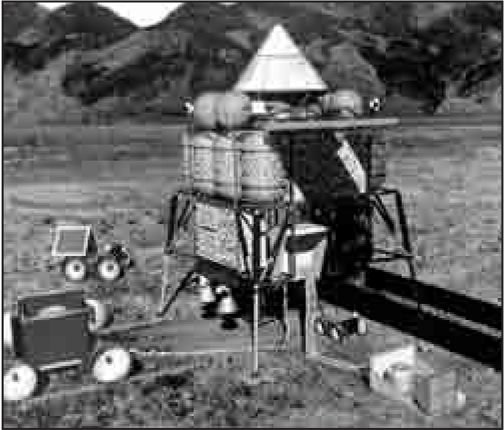
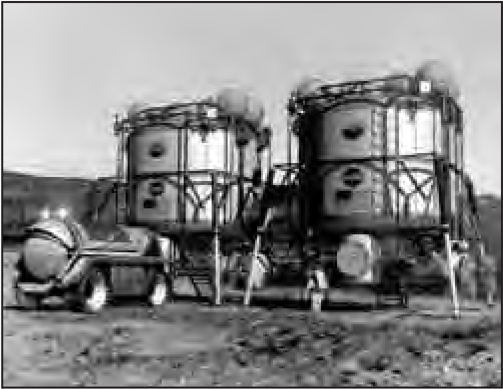
| 1950s | Large flotillas, many launches, large crews, and long conjunction-class journeys. [11] | Mars was framed as the major successor to the Moon. |
| 1959-1964 | Studies examined nuclear-thermal, electric, chemical, flyby, orbiter, and landing missions. [12] | Planning became more systematic, addressing radiation, artificial gravity, aerobraking, rendezvous, redundancy, and launch timing. |
| 1965-1971 | Mariner 4 revealed a thin atmosphere, craters, higher-than-expected radiation, and no visible canals. [13] | Earlier assumptions were overturned, undermining some aerodynamic landers and piloted-flyby concepts. |
| 1970s-1980s | Mariner 9 and Viking revealed volcanoes, channels, possible ancient water, and useful surface materials. [14] | Local resources became central to plans for producing oxygen, methane, and life-support consumables on Mars. [15] |
| 1989-1993 | The Space Exploration Initiative produced major studies but failed to secure durable political and financial support. [16] | The episode demonstrated that a presidential announcement alone could not sustain a Mars programme. |
| 1990s | Mars Direct and NASA reference missions favoured conjunction-class flights, aerobraking, local resource use, split architectures, and reduced dependence on lunar or low-Earth-orbit infrastructure. [17][18] | Planning shifted from spectacular national projects toward incremental and potentially more affordable preparation. |
The technical problems that shaped every plan
Propellant mass was the recurring systems problem. Every mission had to pay for departure from Earth, arrival at Mars, movement around or from the planet, and the return journey. This made trajectories, propulsion systems, staging, aerobraking, and local resource production tightly connected design choices. [19]
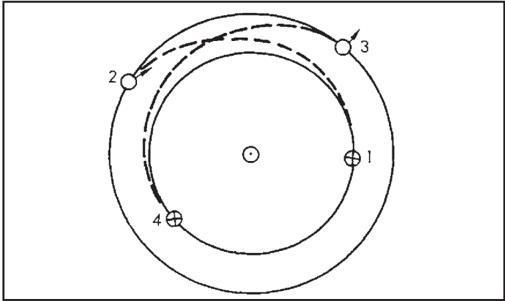
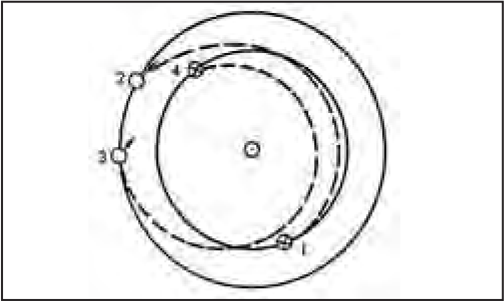
Conjunction-class missions generally reduced propellant and spacecraft mass by using relatively low-energy transfers, but they required missions lasting roughly 900 to 1,100 days and a long stay on Mars. Opposition-class missions offered a shorter stay, but demanded a much more energetic return and therefore more propellant. [20][21]
- Aerobraking: using a planet's atmosphere to lose spacecraft speed and reduce the propellant required for arrival or departure. Its usefulness depended on accurate knowledge of the atmosphere and careful control of heating and trajectory. [22]
- Redundancy: carrying backup ships, habitats, spare parts, reserve landers, or rescue options. These measures improved crew safety but added mass and cost. [23]
- In-situ resource utilisation: using local materials rather than transporting every consumable from Earth. By the 1990s, plans prominently considered producing oxygen and methane propellants on Mars. [24][25]
- Split architectures: dividing the mission among separately launched vehicles, habitats, cargo craft, or return systems so that no single spacecraft had to carry every requirement from Earth. [26]
The recurring tension between ambition and affordability
The late 1960s represented a technical and conceptual high point. NASA and industry studied piloted flybys, nuclear-rocket landings, and very large spacecraft. Yet Vietnam, domestic unrest, budget pressure, the Apollo 1 fire, and the termination of Saturn V and NERVA halted that momentum. [27]
Later proposals responded by making the mission smaller, more modular, or more dependent on technologies that could be developed incrementally. Private groups and individuals revived the subject through the Case for Mars conferences, The Planetary Society, base studies, cyclers, Lagrange-point staging, and possible US-Soviet cooperation. [28]
This evolution did not mean that the fundamental difficulties had disappeared. It meant that planners increasingly treated affordability and continuity as design requirements rather than as questions to be addressed after the ideal mission had been defined. [29][30][31]
What the history ultimately teaches
Mars knowledge repeatedly changed mission architecture. Early telescope-based assumptions about canals, atmosphere, landing conditions, and life were overturned by spacecraft observations, while later evidence of ancient water and possible biological traces renewed scientific interest. [32][33]
The history also shows that technological ideas tend to recur. Later planners repeatedly rediscovered concepts such as aerobraking, artificial gravity, cyclers, local resource use, and split mission architectures. Preserving earlier studies therefore has practical value, because it prevents future programmes from paying to reinvent solutions already explored. [34]
By 2000, the direction of travel was clear: robotic precursor missions, Earth-based technology development, demonstrations of local resource production, human-factors research, realistic surface operations, and reference architectures that could be refined over time. NASA had begun integrating robotic and human Mars planning and recognised that people might eventually reach Mars without another Apollo-scale national mobilisation. [35]
Conclusion
Portree's overall conclusion is measured rather than triumphalist. Human Mars flight was neither shown to be imminent nor judged impossible. The past fifty years demonstrated that credible technical routes could be identified, but also that cost, infrastructure, institutional weakness, shifting national priorities, and fragile political commitment could stop them. [36]
The enduring insight is that Mars exploration must be designed as a sustained programme, not a one-off gesture. A durable effort would need a clear reason for sending people, controlled scope and cost, continuity across political cycles, early attention to planetary protection, effective use of robots and Martian resources, and a realistic account of what astronauts can do that machines cannot. [37]
Create your account to keep this answer and continue from it later.
Let's look at alternatives:
- Modify the query.
- Start a new thread.
- Remove sources (if manually added).