Space Settlements: A Design Study 1977
Space Settlements: A Design Study 1977
The study asks how humans could build a permanent community beyond Earth, and its central answer is that settlement is technically plausible but depends on solving social, economic, ecological, and organizational problems as carefully as engineering problems.[1] The proposed colony is meant to be a real community where people work, raise families, live ordinary lives, and generate enough value to maintain itself and expand.[2]
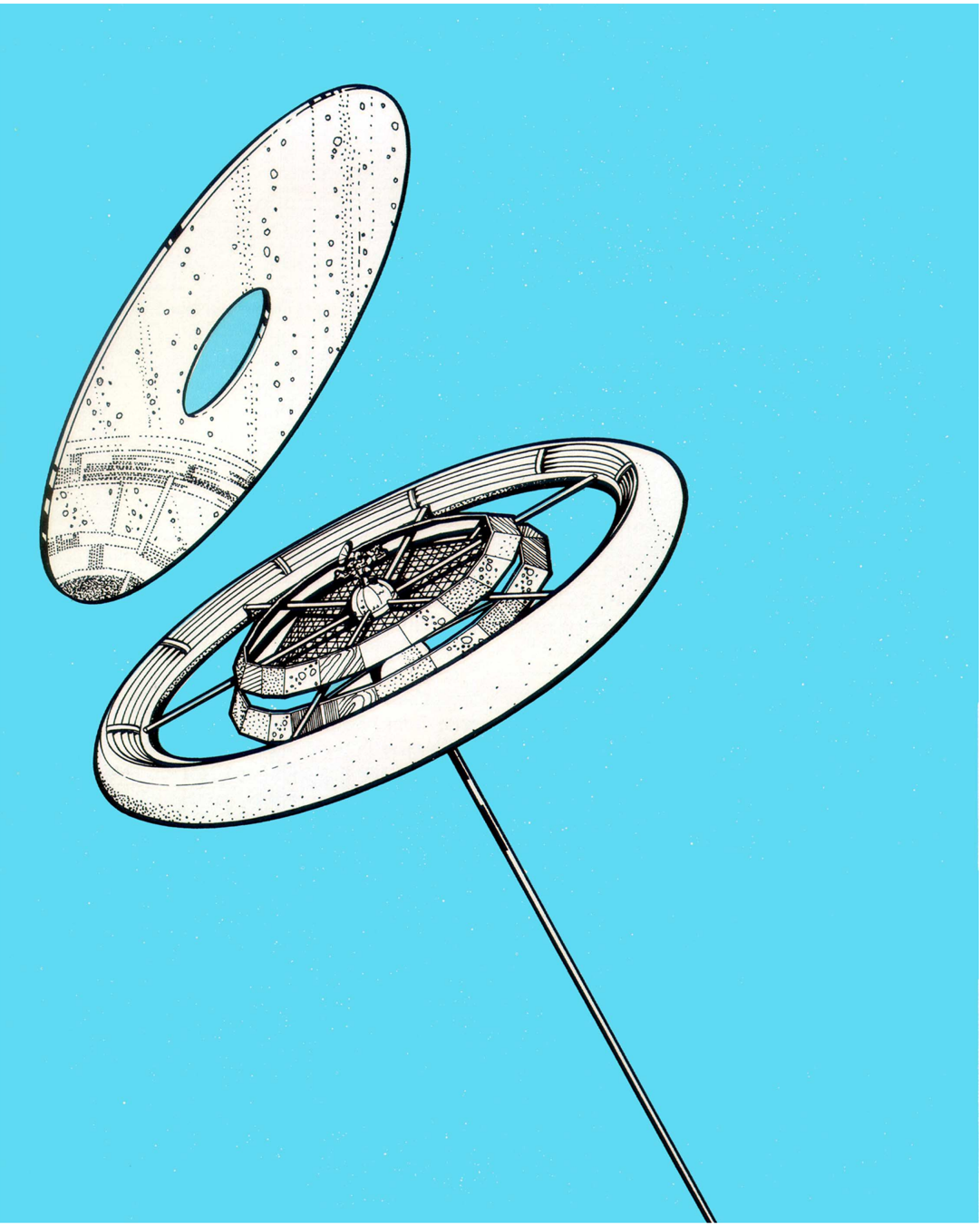
The baseline colony
The reference design is a settlement for 10,000 permanent residents in a rotating torus, located near the Earth-Moon L5 libration point. L5 is a gravitationally favorable region selected for comparatively practical connections to both Earth and the Moon.[3][4]
| System | Proposal | Why it matters |
|---|---|---|
| Habitat | Rotating torus about 1,790 m in diameter, with a tube approximately 130 m across and six spokes leading to a central docking hub.[5] | The geometry combines usable living area, structural practicality, and a sense of openness. |
| Artificial gravity | Rotation at 1 revolution per minute, producing approximately 0.9 to 1 g.[6] | The study uses near-Earth gravity as a conservative response to uncertainty about long-term weightlessness and partial gravity.[7] |
| Radiation protection | A separate passive shield made from roughly 4.5 tonnes of lunar material per square metre, totaling about 9.9 million tonnes for the torus.[8] | Shielding is treated as one of the colony's largest mass and transport challenges. |
| Resources | Lunar soil provides bulk materials such as oxygen, aluminum, silica, construction feedstock, soil, and shielding mass. Earth initially supplies hydrogen, carbon, nitrogen, specialized equipment, and some biological material.[9] | Using lunar material avoids launching all large structural masses from Earth's deeper gravity well.[10] |
| Food and life support | Intensive agriculture combines crops, livestock, fish, atmospheric regeneration, water recovery, waste processing, and nutrient recycling.[11][12] | Life support is designed as an integrated ecological system rather than a set of independent machines. |
| Economic activity | The principal commercial enterprise is manufacturing solar power satellites for delivery to geosynchronous orbit, alongside colony construction and other space manufacturing.[13][14] | Exports are necessary because a population of 10,000 cannot internally provide every modern good, service, and cultural function.[15] |
How the colony would work
- Lunar materials processing: Lunar soil would be processed near the colony using solar furnaces and chemical or electrochemical methods to produce aluminum, oxygen, glass, and other materials.[16]
- Sunlight and day-night cycles: Stationary and rotating mirrors would direct sunlight into the torus. Segmented mirrors would regulate illumination and create day-night cycles in residential and agricultural areas.[17]
- Agricultural resilience: Three agricultural areas would contain controlled zones that could be isolated, helping contain disease and preserve food production if one section failed.[18]
- Waste recovery: Continuous wet oxidation would sterilize waste, recover water, return nutrients, and generate carbon-dioxide-rich gas for agricultural use.[19]
- Radiation shielding at windows: Mirrored chevrons would admit sunlight while limiting direct particle radiation through window areas.[20]
- Adaptable interiors: Lightweight aluminum frames, non-load-bearing panels, prefabricated mechanical systems, and modifiable layouts would allow residents to change interior spaces over time.[21]
The design is therefore more than a pressure vessel. It links mining, transport, energy, agriculture, recycling, manufacturing, habitation, and social organization into one operating system.[22]
Key assumptions and trade-offs
The study deliberately makes conservative choices where evidence was limited. It assumes near-Earth gravity, a general-population radiation limit of no more than 0.5 rem per year, and a reduced-pressure atmosphere of about 50.8 kPa with normal oxygen partial pressure, nitrogen as buffer gas, low carbon dioxide, and controlled humidity.[23][24][25]
Its agricultural model is highly demanding: year-round cultivation with controlled carbon dioxide, lighting, temperature, water, and nutrients is assumed to feed 10,000 people using about 61 hectares.[26] At the same time, the first settlement is not expected to be fully self-sufficient. It would remain dependent on Earth for some materials, advanced equipment, expertise, and replacement goods for an extended period.[27][28]
The torus is presented as a compromise. Other forms could offer advantages in volume or structural mass, but the study considered them less satisfactory for psychological reasons, including shorter sightlines, reduced apparent openness, more complicated circulation, and a stronger sense of confinement.[29] The Moon itself is rejected as the principal habitat location because it lacks continuous sunlight, imposes one-sixth Earth gravity, and is less well placed for sending solar power satellites to geosynchronous orbit.[30]
Major insights
- Mass drives the project. Radiation shielding requires millions of tonnes, and transportation is expected to remain the largest cost category. Access to lunar oxygen is projected to reduce transportation costs substantially.[31]
- Economic self-sufficiency is different from social self-sufficiency. The colony might balance imports and exports economically, yet 10,000 people could not supply the full range of skills, institutions, cultural variety, and services associated with a modern society.[32]
- Human factors are infrastructure. Privacy, communication with Earth, diversity, return migration, flexible governance, varied spaces, natural light, living organisms, and views beyond the habitat are treated as important responses to isolation and social stress.[33][34]
- Expansion is part of stability. New settlements would create markets, labor opportunities, cultural diversity, and innovation, while reducing the risk that the first colony becomes socially and economically stagnant.[35][36]
- The proposal is a starting point, not a final blueprint. The study was produced in a ten-week effort, was not fully optimized, and used conservative assumptions because key physiological, ecological, economic, and engineering data were unavailable.[37]
- Future evidence could change the architecture. Improved knowledge of partial gravity, radiation tolerance, agriculture, automation, materials processing, propulsion, active shielding, and asteroid resources could favor different habitat sizes, shapes, pressures, or locations.[38]
Overall assessment
The report's deepest insight is that space settlement should be understood as the beginning of an industrial and cultural civilization, not as the construction of a single spacecraft. Its L5 torus is a conservative demonstration case: technically ambitious, dependent on lunar resources and highly productive ecological systems, initially tied to Earth, and economically justified through space-based energy production.[39]
The authors consequently call for further systems research on radiation, artificial gravity, closed ecology, intensive agriculture, lunar processing, transportation, human factors, governance, environmental effects, and the economics of space-based energy.[40] The lasting lesson is that keeping people alive in space is only the first requirement. A viable settlement must also support health, meaning, economic exchange, cultural growth, and the ability to create new communities.
Create your account to keep this answer and continue from it later.
Let's look at alternatives:
- Modify the query.
- Start a new thread.
- Remove sources (if manually added).