Summarize the key points and insights from the sources
Curious Facts in the History of Insects: A Victorian Exploration of Entomology and Folklore
Published in 1865, Frank Cowan's Curious Facts in the History of Insects presents a comprehensive compilation of legends, superstitions, and historical accounts related to insects, spiders, and scorpions[1]. The work is not a scientific treatise on the natural history of insects; rather, it is a deliberate collection of what the author terms 'extra-scientific facts' gathered from chronicles, histories, and travelogues[1]. Cowan's primary objective was to increase interest in the science of entomology by showcasing the rich tapestry of human belief and culture that has been woven around these creatures throughout history[1].
Cowan, who began the work at the Congressional Library in Washington during the winter of 1863-4, makes a crucial distinction about his methodology[1]. He positions himself as a historical compiler, not a scientific verifier. He clarifies that he does not vouch for the scientific truth of every belief recorded, but for the historical accuracy of its existence in literature and folklore[1]. For Cowan, the fact that Pliny claimed beetles could be used as remedies is historically true, regardless of the remedy's actual efficacy[1]. This approach provides a unique window into the multifaceted and often contradictory relationship between humans and the insect world, a relationship defined by fear, reverence, utility, and artistry.
Insects as Omens and Agents of Divination
A significant portion of Cowan's work is dedicated to the role of insects in superstition and folklore, where they frequently appear as omens or tools for divination. These beliefs span a wide spectrum of human emotion, from joy and hope to terror and dread. The interpretation of an insect's appearance often depended heavily on cultural context and the specific species encountered.
- The Lady-bird: Widely seen as a 'harbinger of joy,' the Lady-bird was associated with good fortune and fine weather[1]. In Scandinavia, it was dedicated to the Virgin Mary[1]. It was also used in love divination, with young girls in Norfolk reciting rhymes to the insect to predict when they would marry[1].
- The Death-watch Beetle: In stark contrast, the clicking sound made by the Death-watch beetle (Anobium tessellatum) was a source of widespread fear, believed to be an 'omen of the death of some one in the house wherein it is heard'[1].
- The 'Coffin-cutter': In Ireland, a large beetle known as the 'Coffin-cutter' was viewed with suspicion, with the populace believing it was connected in some way to 'the grave and purgatory'[1].
- The Siamese Dream-book: Cowan references a Siamese text that provides interpretations for various encounters with insects[1]. For example, an insect falling and striking a person's face was a sign that the individual would soon marry[1].
The Entomological Apothecary: Insects in Historical Medicine
The book details a vast and curious pharmacopoeia derived from the insect world. For centuries, insects and their byproducts were prescribed for a wide range of ailments, reflecting a medical tradition where observation and superstition were often intertwined.
A Victorian Apothecary's Shelf of Insect Remedies
An assortment of glass jars and vials on wooden shelves in a dimly lit Victorian apothecary. The jars contain various insects like beetles, spiders in webs, and dried caterpillars, with handwritten labels indicating their medicinal uses such as 'For Ague' or 'Toothache Remedy'. The atmosphere is scholarly and slightly mysterious.
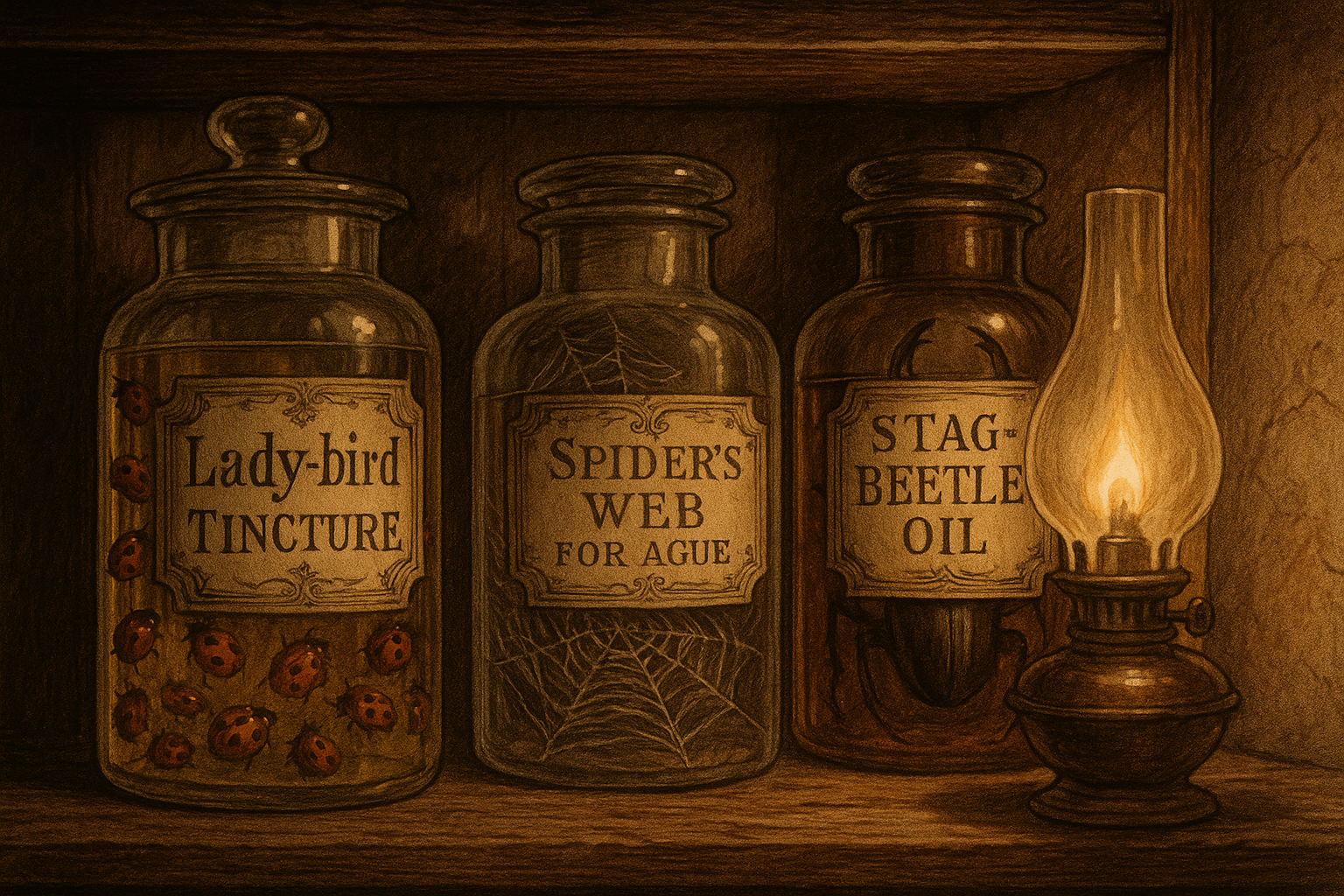
- Lady-birds were considered an effective remedy for colic and measles, and were frequently recommended as a cure for toothaches[1].
- Stag-beetles had multiple uses; their mandibles were used as an absorbent for pains, and an oil derived from the insects was dropped into ears to treat earaches[1].
- Spiders and their webs were common in folk medicine. Pills made from spider webs were considered an 'infallible cure for the ague'[1], and the webs themselves were used to stop bleeding from cuts, a practice mentioned by Shakespeare[1].
- Chinese Medicine: Cowan records that in China, the tail of a 'very deformed insect' was dried and powdered to be given to women in labor, as it was believed to 'forward their delivery'[1].
A Culinary History: The Practice of Entomophagy
Cowan documents that the practice of eating insects, or entomophagy, was far from a novelty, but a dietary staple in many cultures around the world. Insects provided a vital source of nourishment, and in some cases, were considered great delicacies.
- The Grou-grou: The large, white larva of the Palm-weevil, known as the Grou-grou, was considered 'one of the greatest dainties in the West Indies' when fried or broiled[1].
- Locusts: For Arabs in the Sahara, locusts were a crucial food source. They were prepared by being roasted, dried, and pounded into a sort of pudding or eaten whole after removing the head, wings, and legs[1].
- Silkworm Pupae: In China, the pupae of silkworms were not discarded but were eaten and 'considered delicacies'[1].
- Centipedes: The naturalist Humboldt observed Indian children in South America digging up and eating large centipedes, some of which were eighteen inches long[1].
Art, Adornment, and Imperial Symbols
The natural beauty of insects, with their iridescent colors and intricate forms, has long inspired their use in art and personal adornment. From jewelry and embroidery to religious icons and imperial symbols, insects have been incorporated into human material culture across the globe.
Personal Adornment and Jewelry
- Beetle Jewelry: In Chili and Brazil, women fashioned beautiful necklaces from 'golden Chrysomelidae and brilliant Diamond-beetles'[1]. The iridescent wing-cases (elytra) of certain beetles were used to embroider dresses in China, England, India, and Ceylon[1][1].
- Luminous Ornaments: Fire-flies (Cucujus) were used as living jewels in the West Indies and Spanish Colonies, where they were tied to garments or worn in the hair to create a dazzling, moving display of light[1]. In Italy, gentlemen would adorn the hair of ladies with glow-worms on summer evenings[1].
- Butterfly Head-dresses: The book notes the contemporary fashion of French and American ladies wearing butterflies on their head-dresses[1].
Symbolism in Art and Governance
Beyond mere decoration, certain insects were imbued with profound symbolic meaning, representing deities, creative power, and imperial authority. These symbols were carved into monuments, stamped onto currency, and woven into the very fabric of power.
- The Sacred Scarab: The Scarab beetle (Ateuchus sacer) was a central figure in ancient Egyptian religion and art[1]. As a symbol of the sun and creation, it was worshiped, carved into gems and monuments, and placed in tombs[1]. This artistic form was later adopted by the Etruscans and Greeks for their gems[1].
- The Imperial Bee: Cowan recounts the theory that the golden bees found in the tomb of the Frankish king Childeric were the origin of the Fleur-de-lis in the Arms of France[1]. Centuries later, Napoleon I and II had their imperial robes embroidered with these same golden bees[1].
- Insects on Currency: Bees were depicted on an American Continental forty-five dollar bill from 1779, and the effigies of locusts were perpetuated on ancient coins[1][1].
Plagues, Phenomena, and Passionate Collectors
The book also chronicles remarkable historical events and strange phenomena attributed to insects, as well as anecdotes revealing the profound passion some individuals have held for entomology.
- Devastating Plagues: Cowan recounts numerous historical accounts of locust swarms causing immense destruction, famine, and pestilence[1]. One such plague in Africa was said to have caused a pestilence that killed 800,000 people in the kingdom of Massinissa alone[1].
- 'Showers of Blood': The mysterious phenomenon of 'showers of blood' is explained as the red fluid discharged by vast numbers of butterflies and other insects upon emerging from their pupal state[1].
- Passionate Entomologists: An anecdote describes General Count Dejeau, an aide to Napoleon, who was so devoted to collecting that he pinned insects to his hat even during battle. After being struck in the head at the battle of Wagram, his first words upon recovering were, 'I am not dead but, alas! my insects are all gone!'[1].
Conclusion: A Multifaceted Relationship
Frank Cowan's Curious Facts in the History of Insects provides a rich and detailed summary of the historical relationship between humanity and the insect world. The book demonstrates that insects have been far more than just pests or objects of scientific curiosity. They have been deities, omens, medicines, food sources, artistic muses, and symbols of imperial power[1]. Cowan's work successfully achieves its goal of making entomology more engaging by showing that the story of insects is inextricably linked to the story of human culture, belief, and history.
References
Get more accurate answers with Super Pandi, upload files, personalized discovery feed, save searches and contribute to the PandiPedia.
Let's look at alternatives:
- Modify the query.
- Start a new thread.
- Remove sources (if manually added).