How did the inhabitants of the West Indies use the Cucujus fire-fly?. This topic explores the practical and decorative uses of luminous beetles in the West Indies as described in historical accounts. The content will detail how they served as lamps for household tasks and guides for night travelers.
The Luminous Beetle: How West Indies Inhabitants Used the Cucujus Fire-fly
Historical accounts from the West Indies reveal the remarkable resourcefulness of its inhabitants in their use of a native luminous beetle known as the Cucujus (Elater noctilucus)[1]. Far more than a simple curiosity of nature, this fire-fly was an integral part of daily life, serving a multitude of functions that ranged from the highly practical to the purely decorative. These insects provided a sustainable and readily available source of light for nighttime activities, guided travelers through the darkness, and were even incorporated into festive attire and rituals. This report explores the diverse and ingenious applications of the Cucujus, drawing from historical narratives that paint a vivid picture of its role in the culture and society of the West Indies.
The Cucujus Fire-fly (Elater noctilucus)
A specimen of the Elater noctilucus, also known as the Headlight Elater or Cucujus. The two large spots on its thorax emit a powerful, steady bioluminescent glow.
A Living Lantern: Practical Uses for Illumination
The most fundamental use of the Cucujus was as a source of light, effectively a living, self-powered lantern. The glow emitted by these beetles was bright enough to enable a variety of tasks that would otherwise be impossible after sunset. Historical records describe how the fire-flies transformed the night, allowing domestic and personal activities to continue in their steady, cool light[1].
Domestic Life by Fire-fly Light
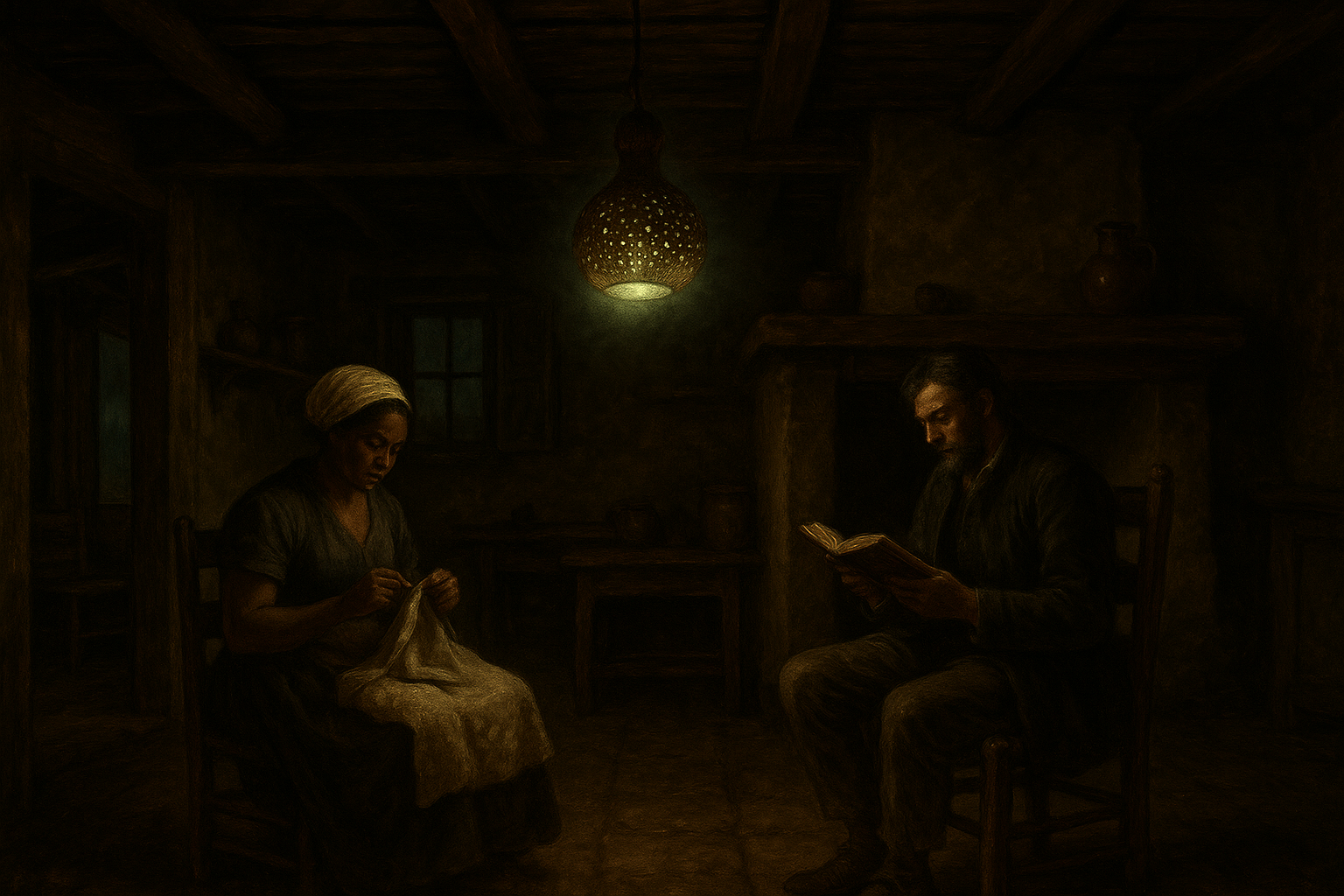
An artistic interpretation of a West Indies household in a historical setting, where inhabitants are sewing and reading by the collective glow of Cucujus fire-flies held within a perforated gourd cage.
Household and Domestic Lighting
Within the home, the Cucujus served as an all-purpose lamp. According to an old translation of Peter Martyr's History of the West Indies, the light was sufficient for a wide range of detailed work. The text notes, "so that the Inhabitants spinne, sewe, weave, and daunce by the light of the flying Cucuji. Our men also read and write by that light"[1]. This demonstrates that the beetles' luminescence was not merely ambient but strong enough for tasks requiring focus and precision. In more recent times, the naturalist Humboldt observed that among poorer households in Cuba, a simple perforated gourd containing a dozen fire-flies was enough to provide light for an entire night[1]. This practice highlights an economical and accessible lighting solution for the general populace.
The utility of these fire-flies extended beyond the home to situations where conventional lights were impractical or forbidden. One account tells of a lady from Trinidad who, while on a ship where open flames were prohibited for fear of attracting privateers, used Cucujus beetles to provide the light she needed to breastfeed her child during the night[1].
Guidance for Night Travel and Activities
For those venturing out after dark, the Cucujus was an indispensable guide. Travelers devised an ingenious method for hands-free navigation by tying two fire-flies to the great toes of their feet[1]. This illuminated the path directly before them, preventing stumbles and falls in the dark terrain. In addition to lighting their way, they would carry another beetle in their hand to help them hunt for small local animals known as 'Hutiae'[1]. The fire-flies were also employed to facilitate night fishing, their glow likely used to attract fish or simply to see by the water's edge[1].
Beyond Light: Decoration, Ritual, and Pest Control
The applications of the Cucujus fire-fly went far beyond simple illumination. The inhabitants of the West Indies integrated these living lights into their culture, entertainment, and even household maintenance in creative ways.
- Personal Adornment: The beetles were used as living, sparkling jewels. In the Spanish Colonies, young people would tie great numbers of them to their garments and even to their horses during festivals, creating a spectacular moving display of light as they rode through the streets[1]. In later times, this practice evolved into a high-fashion statement, with ladies wearing as many as fifty to one hundred Cucujus on a single ball-room dress as a dazzling ornament[1].
- Ritual and Entertainment: For amusement or to create a frightening spectacle, people would rub their faces with the flesh of a dead Cucujus, causing their skin to "shine like a flame of fire"[1]. A similar practice was observed among the Caribbee Islanders, who would anoint their entire bodies with the juice squeezed from the beetles for certain solemnities where candles were forbidden, making themselves glow in the dark[1].
- Pest Control: The Cucujus also served a practical purpose inside the home as a form of biological pest control. When released indoors, the beetles would hunt and consume gnats, allowing the inhabitants to rest peacefully without being bothered by biting insects[1].
An Unintentional Tool of Warfare
Perhaps the most dramatic role the Cucujus played was in military encounters, where its natural glow led to significant confusion and miscalculation. The swarms of fire-flies were mistaken by newly arrived Europeans for the lit matches of an opposing army's matchlock muskets, creating the illusion of a much larger and more prepared fighting force.
The Fire-fly Deception
An illustrative depiction of European soldiers, like those under Sir Thomas Cavendish, landing on a West Indies shore at night and retreating in alarm, mistaking swarms of Cucujus fire-flies in the trees for the lit fuses of a large enemy force.
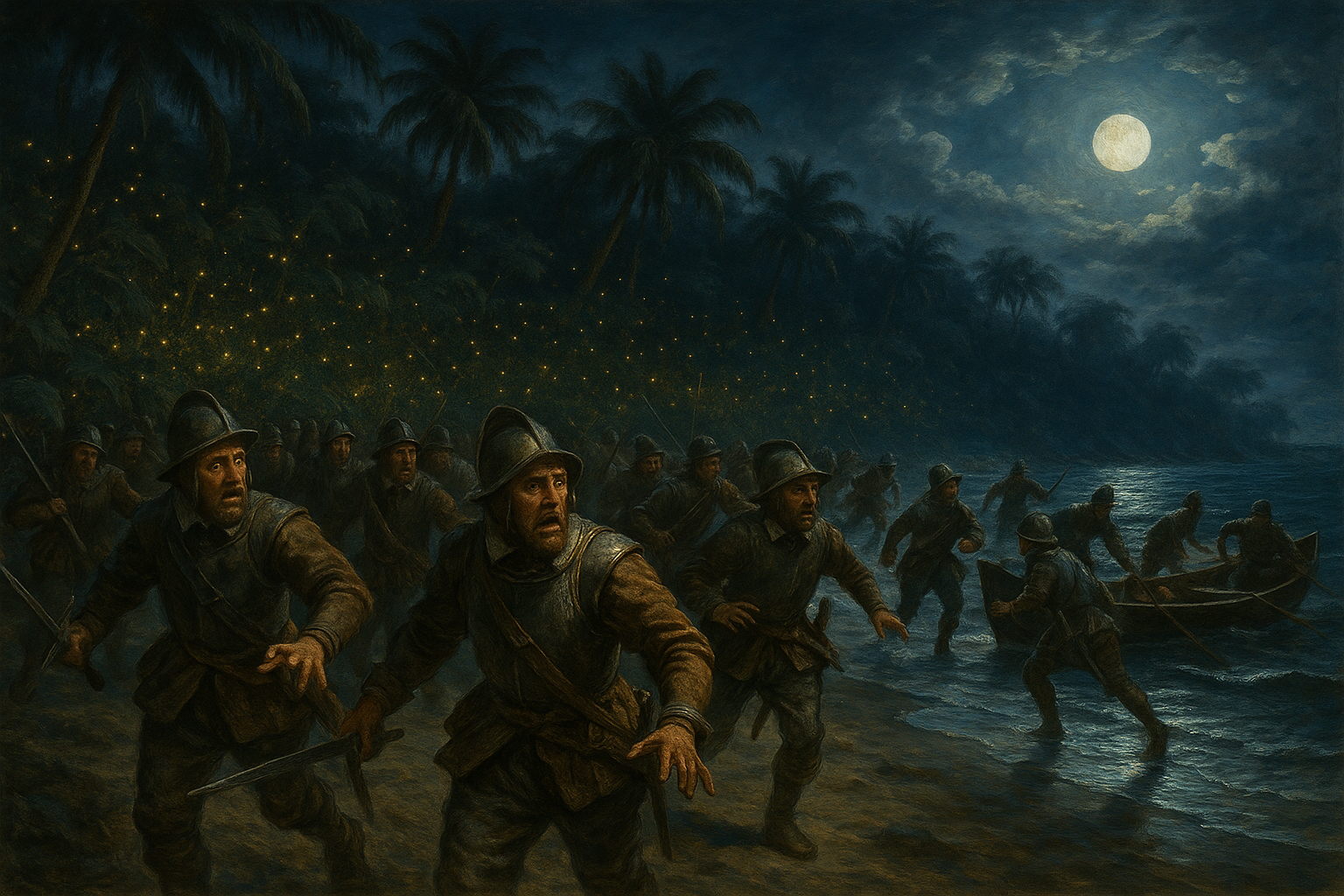
This natural phenomenon had real strategic consequences. Historical accounts note that when English explorers Sir Thomas Cavendish and Sir Robert Dudley first landed in the West Indies, their forces were so intimidated by the sight of these countless lights in the woods that they believed a Spanish army was waiting for them. This misinterpretation caused them to retreat to their ships, effectively repelled not by human soldiers, but by a swarm of insects[1].
Conclusion
The Cucujus fire-fly was far more than a simple insect to the inhabitants of the West Indies; it was a multifaceted natural resource. Historical records illustrate how its bioluminescence was ingeniously applied to solve everyday problems, from providing light for domestic chores and nighttime travel to controlling pests. Beyond its practical utility, the fire-fly was woven into the cultural fabric of the region, used as a stunning form of personal decoration and for ritualistic purposes. The accounts of these beetles unintentionally deceiving military forces further underscore their significant, if sometimes accidental, impact. The story of the Cucujus is a compelling example of human ingenuity and adaptation, showcasing a deep and resourceful relationship with the natural world.
References
Get more accurate answers with Super Pandi, upload files, personalized discovery feed, save searches and contribute to the PandiPedia.
Let's look at alternatives:
- Modify the query.
- Start a new thread.
- Remove sources (if manually added).