
An Executive's Guide to Quantum Advantage: Separating Hype from Reality
An Executive's Guide to Quantum Advantage: Separating Hype from Reality
Navigating the Quantum Revolution: A C-Suite Imperative


Quantum computing is a revolutionary technology that leverages the principles of quantum mechanics to solve complex problems intractable for even the most powerful classical supercomputers[5]. For the boardroom, it is best understood as a new tool for managing immense complexity[5]. Unlike classical computers that use bits (either 0 or 1), quantum computers use 'qubits'[8]. A qubit can be a blend of both 0 and 1 simultaneously (superposition) and can be linked to other qubits (entanglement), allowing the machine to explore a vast number of possibilities at once[5]. This capability is not a distant dream; practical, scalable quantum computing is just a few years away and is essential for realizing the full potential of artificial intelligence[8]. The United Nations has declared 2025 the International Year of Quantum Science and Technology, signaling a global inflection point[5]. This is no longer a conversation for physicists; it has become a critical strategic discussion for the boardroom[5].
Myths and Realities of Quantum Commercialization
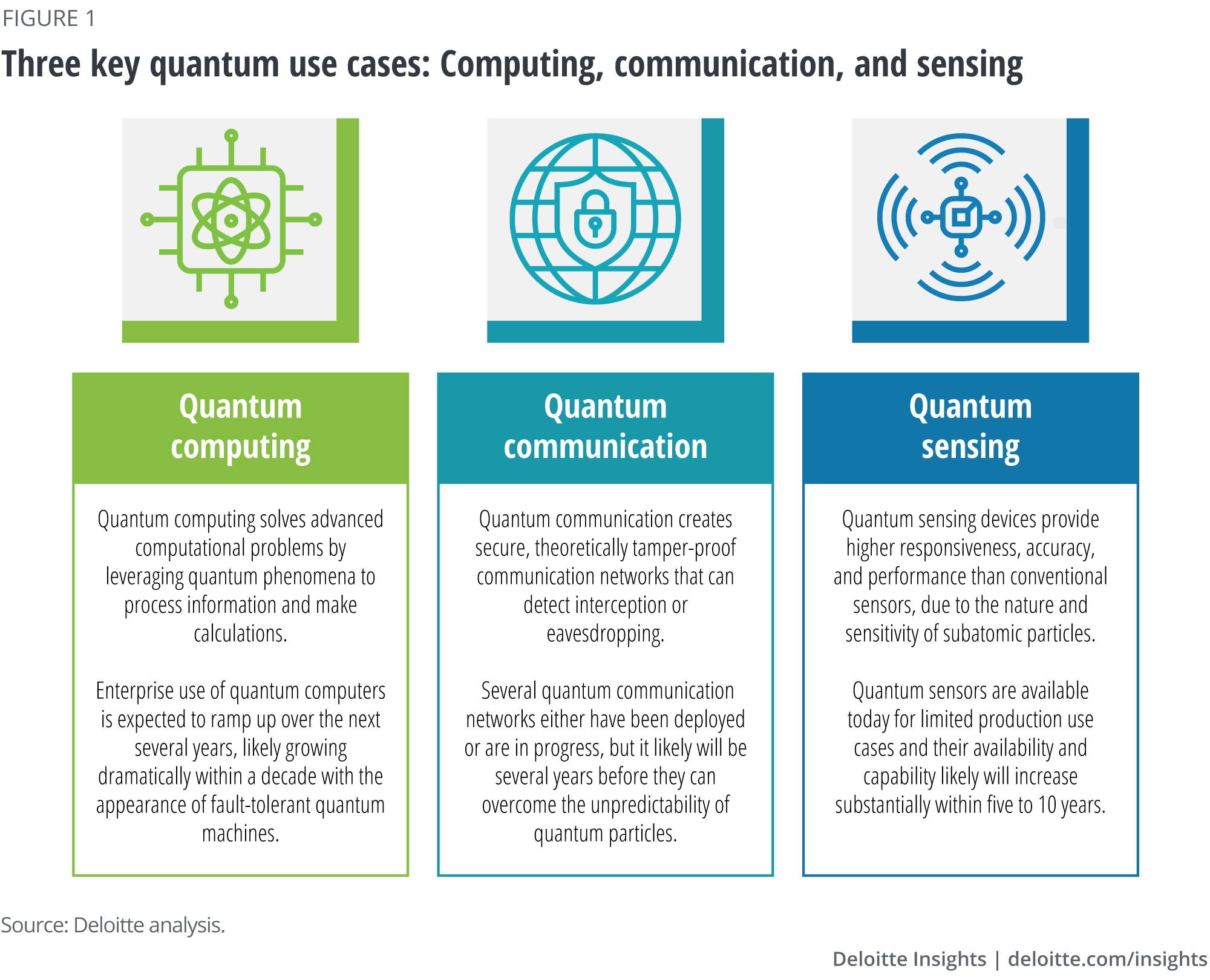

Navigating the quantum landscape requires separating persistent myths from the emerging commercial reality.
Myth 1: It's too early.
The reality is that the era of quantum commercialization has already begun[6]. Companies like Volkswagen and JPMorgan Chase are not waiting for a perfect quantum computer; they are engaging with what’s available to experiment with real-world optimizations and simulations today[6].
Myth 2: Only tech giants can succeed.
The quantum ecosystem is teeming with agile startups, many spun out of universities, that are not only competing with but also partnering with major tech companies[6]. For example, IonQ, founded by two professors, became the world's first publicly traded pure-play quantum computing company, demonstrating that academic origins can be turned into a multi-billion-dollar enterprise[6].
Myth 3: There's no market yet.
While the market is young, it is not nonexistent[6]. Early markets are forming now, driven by forward-thinking adopters in finance, pharmaceuticals, and logistics seeking a competitive edge[6]. Volkswagen's pilot project to optimize traffic flow in Lisbon using a quantum algorithm is a clear example of market interest[6].
Myth 4: We can just license the intellectual property (IP) later.
This passive approach is a risky myth. Early-stage quantum inventions are often too complex and nascent for a large company to license without the significant development and de-risking that a focused startup provides[6]. A startup acts as the necessary bridge, gathering inventors, raising capital, and building prototypes to prove the technology's value[6].
Defining Success: Understanding Quantum Advantage and Benchmarks
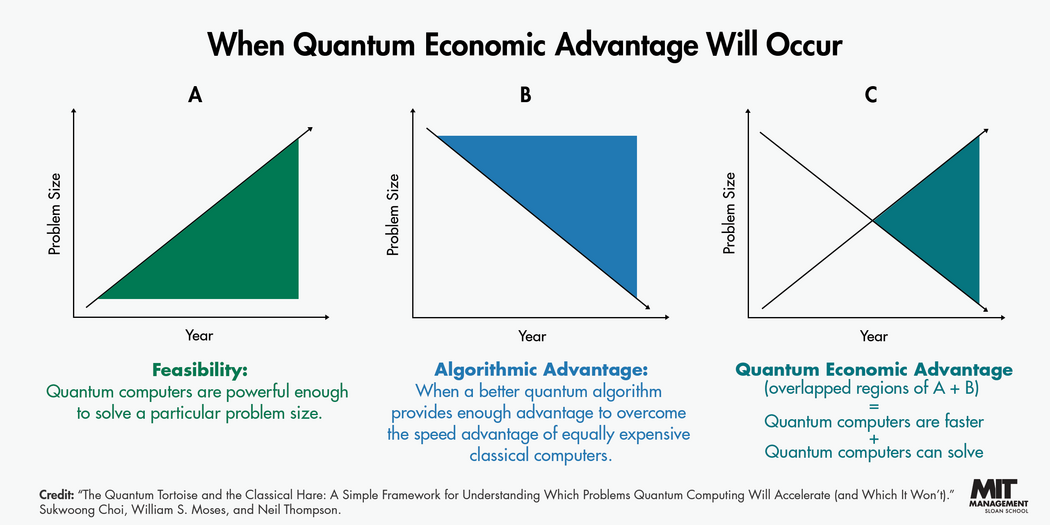

The ultimate goal is 'quantum advantage,' the ability to solve problems beyond the reach of classical computers[3]. However, a more practical milestone for businesses is 'quantum economic advantage,' which occurs when a problem can be solved more quickly with a quantum computer than with a comparably priced classical one[3]. An MIT framework likens this to a race between the 'Quantum Tortoise and the Classical Hare'[3]. Classical computers (the hare) are generally faster, but quantum computers (the tortoise) can use more efficient algorithms, taking a more direct path to the solution[3]. To measure progress, the field relies on benchmarks, defined as a set of tests designed to compare the performance of different computer systems[12]. A good benchmark must be relevant, reproducible, fair, verifiable, and usable[12]. Key metrics include:
- Quantum Volume (QV): Quantifies the largest square quantum circuit (equal width and depth) that a processor can successfully run[12].
- Q-Score: An application-focused metric measuring the maximum number of variables a quantum processor can handle in a standard optimization problem[12].
- Algorithmic Qubits (AQ): Measures the largest quantum circuit a processor can successfully run across six key algorithmic classes, moving beyond the square-circuit limitation of QV[12].
No single benchmark can capture all aspects of performance, so a suite of benchmarks is necessary for a comprehensive evaluation[12].
Early Applications: Quantum Computing Case Studies
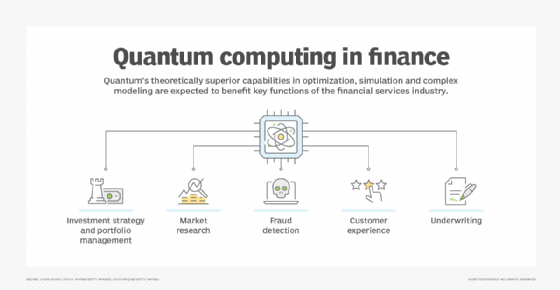
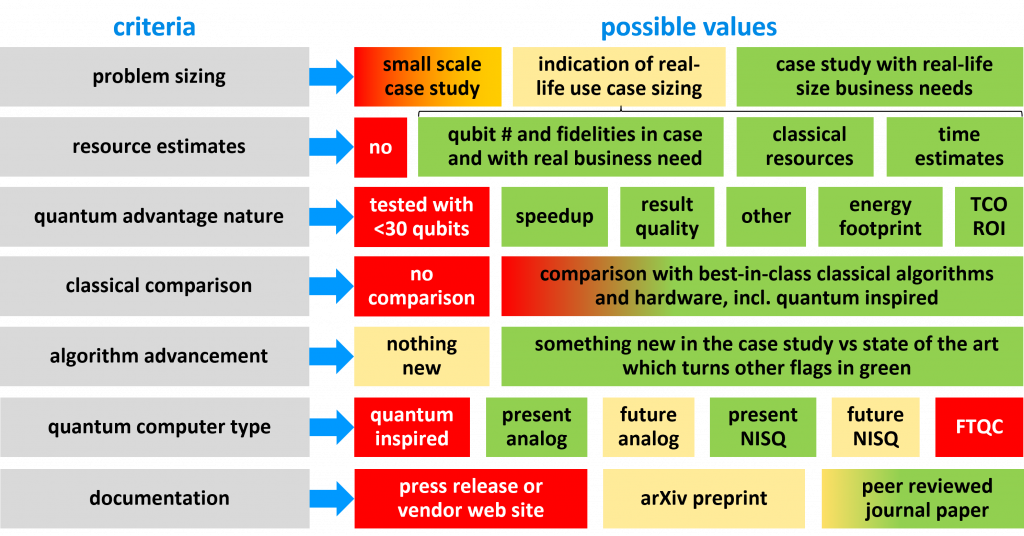
Industry-led proof-of-concept studies are already demonstrating quantum computing's potential to solve practical challenges across various sectors[1]. These projects, facilitated by organizations like the UK's National Quantum Computing Centre (NQCC), provide a snapshot of current capabilities.
- Financial Services: A consortium explored quantum machine learning (QML) for credit card fraud detection[1]. Using quantum restricted boltzmann machines, the model showed competitive performance on a highly imbalanced dataset, achieving promising results with no false negatives and very few false positives[1].
- Healthcare: One project improved the classification of cancer cell types from liquid biopsies using a quantum support vector machine (QSVM)[1]. The quantum classifier successfully distinguished between cancer pairs, in some cases outperforming a classical deep neural network[1].
- Energy & Sustainability: To help advance climate goals, a project explored using quantum optimization to determine the optimal layout of turbines within an offshore wind farm to maximize energy production[1]. The problem was successfully implemented on photonic quantum hardware[1].
- Aerospace: A study assessed the feasibility of running Computational Fluid Dynamics (CFD) simulations on quantum hardware for aerodynamic design[1]. The results showed that measurement errors from current hardware had a negligible effect on simulation accuracy, preserving the performance advantage without sacrificing reliability[1].
Managing Quantum Risk: The Ticking Clock of Cybersecurity
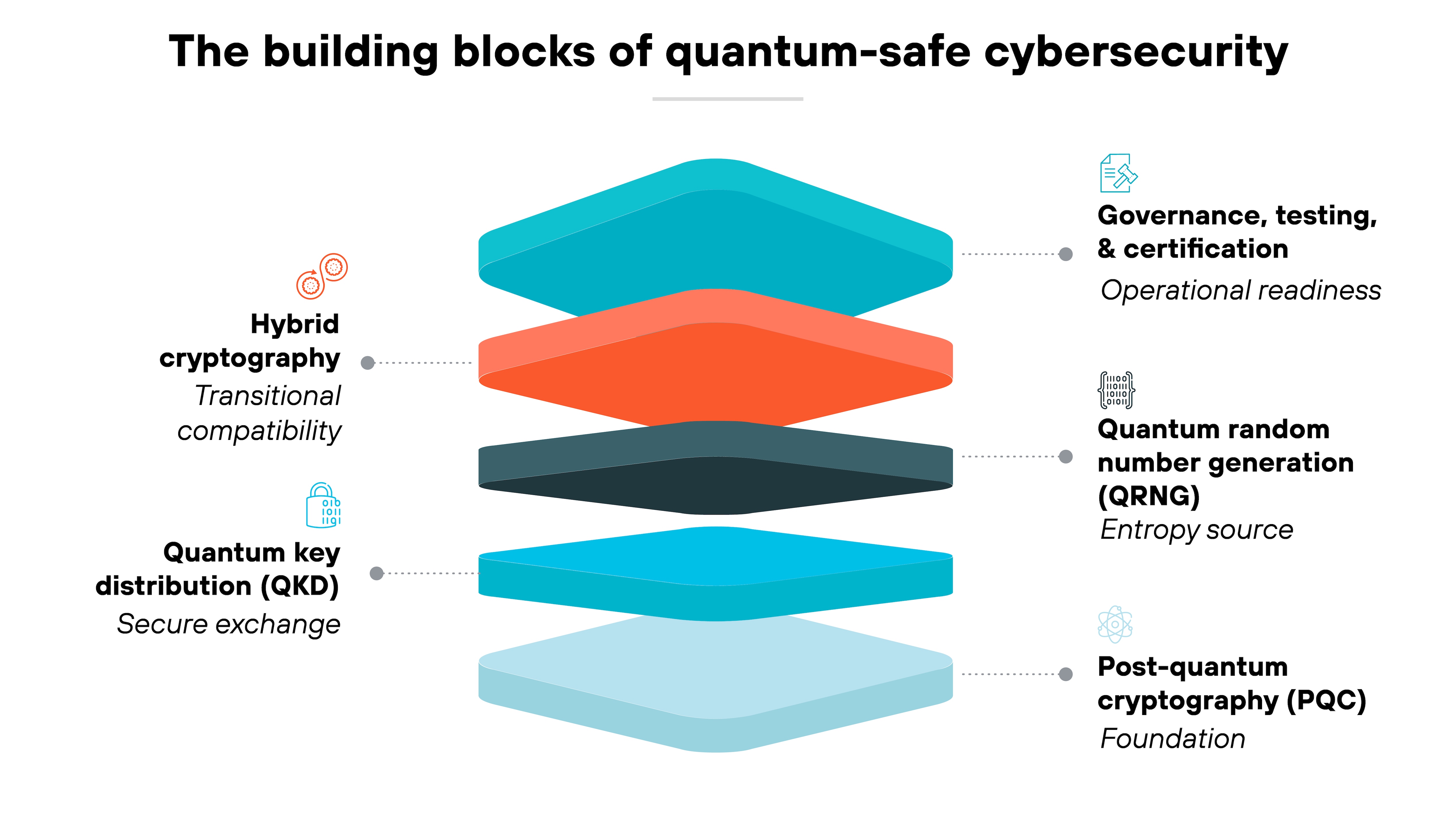
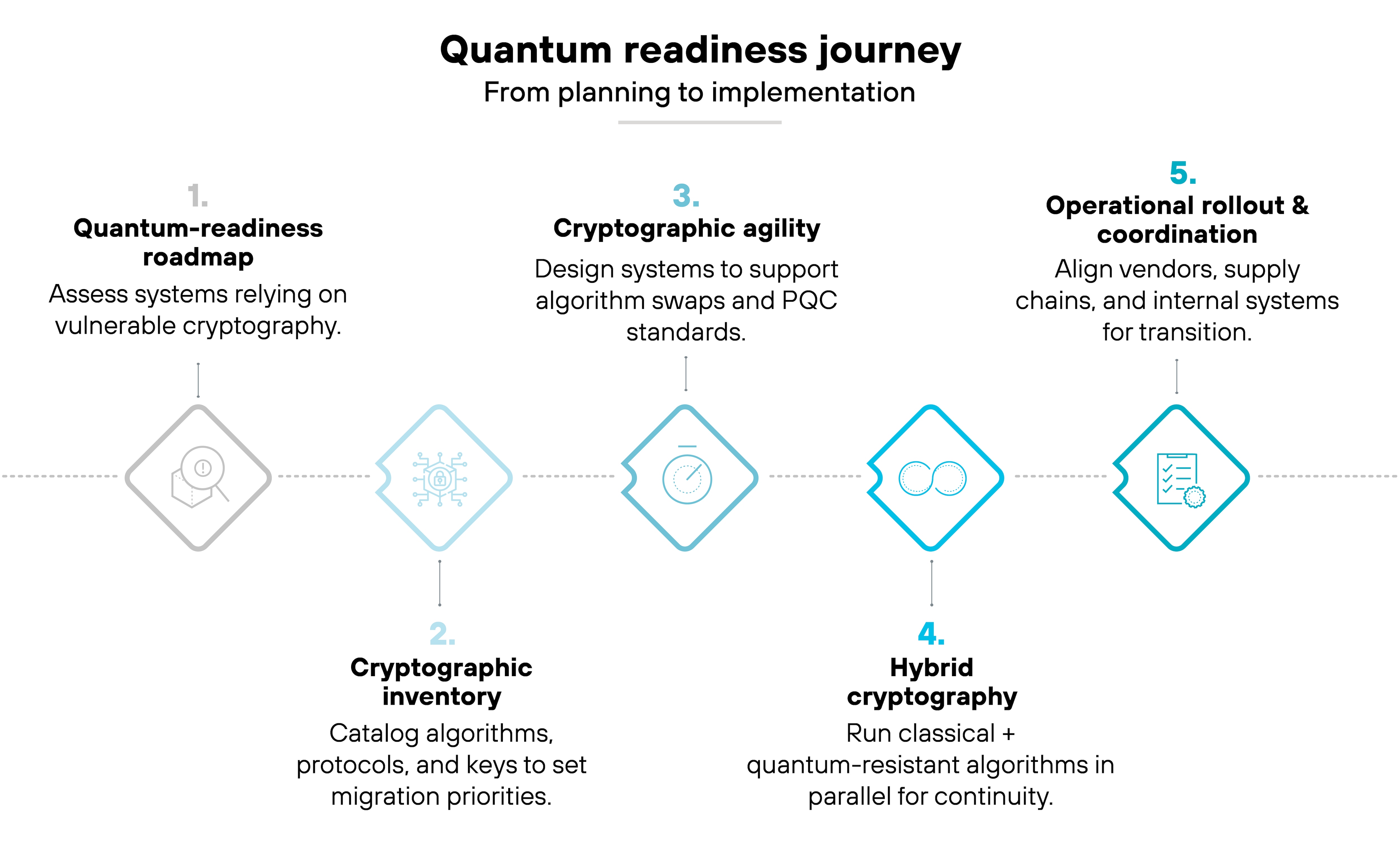
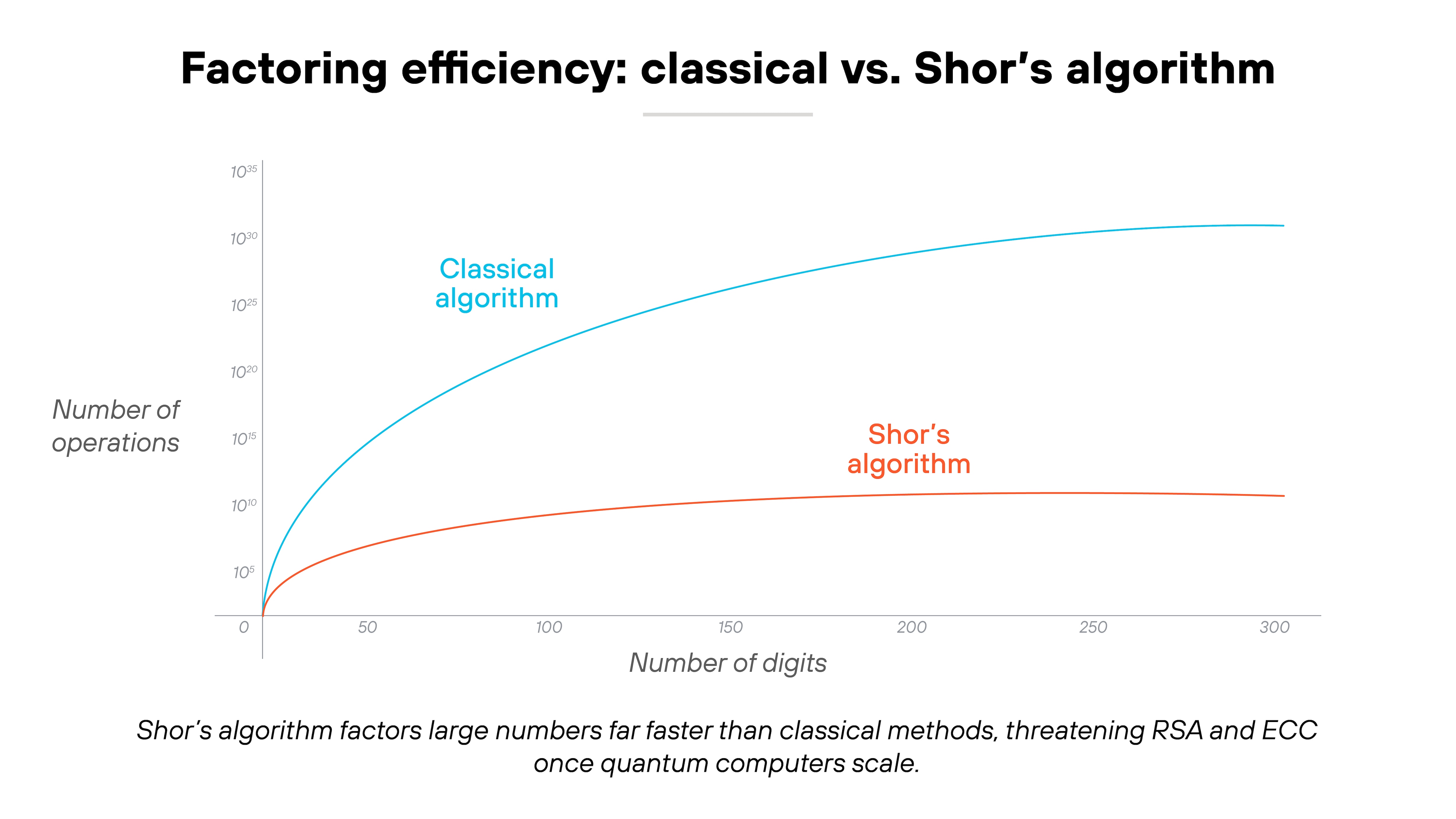
The immense power of quantum computing presents an urgent and unavoidable threat to cybersecurity[5]. Leaders must prepare for the 'encryption cliff,' a point where quantum computers could break current encryption standards, making our digital world unsecure almost all at once[4]. This threat is amplified by the 'harvest now, decrypt later' strategy, where adversaries are capturing encrypted data today with the intent of breaking it once a powerful quantum computer is available[5]. The solution is Post-Quantum Cryptography (PQC), a new generation of encryption standards designed to be secure against attacks from both classical and quantum computers[5]. The U.S. National Institute of Standards and Technology (NIST) finalized its first set of PQC standards in August 2024[10]. A robust Quantum Risk Management (QRM) program begins with governance; boards must formally recognize quantum exposure as a critical strategic risk[2]. Key functions must be involved:
1. Security Architecture must create an inventory of where vulnerable algorithms are deployed to plan the transition[2].
2. Enterprise Risk Management (ERM) must integrate quantum risk into the enterprise risk register and define key risk indicators (KRIs) to measure exposure and progress[2].
3. Legal and Records Management must identify which records require long-term confidentiality and assess compliance obligations[2].
4. Product Engineering must design cryptographic agility into products, especially those with long service lives like IoT and medical devices, to allow for future updates[2].
A Practical Roadmap for Quantum Readiness
For C-suite leaders, the focus should not be on the technical details of hardware but on identifying 'quantum-ready' problems within the organization[5]. This problem-first approach grounds strategy in tangible business value[5]. Leaders should ask, 'Where are we currently relying on ‘good enough’ approximations instead of optimal solutions?'[5]. While the technology is emerging, the time for strategic planning is now. The global quantum computing market is projected to grow to USD 5.3 billion by 2029, and some companies already expect to invest over $15 million annually[10][3]. To prepare, leaders should:
- Leverage Cloud Platforms: The rise of Quantum-as-a-Service (QaaS) from providers like AWS, Azure, and IBM democratizes access, allowing companies to experiment and develop algorithms without massive capital expenditure[5].
- Build Talent: There is a significant quantum skills gap; McKinsey predicts that by 2025, fewer than half of quantum jobs will be filled[3]. Businesses must build a quantum-ready workforce by training existing employees, recruiting specialists, and collaborating with academic institutions[8].
- Develop a Roadmap: Proactively prepare for the transition to post-quantum cryptography. Consult technology partners to understand their roadmaps and identify whether legacy IT needs to be replaced sooner than planned, ensuring appropriate budget allocation[4].
Let's look at alternatives:
- Modify the query.
- Start a new thread.
- Remove sources (if manually added).