
The Hampdenshire Wonder: Is There Anyone Else?

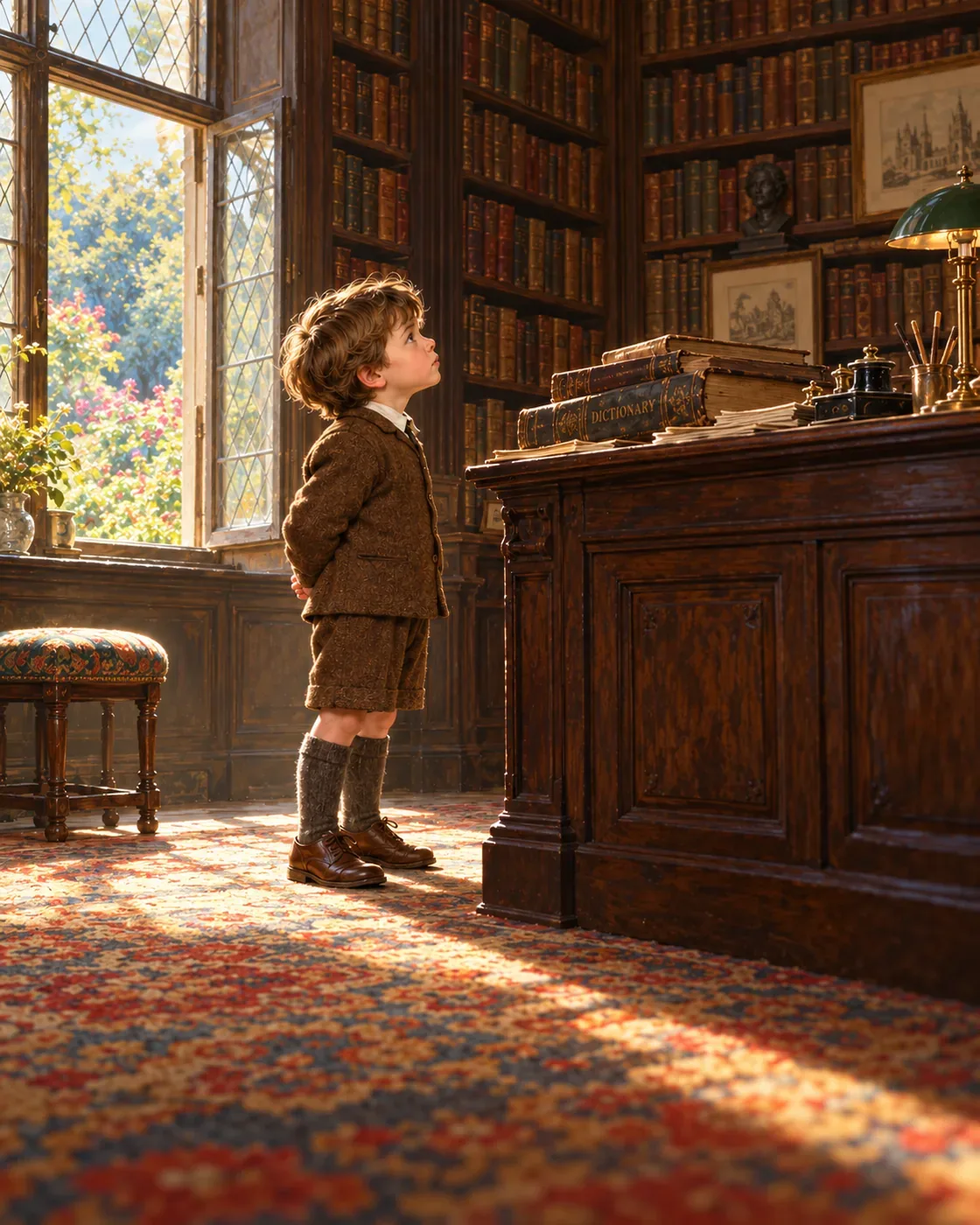
The boy could understand books the adults struggled to read. First, though, someone had to make his chair high enough to reach the table.
Victor Stott was four and a half. Challis welcomed him into his library. Thousands of books waited there. Victor asked for a dictionary.
They built him a seat from eight volumes of an encyclopaedia. His feet hung above the floor. He opened the first page.
His eyes moved faster than Challis expected. The secretary, Lewes, thought he was pretending. A child could turn pages. That did not mean he could read them.
The next morning, he came back. When no one opened the door, he climbed through a window. Soon the dictionary was under him and the encyclopaedia was on the desk.
For weeks, the adults watched. They brought milk and bread. His mother sometimes stood outside the window. Victor kept reading.
At last he reached the final volume. Then he read the index. Lewes took that as proof: surely no one who understood a book would read its index like a story.
The index was not the end of his search. Victor began asking about knowledge beyond these books. When he explained what he had understood, Challis listened for hours.
He described a way of understanding life that the scholar could not follow. Worse, Challis feared that accepting it would undo the things that made his own life meaningful.
Evening deepened. Victor’s explanation ended. All the books in the room remained exactly where they were.
“Is there none of my kind?” he asked. His hand rested on the books. “Is this all?” Challis told him there was no one like him.
The boy climbed out through the low window. Inside, the books that had made his chair taller were still waiting. They could help him reach the table. They could not answer him.
Veamos alternativas:
- Modifica la consulta.
- Inicia un nuevo hilo.
- Eliminar fuentes (si se han agregado manualmente).