Fossil Ink
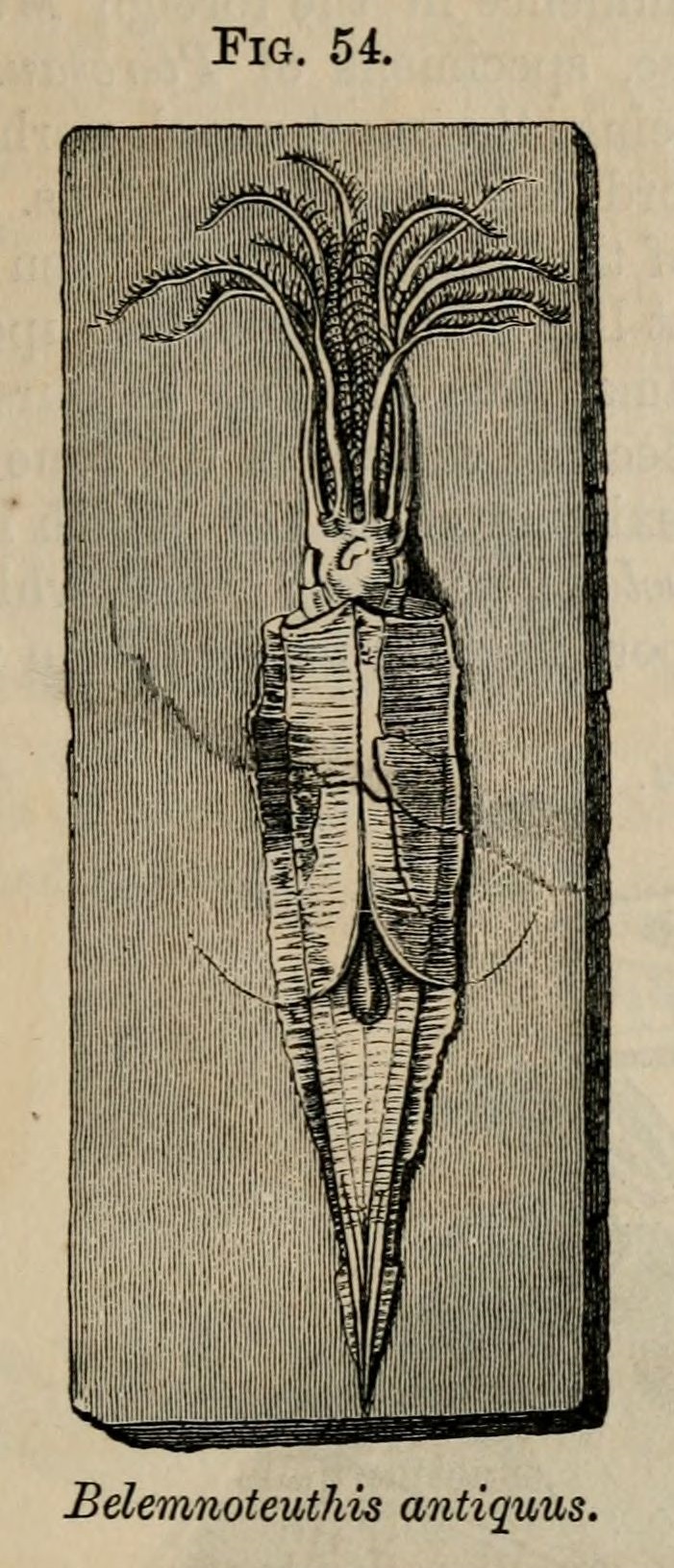
Country people in England called them thunderbolts: dart-shaped stones turning up in the fields, some under an inch long, some more than a foot.
They are belemnites, and they are not stones at all. Each is the internal skeleton of an animal much like a cuttlefish, whose eight arms carried fifteen to twenty pairs of hooks apiece for gripping fish, and whose head held very large eyes.
The extraordinary part is what some specimens still contain. Not only the skeleton, but the ink: the oval sac that held it, the tube through which it was shot out into the water, and the black fluid itself, preserved in a solid state, long after the last time the animal used it to disappear[1].
Crea tu cuenta para conservar esta respuesta y continuar desde aquí más tarde.
Veamos alternativas:
- Modifica la consulta.
- Inicia un nuevo hilo.
- Eliminar fuentes (si se han agregado manualmente).