Descubre Pandipedia
Un directorio creciente de respuestas útiles seleccionadas por la comunidad de Pandi. Busca en la colección o explora los últimos descubrimientos.
2286 entradas disponibles
The day a lake turned into a giant drain
Veamos alternativas:
- Modifica la consulta.
- Inicia un nuevo hilo.
- Eliminar fuentes (si se han agregado manualmente).

What is the theory of relativity?
Transcripción
The theory of relativity, formulated by Albert Einstein, consists of special relativity (1905) and general relativity (1915). Special relativity establishes that space and time form a continuum and introduces the concept of relative simultaneity. General relativity describes how massive objects warp space-time, leading to gravity. Einstein’s findings, including the equation E=mc² and the constant speed of light, have profoundly influenced physics, confirming principles through experiments such as the Michelson-Morley test[1][2][3][5].
Veamos alternativas:
- Modifica la consulta.
- Inicia un nuevo hilo.
- Eliminar fuentes (si se han agregado manualmente).
Understanding Generative Adversarial Networks
Understanding Generative Adversarial Networks
Generative Adversarial Networks (GANs) have gained significant attention in the field of deep learning, recognized for their ability to generate realistic data. This blog post simplifies the core concepts of GANs, their architecture, and their applications based on the insights from the foundational paper on the subject.
What Are GANs?
GANs propose a novel framework for estimating generative models through an adversarial process. This involves training two models simultaneously: a generator (G) that learns to capture the data distribution and a discriminator (D) that assesses whether a sample is from the training data or generated by G. The training goal for G is to maximize the probability of D making a mistake, effectively engaging both models in a two-player minimax game[1].
The Architecture
In GANs, the generator produces samples that mimic the real data, and the discriminator evaluates these samples. The training process can be described mathematically as:
[
\minG \maxD V(D, G) = \mathbb{E}{x \sim p(x)}[\log D(x)] + \mathbb{E}{z \sim pz(z)}[\log(1 - D(G(z)))]
]
This equation reveals that the discriminator's role is to distinguish real from generated samples while the generator aims to improve its output to fool the discriminator[1].
Training Process
The authors discuss a systematic approach to training both models effectively. They detail how alternating between updating D and G is crucial for optimal performance. D is trained to differentiate between real and fake samples, while G is updated to generate samples that can deceive D[1].
Early in the training, if G produces poor samples, D can easily reject them, leading to saturation of the training signal. As training progresses, the authors emphasize that D must be kept at near-optimal performance so that G can learn from meaningful feedback, thus enhancing its ability to generate realistic samples[1].
Theoretical Foundations
The paper delves into the theoretical basis of GANs, establishing that under certain conditions, the generator can learn to approximate the true data distribution effectively. The theoretical underpinnings focus on the interplay between the two networks, highlighting how their competitive nature drives the entire generation process[1].
The authors also present algorithms for implementing GANs, focusing on refining the generator and discriminator steps. They advise that during training, one must be cautious of how updates to G and D might affect the stability of the overall system[1].
Challenges and Advantages
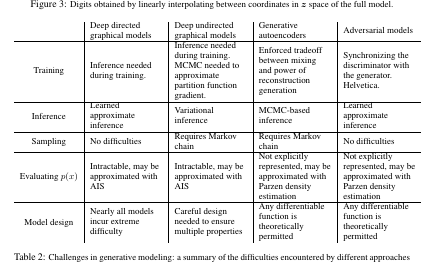
Despite their innovative approach, GANs face specific challenges. For instance, they may struggle with convergence and mode collapse, where the generator produces limited variations of outputs. Moreover, the framework requires careful synchronization between G and D during training to ensure that they contribute effectively to the learning process[1].
However, the advantages of GANs are compelling. They enable the generation of high-dimensional samples without the need for explicit probabilistic modeling. The flexibility of the architecture also allows it to be applied in various contexts, from image generation to data augmentation in machine learning tasks[1].
Applications
GANs have far-reaching applications across numerous domains. They are utilized in generating images, enabling artistic creation, enhancing training datasets, and even creating synthetic data for privacy-preserving purposes. The paper illustrates their efficacy by comparing generated samples from GANs against traditional models, showcasing the high quality achieved through this framework[1].
Furthermore, GANs have sparked interest in research areas such as semi-supervised learning, where they help in improving classifier performance when labeled data is scarce. The ability of GANs to learn from unlabelled data demonstrates their versatility and potential for future advancements in machine learning[1].
Conclusion
Generative Adversarial Networks represent a significant leap forward in data generation techniques, combining a competitive learning process with the power of deep learning architectures. The insights provided in the foundational paper outline not only the mechanics of GANs but also their practical implications and the myriad of challenges they present. As research continues to evolve, GANs are likely to play a pivotal role in the future of artificial intelligence and data science, ushering in new techniques and applications that we have yet to fully explore[1].
Veamos alternativas:
- Modifica la consulta.
- Inicia un nuevo hilo.
- Eliminar fuentes (si se han agregado manualmente).
What is the Sweet Little Rain coffee?
Transcripción
The Sweet Little Rain coffee is a whimsical beverage from Mellower Coffee, featuring a large cup of Americano topped with a cloud of cotton candy suspended above it. As steam from the hot coffee melts the cotton candy, it 'rains' sugar into the drink, creating a unique and visually appealing experience[1][5][4]. Known for its popularity in various countries and social media, it is often described as both enjoyable and challenging due to its slow melting process[3][2].
Fuentes
- Cotton Candy Coffee | Sweet Little Rain | Mellower Coffee Singapore
- This Cafe Serves Magical Cups of Coffee with a Floating Cotton Candy Cloud That “Rains” Sugar
- ‘Coffee with Cotton Candy’ Facebook Post
- This Giant Cup Of Coffee Comes With a Cotton Candy Cloud That Rains Sugar
- Coffee with a Cloud of Cotton Candy
Veamos alternativas:
- Modifica la consulta.
- Inicia un nuevo hilo.
- Eliminar fuentes (si se han agregado manualmente).
Vintage hobbies revival photos



Veamos alternativas:
- Modifica la consulta.
- Inicia un nuevo hilo.
- Eliminar fuentes (si se han agregado manualmente).
How do you create a simple budget?
Transcripción
To create a simple budget, start by calculating your net income, which is your take-home pay after deductions for taxes and other expenses[5][8]. Next, track your spending by listing all fixed and variable expenses, separating essentials from nonessentials[2][6]. Set realistic financial goals and categorize your spending into needs, wants, and savings[4][7]. Finally, regularly review and adjust your budget to stay on track and make necessary changes as your income or expenses fluctuate[1][3][8].
Fuentes
- How to Make a Budget: Your Step-by-Step Guide
- How To Budget In 7 Simple Steps
- How to Budget Your Money: 5 Step Guide to Create a Budget
- How to Make a Budget in 7 Easy Steps (With Printable Worksheet)
- How to Budget Money: A 5-Step Guide
- Budgeting 101: How to Budget Money - NerdWallet
- How to create a budget in 5 steps
- How to Create a Budget in 6 Simple Steps
Veamos alternativas:
- Modifica la consulta.
- Inicia un nuevo hilo.
- Eliminar fuentes (si se han agregado manualmente).
What is the Big Bang theory?
Transcripción
The Big Bang theory is the leading explanation of how the Universe began, suggesting it started from an infinitely hot and dense point about 13.8 billion years ago and has been expanding ever since. This expansion is supported by observations such as galaxies moving away from us, cosmic microwave background radiation, and the abundance of light elements like hydrogen and helium predicted by Big Bang Nucleosynthesis[1][2][3][4].
Veamos alternativas:
- Modifica la consulta.
- Inicia un nuevo hilo.
- Eliminar fuentes (si se han agregado manualmente).
How do tsunamis form and their effects?
Transcripción
Tsunamis primarily form due to underwater earthquakes, volcanic eruptions, or landslides that displace a large volume of water. This displacement generates a series of waves that can travel vast distances at high speeds, sometimes exceeding 500 miles per hour in deep water, but can grow significantly in height as they approach shore due to shallower ocean depths. The resulting waves can cause catastrophic flooding, damaging infrastructure, and leading to loss of life when they inundate coastal areas [1][3][4][5][6][7][8].
Fuentes
- Tsunami Facts: How They Form, Warning Signs, and Safety Tips
- Tsunami Facts and Information
- How do tsunamis form?
- Tsunamis
- Tsunami: What is it, Causes, Formation, Types
- What Causes Tsunamis? | Britannica
- What causes a tsunami? An ocean scientist explains the physics of these destructive waves
- What Is a Tsunami? | NASA Space Place – NASA Science for Kids
Veamos alternativas:
- Modifica la consulta.
- Inicia un nuevo hilo.
- Eliminar fuentes (si se han agregado manualmente).
Why is a morning routine crucial for success?
Transcripción
A morning routine is crucial for success because it sets the tone for the entire day, enhancing productivity and mental clarity. By establishing a structured routine, individuals achieve clarity and focus, reducing stress and decision fatigue, which boosts overall well-being and productivity[1][2][4][5].
Regularly engaging in mindfulness, physical activity, and goal-setting during this time fosters a positive mindset, empowering individuals to tackle challenges effectively[6][7][8][9]. Ultimately, a well-crafted morning routine allows for greater self-discipline and accomplishment throughout the day[2][5].
Fuentes
- Rise and Thrive: A Science-Backed Guide to the Perfect Morning Routine
- The Benefits of a Top Morning Routine: Setting the Tone for Success —
- Morning Routine: 7 Steps to a More Productive and Happier Day
- 7 Science-Backed Secrets of a Productive Morning Routine
- Creating and Maintaining an Effective Morning Routine
- Morning Routine Mastery: 30 Key Habits For Success
- 10 Steps to Starting a Morning Routine
- The Power Of A Mindful Morning Routine
- Best morning routine: 22 habits for a productive day [2026] •
Veamos alternativas:
- Modifica la consulta.
- Inicia un nuevo hilo.
- Eliminar fuentes (si se han agregado manualmente).
What are different types of biomes?
Transcripción
Biomes can be categorized into two main types: terrestrial and aquatic. Key terrestrial biomes include tropical rainforests, temperate forests, grasslands, deserts, tundra, and taiga[1][4]. Aquatic biomes encompass freshwater systems like rivers and lakes and marine ecosystems such as oceans and coral reefs[2][4].Each biome is characterized by distinct climates, plant life, and animal communities[3][5].
Veamos alternativas:
- Modifica la consulta.
- Inicia un nuevo hilo.
- Eliminar fuentes (si se han agregado manualmente).