Descubre Pandipedia
Un directorio creciente de respuestas útiles seleccionadas por la comunidad de Pandi. Busca en la colección o explora los últimos descubrimientos.
2322 entradas disponibles
Check SEC.gov Before You File FOIA
Transcripción
Before reporters file a Freedom of Information Act request to the Securities and Exchange Commission, they should first search SEC.gov for what is already public. The guide says FOIA is for non-public records, including records compiled in investigations, consumer complaints, and certain staff comment letters. It also means reporters should check whether the filing or record they need is already available online, document the pages, tools, and search terms they used, and then treat FOIA as the next step only if the material still is not available. The SEC also says it will not do research, answer written questions, or create records, so a request should be focused on one subject.
Veamos alternativas:
- Modifica la consulta.
- Inicia un nuevo hilo.
- Eliminar fuentes (si se han agregado manualmente).
Administrative law after Loper Bright. Build a structured issue map covering Chevron, Loper Bright, Skidmore, Auer, Kisor, APA review, rulemaking, adjudication, exhaustion, ripeness, finality, and separation of powers. Include a source-boundary note distinguishing the Justia outline from the 2025 commentary and requiring primary-authority verification for any current legal proposition.
Post-Loper Bright Administrative Law Issue Map
This is a research framework, not a statement of verified current law. The attached Justia Administrative Law Cases Outline was blocked by Cloudflare and yielded no substantive content about Chevron, Skidmore, Auer, Kisor, APA review, rulemaking, adjudication, exhaustion, ripeness, finality, or separation of powers[1]. The 2025 Verdict/Justia commentary is secondary commentary, so any current legal proposition drawn from it should be checked against primary authority before reliance.
Issue Map
Each entry below is framed as a legal question to research after Loper Bright, rather than an asserted rule. For any current-law use, verify against controlling Supreme Court, circuit, statute, and APA authority.
| Topic | Issue question | Verification note |
|---|---|---|
| Chevron | How much, if any, deference remains available when a statute is ambiguous and an agency offers its own interpretation? | Verify the post-Loper Bright status of Chevron and whether any surviving deference concept applies in the specific circuit or context. |
| Loper Bright | What did Loper Bright change about judicial review of agency statutory interpretation, and what parts of preexisting doctrine remain relevant? | Check the Supreme Court opinion itself and later appellate applications before stating any current rule. |
| Skidmore | When do agency interpretations receive respect based on persuasiveness rather than controlling deference? | Confirm whether Skidmore now supplies the main framework for nonbinding interpretations and how courts operationalize persuasiveness. |
| Auer | When, if ever, do courts defer to an agency’s interpretation of its own regulation? | Verify whether Kisor’s limits still govern and how courts distinguish genuine ambiguity from clear text. |
| Kisor | What limitations must be satisfied before a court gives weight to an agency’s regulatory interpretation? | Check the current vitality of Kisor and any post-Loper Bright treatment of regulatory deference. |
| APA review | How should courts review agency action under the APA when statutory and regulatory interpretation questions overlap with arbitrary-and-capricious review? | Confirm the interaction between APA standards of review and deference doctrines using primary authority. |
| Rulemaking | How does post-Loper Bright review affect notice-and-comment rulemaking, especially where a rule turns on a contested statutory meaning? | Verify whether courts now scrutinize the agency’s legal interpretation more directly before or within APA reasoned decisionmaking review. |
| Adjudication | Does the same post-Loper Bright interpretive approach apply when an agency resolves statutory meaning in case-specific adjudication? | Check for distinctions between rulemaking and adjudication in judicial review and preservation of issues. |
| Exhaustion | When must a regulated party exhaust agency processes before seeking judicial review of an agency’s legal interpretation? | Verify exhaustion requirements from statutes, regulations, and judge-made doctrines, not from deference doctrine alone. |
| Ripeness | When is a challenge to an agency interpretation fit for judicial review before enforcement or final agency action? | Confirm the applicable ripeness framework and how courts treat preenforcement legal challenges after Loper Bright. |
| Finality | What counts as final agency action eligible for APA review, especially when the agency’s legal interpretation appears in guidance, policy, or an enforcement position? | Verify finality with primary authority and distinguish final agency action from nonfinal or tentative statements. |
| Separation of powers | How do deference doctrines and APA review allocate interpretive authority between courts and agencies consistent with separation-of-powers principles? | Use constitutional and structural sources, plus controlling judicial opinions, before characterizing any current balance. |
Source Boundary Note
- The attached Administrative Law Cases Outline source was not substantively accessible because Justia returned a Cloudflare security verification page, so it cannot be used to support current doctrinal claims[2].
- The 2025 Verdict/Justia piece should be treated as secondary commentary and a research prompt, not as a substitute for primary authority.
- For any present-day proposition about Chevron, Skidmore, Auer, Kisor, APA review, rulemaking, adjudication, exhaustion, ripeness, finality, or separation of powers, confirm the rule in the underlying opinions, APA text, and controlling circuit law before citing it.
Veamos alternativas:
- Modifica la consulta.
- Inicia un nuevo hilo.
- Eliminar fuentes (si se han agregado manualmente).

Mount Everest: Earth’s highest mountain
Mount Everest is the highest mountain on Earth above sea level, located in the Mahalangur Himal sub-range of the Himalayas on the border between Nepal and the Tibet Autonomous Region of China[1][2]. Its elevation is 29,032 feet (8,849 meters)[3]. Locally, it is known as Sagarmāthā in Nepal and Qomolangma (or Chomolungma) in the Tibet Autonomous Region of China[4][5]. The first recorded people to reach the summit were Edmund Hillary and Tenzing Norgay in 1953[6]. Would you like to know more about the historical climbing routes on the mountain?
Veamos alternativas:
- Modifica la consulta.
- Inicia un nuevo hilo.
- Eliminar fuentes (si se han agregado manualmente).

5 Biosensors Reshaping Noninvasive Health Tracking
Veamos alternativas:
- Modifica la consulta.
- Inicia un nuevo hilo.
- Eliminar fuentes (si se han agregado manualmente).
Retro LAN Party Memories

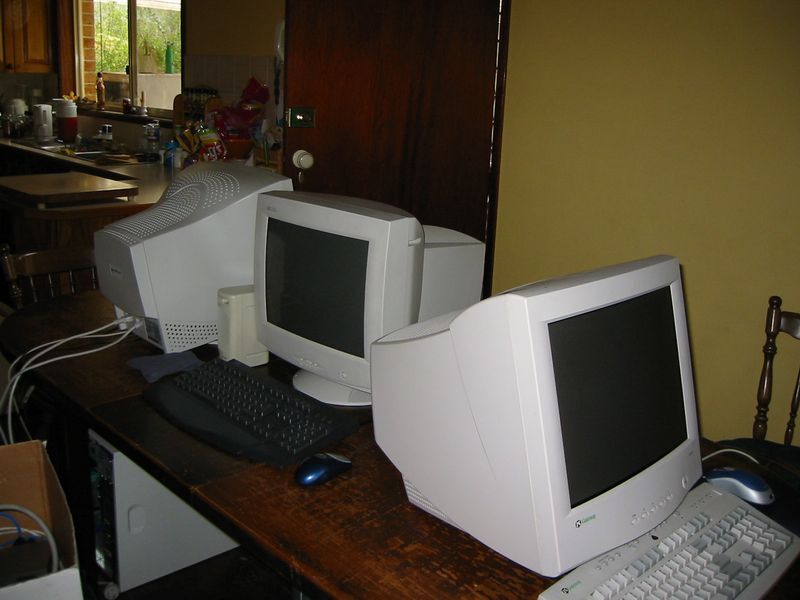



Veamos alternativas:
- Modifica la consulta.
- Inicia un nuevo hilo.
- Eliminar fuentes (si se han agregado manualmente).
Harvest Now, Decrypt Later: Quantum Security Risk. (2026).
Harvest Now, Decrypt Later: Quantum Security Risk
The Palo Alto Networks source describes HNDL as a present-day threat: attackers can collect or steal encrypted data now and store it until future quantum computers may be able to decrypt it. In other words, the risk starts when the data is intercepted or copied, not when quantum computers finally arrive.[1][2]
This makes HNDL especially relevant for data that must remain confidential for a long time, because the value of the stolen ciphertext can persist for years or decades before a decryption attempt is possible.[3]
What is at risk and how to respond
- The main cryptographic concern is public-key cryptography, especially RSA and elliptic-curve cryptography, which the source says are expected to be vulnerable to sufficiently powerful quantum computers.[4]
- The most exposed data is long-lived sensitive information, including government records, financial data, healthcare information, intellectual property, and defense data.[5]
- The source recommends starting post-quantum migration now by building cryptographic inventories, improving crypto-agility, checking vendor readiness, and creating migration roadmaps.[6]
HNDL is difficult to detect and reverse because once encrypted data has been collected, organizations cannot easily "unharvest" it; they can only reduce future exposure by migrating systems and data protection strategies before quantum decryption becomes practical.[7][8]
Veamos alternativas:
- Modifica la consulta.
- Inicia un nuevo hilo.
- Eliminar fuentes (si se han agregado manualmente).
Aqua-glass horizon with bubbles and global glow

Veamos alternativas:
- Modifica la consulta.
- Inicia un nuevo hilo.
- Eliminar fuentes (si se han agregado manualmente).
Polarization in voter media consumption
Veamos alternativas:
- Modifica la consulta.
- Inicia un nuevo hilo.
- Eliminar fuentes (si se han agregado manualmente).
Jupiter: the Solar System's magnetic heavyweight
Veamos alternativas:
- Modifica la consulta.
- Inicia un nuevo hilo.
- Eliminar fuentes (si se han agregado manualmente).
Why onions make you cry
Transcripción
When onion cells are cut, alliinase and lachrymatory-factor synthase help create syn-propanethial S-oxide, the volatile lachrymatory factor that escapes into the air.
That vapor dissolves in the tear film, forms a mild acid, and irritates corneal sensory nerve endings described as trigeminal pain receptors or nociceptors.
The trigeminal signal then tells the brain to drive the lacrimal glands, flooding the eye with tears to dilute and wash away the irritant, and the effect is usually weaker with low-sulfur onions, freshness, a sharp knife, chilling, good airflow, the root end saved for last, and snug goggles rather than ordinary glasses.
Fuentes
- Volatile Sulfur Compounds in Food
- Propanethial-S-oxide
- syn-Propanethial-S-oxide - Wikipedia
- What Makes Onions Burn Your Eyes? The Science Explained
- Do Contact Lenses Prevent Onion Crying?
- _syn_ -Propanethial-_S_ -oxide — Grokipedia
- Why Cutting Onions Makes You Cry—and How to Reduce the Burn
- Why Do Onions Make You Cry?
- The Surprising Reason Onions Make You Cry—Plus Tips to Reduce Tears
- Why Onions Make You Cry and How to Stop It: Practical Solutions
- Why Do We Cry When Cutting Onions? The Science Behind the Tears
Veamos alternativas:
- Modifica la consulta.
- Inicia un nuevo hilo.
- Eliminar fuentes (si se han agregado manualmente).