
Understanding ScreenAI: A Vision-Language Model for UI and Infographics
Understanding ScreenAI: A Vision-Language Model for UI and Infographics
Introduction to ScreenAI
ScreenAI is an innovative vision-language model designed to enhance the understanding of user interfaces (UIs) and infographics. As technology evolves, the ability to seamlessly interpret and interact with various visual formats becomes crucial. This model builds upon the principles shared between UIs and infographics, facilitating improved human-computer interaction.
Key Features of ScreenAI
Vision-Language Integration

ScreenAI leverages a modal architecture that combines visual inputs with natural language processing. This architecture is based on a unique mixture of datasets, which allows the model to tackle comprehension tasks related to both UIs and infographics. The system performs multiple functions including question answering, UI navigation, and summarization, all of which contribute significantly to understanding complex screens and infographics[1].
Advanced Task Performance
One of the standout features of ScreenAI is its ability to surpass existing benchmarks in crucial document understanding tasks. For example, during evaluation, ScreenAI achieved state-of-the-art (SoTA) results, especially in tasks that require comprehensive understanding of infographics and UI elements. This advancement is attributed to the model's customizable and adaptable nature, which facilitates its application across various formats and platforms[1].
Multi-Task Learning and Applications
ScreenAI’s architecture supports a multitude of tasks that enhance its usability. It is designed to perform effective screen annotation, facilitate question answering, and provide comprehensive screen summaries.
Screen Annotation
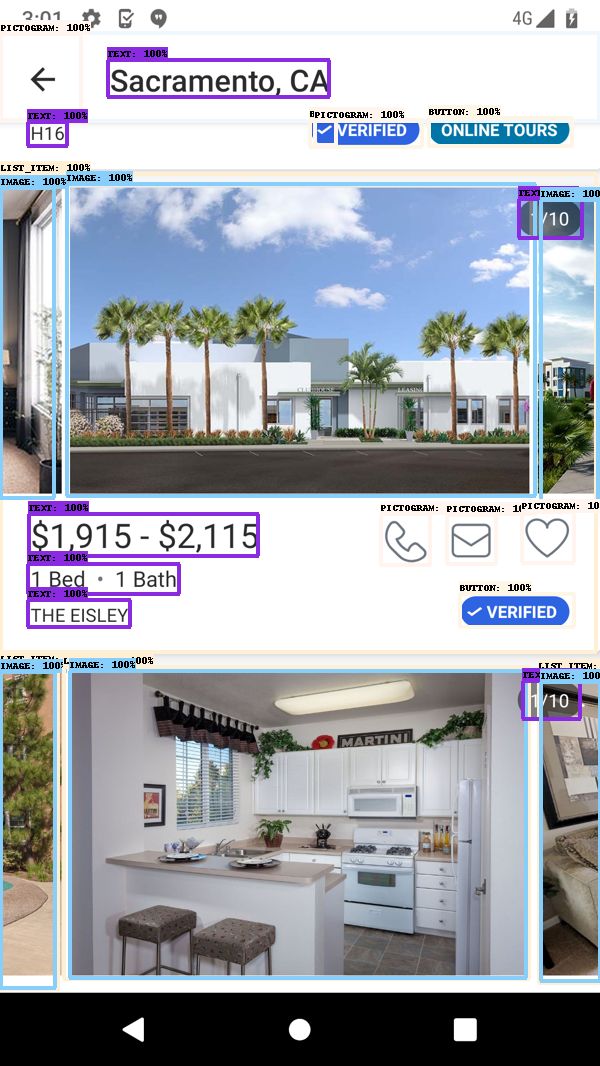
Screen annotation tasks involve detecting and identifying UI elements presented on a screen. The model incorporates a layout annotator to systematically label these elements, which include images, text, and various icons. This process is essential for interpreting data displayed in different formats[1].
Question Answering

In the context of question answering, ScreenAI can respond accurately to inquiries about infographics and UI layouts. For instance, users can pose complex questions regarding visual data, and the model generates explicit answers. This is achieved through an integrated understanding of the visual and textual elements, allowing it to provide concise and relevant information[1].
Summarization Capabilities
Moreover, ScreenAI excels in summarizing content displayed within UIs and infographics. The model is designed to distill essential information from complex visuals, making it easier for users to grasp key messages without sifting through excessive details[1].
Training and Model Architecture
Training Procedures

The training procedures for ScreenAI are grounded in self-supervised learning, allowing the model to learn from vast amounts of unlabeled data. This approach addresses the challenges related to data scarcity and enhances the model’s performance across various tasks by dynamically adjusting to different datasets[1].
Model Architecture
The architecture applies a multimodal encoder that processes both text and images, making it adept at tackling format variations. By integrating feedback mechanisms, the model continually refines its predictions, leading to improved accuracy over time. The vision encoder significantly contributes to understanding the contextual nuances present in different visual scenarios[1].
Evaluation and Results
State-of-the-Art Performance
During extensive evaluations, ScreenAI was benchmarked against several leading models. The results demonstrated that it outperformed existing models by achieving higher accuracy in tasks like screen annotation and question answering. For instance, it was noted that the incorporation of advanced features such as pix2struct patching significantly enhanced its ability to generalize across diverse visual inputs[1].
Diverse Task Adaptation
ScreenAI's ability to adapt to various tasks further underscores its versatility. From analyzing mobile screens to large document layouts, the model maintains a consistent performance level. Its training regimen includes a robust mixture of pre-training and fine-tuning tasks that prepare it for real-world applications, offering insights across multiple domains[1].
Conclusion
ScreenAI represents a significant leap forward in the field of vision-language models, particularly regarding the understanding of user interfaces and infographics. With its advanced architecture, robust training methodologies, and proven state-of-the-art performance, ScreenAI not only enhances the interaction between humans and machines but also sets a new standard for future developments in intelligent visual data comprehension. The integration of various tasks within a unified model showcases its potential to transform how users interact with complex visual information in everyday applications[1].
Veamos alternativas:
- Modifica la consulta.
- Inicia un nuevo hilo.
- Eliminar fuentes (si se han agregado manualmente).