65
weird etymology facts and language oddities that go viral
Here are some weird-history and funny-science fact ideas that should work well for social media in 2024 to 2025:
- “Weird” used to mean fate, destiny, and even witches before it became slang for “odd.” The word goes back to Old English wyrd and later shifted through Shakespeare’s “weird sisters” into the modern meaning.[2][9]
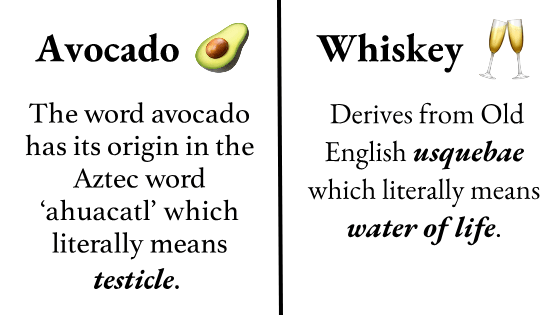
- “Avocado” literally traces back to a word meaning “testicle.” The Aztec word ahuacatl had that meaning, which is why this fruit keeps showing up in viral etymology posts.[1][3][5]
- “Robot” comes from a Czech word meaning “forced labor.” That origin makes the word feel a lot less cute and a lot more ominous.[1][3]
- “Whiskey” means “water of life.” It comes from Gaelic uisge beatha, which is a very poetic name for something that ruins your next morning.[1][5][7]
- “SOS” was not originally “save our souls.” It was chosen in 1910 because it was easy to send in Morse code.[6]
- “Quarantine” comes from the Italian for “forty days.” Venice made ships wait that long during plague outbreaks before letting people ashore.[5]
- “Malaria” originally means “bad air.” People once thought swamp air caused the disease, even though mosquitoes were the real culprits.[5]
- The word “vacaccine” comes from cows. Edward Jenner’s cowpox-based method inspired the term from Latin vaccinus, meaning “from cows.”[3]
- “Blue moon” has a surprisingly messy history. It refers to a second full moon in a month, though the phrase’s usage history is more tangled than people usually think.[28]
- English spelling is full of chaos, and “ghoti” is the classic fake example of how “fish” could be spelled from unrelated sounds. It is one of the internet’s favorite weird-language flexes.[13]
- Some languages have no simple “yes” or “no.” Welsh and Mandarin often answer by repeating or modifying the verb instead.[18]
- Some languages count differently, or barely count at all. The Pirahã language has no words for exact numbers, while Munduruku only goes up to about five before switching to rough terms.[18]
- English has weird grammar quirks too, like “I broke arm” in other languages often becoming “I broke my arm” in standard English. That possessive body-part pattern is unusual, and language nerd bait in the best way.[22]
If you want, I can turn these into:
1. a carousel script,
2. a TikTok/Reels voiceover, or
3. a tweet thread with hooks.
Sign Up To Try Advanced Features
Get more accurate answers with Super Pandi, upload files, personalized discovery feed, save searches and contribute to the PandiPedia.
Sorry, Pandi could not find an answer.
Let's look at alternatives:
- Modify the query.
- Start a new thread.
- Remove sources (if manually added).
Related Content From The Pandipedia
weird language oddities and etymology facts that sound fake but are realsurprising language oddities and food facts for trivia carouselssurprising animal intelligence facts and language oddities for social media 2024 2025The xAI Grok 2 Deep Dive: Key Highlightsweird history facts and bizarre historical events for short form contentIs your favorite word origin a total lie?weird history facts and psychology myths that sound fake but are true for TikTok and Reelsweird food facts and historical food oddities that sound fake but are realWhat are effective daily habits?weird mythological and folklore facts from around the world for triviaweird Egyptian folklore facts and myths for short-form contentweird and funny food facts that sound fake but are true for TikTok and Reelsbizarre historical coincidences and weirdest laws still on the books for funny triviaEye opening numbers on global AI investment 2020 2025surprising animal intelligence facts and natural history trivia for short form video