How do young crows demonstrate 'filial piety' towards their aged parents?. Describe the remarkable behavior of young crows that care for their old, featherless parents. They cover them with their own feathers and gather food to feed them, even helping them to fly.
The Filial Piety of Crows: An Ancient Account of Avian Care
The concept of filial piety, the virtue of respect, obedience, and care for one's parents and elderly family members, is a cornerstone of many human cultures. It is a behavior often considered uniquely human, rooted in complex social structures and moral codes. However, historical accounts suggest that humans have long observed similar devotion in the animal kingdom. One of the most enduring examples is that of the crow, a bird renowned for its intelligence and intricate social life. This report examines a remarkable historical description of filial piety in crows, detailing how young crows are said to care for their aged and ailing parents.
Drawing from a 14th-century text, this analysis will explore the specific behaviors attributed to young crows, including providing warmth and shelter, gathering food, and even assisting their enfeebled parents in flight. The information presented is based on an account by Bartholomew Glanville from the year 1360, which captures a long-held perception of these birds as symbols of profound familial loyalty.
An Ancient Tale of Avian Devotion
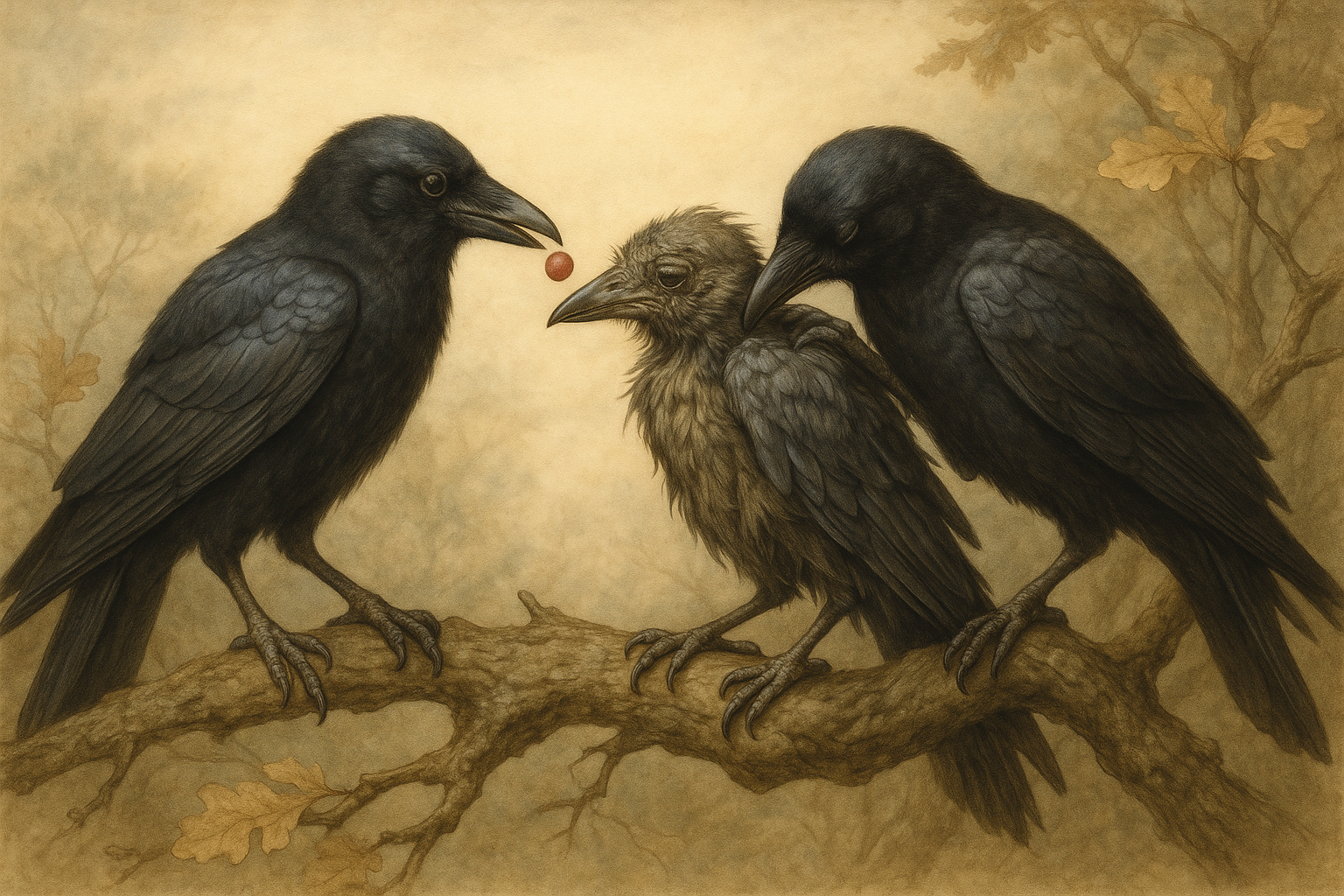
An artistic interpretation of young crows tending to an elderly, frail parent, as described in historical texts. This scene captures the essence of filial piety, showing one crow offering food while another provides comfort.
A 14th-Century Description of Crow Caregiving
The primary source for these observations is a text written by Bartholomew Glanville in 1360, which describes the filial piety of crows as a notable wonder of the natural world[1]. This account, passed down through centuries, provides a fascinating window into historical naturalism and the human interpretation of animal behavior. The text outlines three distinct categories of care that young crows purportedly provide to their parents in their old age.
Providing Shelter and Warmth
The first act of devotion described involves protection against the elements. According to the historical account, as the parent crows age, they may lose their feathers, leaving them vulnerable. The text states, "when the old crows in age be both naked and bare of covering of feathers, then the young crows hide and cover them with their feathers"[1]. This behavior, if interpreted literally, suggests an extraordinary level of care. The young crows are depicted as using their own bodies and plumage to shield their parents from the cold, providing insulation and comfort in their weakened state. This act goes beyond simple proximity, implying a conscious effort to share warmth and provide a living blanket for their featherless elders.
Nourishment for the Aged
The second form of care detailed in the text is providing sustenance. As older birds become too weak to forage for themselves, their survival depends on the support of others. Glanville's account notes that the young crows not only cover their parents but also "gather meat and feed them"[1]. This description highlights a crucial aspect of filial care: ensuring the continued nourishment of family members who can no longer provide for themselves. The term "gather meat" suggests an active and deliberate process of finding and bringing back food, a behavior that requires energy and exposes the young crows to potential risks. This act of feeding is a powerful demonstration of the social bonds and responsibilities within the crow family unit as perceived by the 14th-century author.
Allopreening and Allofeeding in Crows
Crows and other corvids often engage in social behaviors like allofeeding (feeding another) and allopreening (preening another), which strengthens social bonds. This image of one crow feeding another captures the essence of the care described in historical texts.
Assistance in Flight and Rehabilitation
Perhaps the most astonishing behavior described is the physical support and encouragement young crows are said to provide to help their parents fly again. The text vividly portrays this act of avian rehabilitation. It explains that when the old crows become feeble, "the young crows underset them, and rear them up with their wings, and comfort them to use to fly, to bring the members that be diseased into state again"[1]. This passage can be interpreted as a form of physical therapy.
- Underset them: This implies the young crows position themselves underneath their parents to provide lift and support.
- Rear them up with their wings: This suggests the young use their own wings to help elevate the older birds, perhaps giving them the initial momentum needed for flight.
- Comfort them to use to fly: This phrase points to a form of encouragement, suggesting a patient and persistent effort to help the parents regain their mobility and confidence in the air.
- Bring the members that be diseased into state again: This concluding phrase implies the ultimate goal of this behavior is not just temporary aid but the actual rehabilitation of their parents' atrophied or ailing bodies.
Conclusion: A Timeless Symbol of Devotion
The 14th-century account by Bartholomew Glanville paints a powerful picture of young crows as paragons of filial piety. The described behaviors of covering featherless parents for warmth, gathering food to feed them, and physically assisting them to fly again constitute a profound level of care and devotion[1]. While modern ornithology might interpret these behaviors through a different lens, focusing on cooperative breeding and kin selection, this historical text remains significant. It underscores the deep impression that the complex social intelligence of crows has left on human observers for centuries.
Ultimately, this ancient description has cemented the crow's place in cultural symbolism as an emblem of familial loyalty. Whether viewed as literal fact or as an anthropomorphic interpretation of natural behavior, the story of the crow's devotion to its parents continues to be a compelling example of the wonders of the natural world, reflecting a timeless admiration for the bonds of family.
References
Get more accurate answers with Super Pandi, upload files, personalized discovery feed, save searches and contribute to the PandiPedia.
Let's look at alternatives:
- Modify the query.
- Start a new thread.
- Remove sources (if manually added).