How do the unique physical features of the mole aid its subterranean life?. This question focuses on the mole's specific anatomical adaptations for living underground. The answer will detail its fur, small eyes, acute senses, pointed snout, and specialized paws for digging.
Masters of the Underground: The Mole's Anatomical Adaptations
The mole is an animal synonymous with a life lived almost entirely beneath the surface of the earth. Its existence in a world of darkness, soil, and confined spaces has driven the evolution of a remarkable set of physical features. These adaptations are not merely incidental; they are highly specialized tools that allow the mole to thrive in an environment that would be inhospitable to most other mammals. This report will detail the unique anatomical characteristics of the mole, focusing on its specialized fur, reduced eyes, acute alternative senses, and powerful digging apparatus, including its pointed snout and modified paws. Each feature represents a masterclass in evolutionary design for a subterranean life.
The European Mole
A close-up view of a European mole (Talpa europaea), showcasing its dense, dark fur, pointed snout, and large front paws adapted for digging.
A Coat for Confined Spaces: The Mole's Unique Fur
One of the most distinctive features of the mole is its fur, which possesses an 'extraordinary softness'[1]. Unlike the fur of most mammals, which grows in a specific direction, a mole's hairs are very short and each one stands perfectly erect from the skin[1]. This unique structure makes it impossible to ruffle the fur[1]. This adaptation is critical for an animal that spends its life in narrow tunnels, which are often just wide enough to fit its body[1]. The mole frequently needs to move both forwards and backwards within these passages, and if its hair were long and slanted like that of other animals, it would constantly become tangled and impede movement[1]. The velvety, directionless fur ensures smooth passage in any direction, minimizing friction and preventing soil from becoming trapped.
Sight in the Shadows: The Role of the Mole's Eyes
Living in near-total darkness, the mole has little use for keen eyesight. Consequently, its organs of sight are 'very feebly developed'[1]. Moles are equipped with 'very small eyes' that are often so inconspicuous that it has led to a common, albeit incorrect, belief among country people that they have no eyes at all[1]. While not blind, their vision is rudimentary, likely limited to detecting light and shadow. This reduction in visual capability is an evolutionary trade-off, conserving energy that is better invested in senses more useful for navigating and hunting underground.
Navigating by Sound and Sensation
To compensate for its poor vision, the mole has developed other senses to an extraordinary degree. Despite having no external ears, its 'sense of hearing is remarkably acute'[1]. This allows it to detect the subtle vibrations of prey, such as earthworms, moving through the soil. In addition to hearing, its senses of touch and smell are also described as 'remarkably acute'[1]. The sensitive snout and whiskers likely play a crucial role in tactile navigation and locating food within its complex network of tunnels. These heightened senses create a detailed sensory map of its immediate surroundings, enabling the mole to hunt and navigate efficiently in the absence of light.
The Tools of an Excavator: Snout and Paws
Anatomical Illustration of a Mole's Digging Appendages
A detailed scientific illustration showing a cross-section of soil with a mole actively digging. The image highlights the mole's powerful, spade-like front paws with large claws and its elongated, sensitive snout, which are key adaptations for its subterranean life.
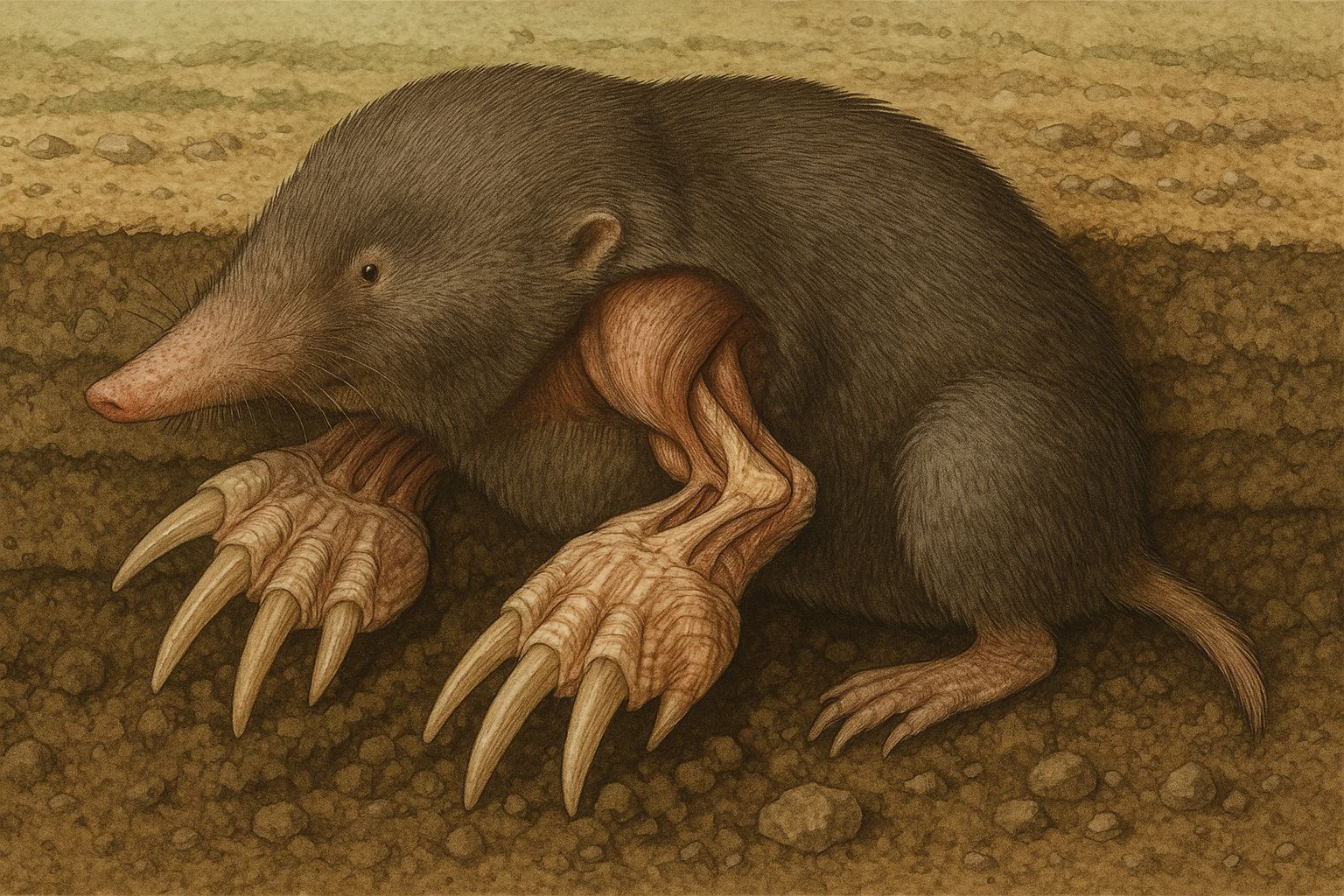
The mole's primary tools for its life of excavation are its snout and front paws. It possesses a 'long pointed snout, which is very strong and flexible'[1]. This snout is not just for smelling but also acts as a tactile organ and a tool to probe and push through the soil. Its strength and flexibility allow the mole to explore its environment and create initial paths for digging.
The most powerful digging instruments are the mole's 'two curiously-shaped paws, which resemble little hands'[1]. These forelimbs are short, powerful, and equipped with broad, spade-like claws. They are turned outwards, providing maximum leverage for moving earth. The source notes that these paws are 'admirably adapted for the use to which they are applied by the mole, that is, scraping out the earth'[1]. This powerful and efficient digging mechanism enables the mole to construct extensive tunnel systems that serve as both its home and its hunting grounds.
Conclusion: A Blueprint for Subterranean Success
The mole's physical form is a testament to specialized evolution. Every key feature, from its velvety, bi-directional fur to its powerful, shovel-like paws, is finely tuned for a life of constant digging and navigating in the dark. The reduction of its eyes is coupled with a significant enhancement of its senses of hearing, touch, and smell, creating a sensory system perfectly suited to its environment. The combination of a strong, flexible snout and robust paws makes it an unparalleled excavator. Together, these unique physical traits create a highly successful animal, perfectly engineered for its subterranean niche.
References
Get more accurate answers with Super Pandi, upload files, personalized discovery feed, save searches and contribute to the PandiPedia.
Let's look at alternatives:
- Modify the query.
- Start a new thread.
- Remove sources (if manually added).