How did tiny coral polyps build entire islands?. Describe how each polyp secreted calcareous matter and occupied a small compartment within a connected colony. Then show how generations of polyps formed reef rings that trapped sediment, supported plants, and gradually helped turn lagoons into islands.
How Tiny Coral Polyps Built Islands
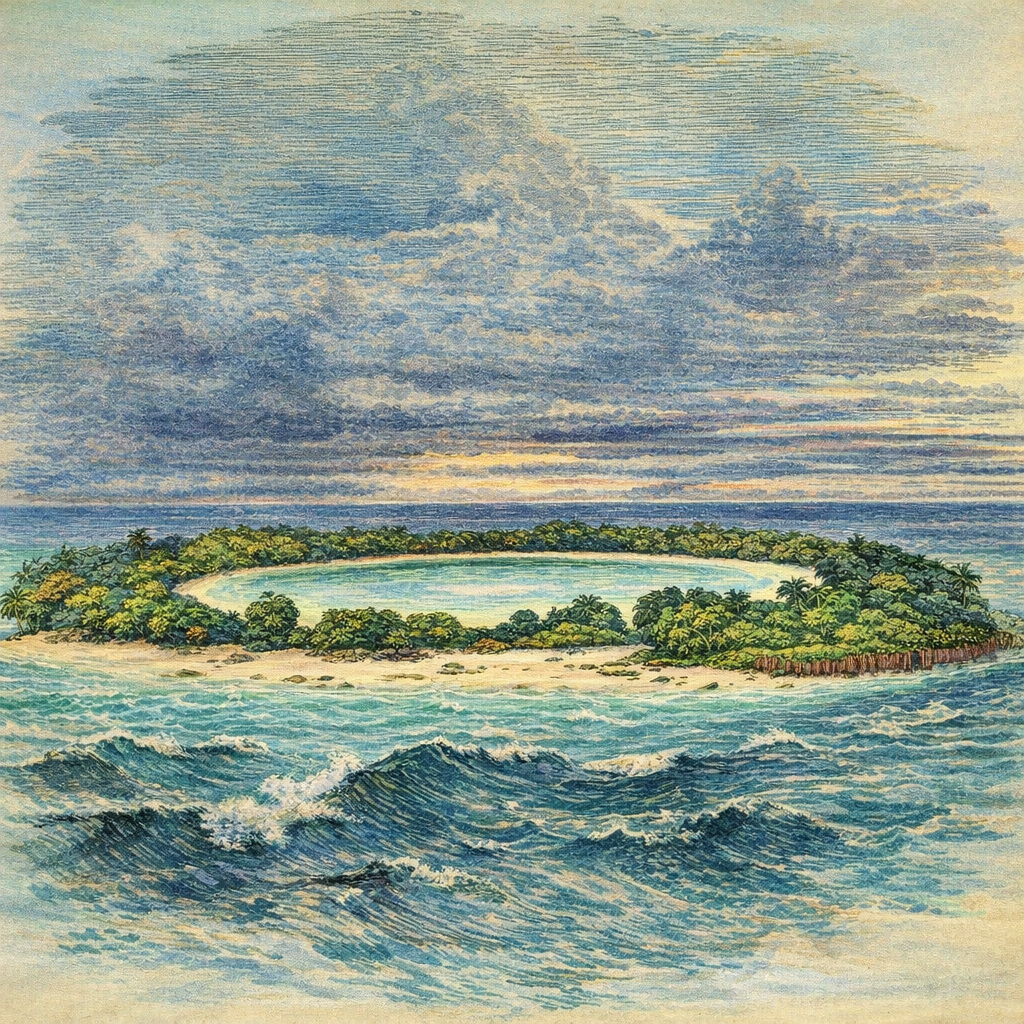
Coral islands formed through the slow, cumulative work of countless tiny polyps. Each polyp built a small calcareous compartment, while generations of connected polyps extended the shared reef until it formed a ring around a lagoon and created the foundations for land.[1][2]
One Polyp, One Compartment in a Shared Colony
A coral polyp secreted a large quantity of calcareous material from the lower part of its body. This material formed a hard structure called the cells, or polypidom, and the polyp occupied one of the small hollows within it.[3]
The colony grew as polyps added compartment after compartment, described by the source as erecting “one story after another.” Although they contributed to one connected structure, the polyps remained individually organized: each had its own stomach and arms for obtaining and digesting food. Damage to one polyp therefore did not stop the functions of the entire colony.[4]
From Reef Rings to Islands
Successive generations continued building the reef month after month, year after year, and century after century. In this way, the accumulating calcareous framework eventually added islands to the solid surface of the globe.[5]
- The reef could grow into a ring enclosing a lagoon. The source calls this ring an atoll, or lagoon island.[6]
- The reef acted as a barrier, arresting sand carried by great rivers into the sea and allowing earth to collect on the coral.[7]
- Once some earth had accumulated, ocean currents deposited tree seeds. Cocoa palms and other plants grew, and their fallen leaves and fruit decayed into additional soil, enabling more plant growth.[8]
- Dead coral near the surface, exposed to sunlight, rotted and crumbled into mud, helping fill the lagoon.[9]
- Sediment, plant-derived soil, and coral mud accumulated together until the lagoon was gradually filled and a complete island formed.[10]
The Transformation in Brief
From coral polyp to island
The essential mechanism was accumulation: polyps supplied the hard framework, the reef ring trapped incoming earth, dead coral contributed mud, and plants converted deposited material into deeper soil. Over immense spans of time, these processes changed an enclosed lagoon into solid ground.[11][12][13][14]
Get more accurate answers with Super Pandi, upload files, personalized discovery feed, save searches and contribute to the PandiPedia.
Let's look at alternatives:
- Modify the query.
- Start a new thread.
- Remove sources (if manually added).