The Mammoth Tree and the Tape Measure
Big trees, bigger claims
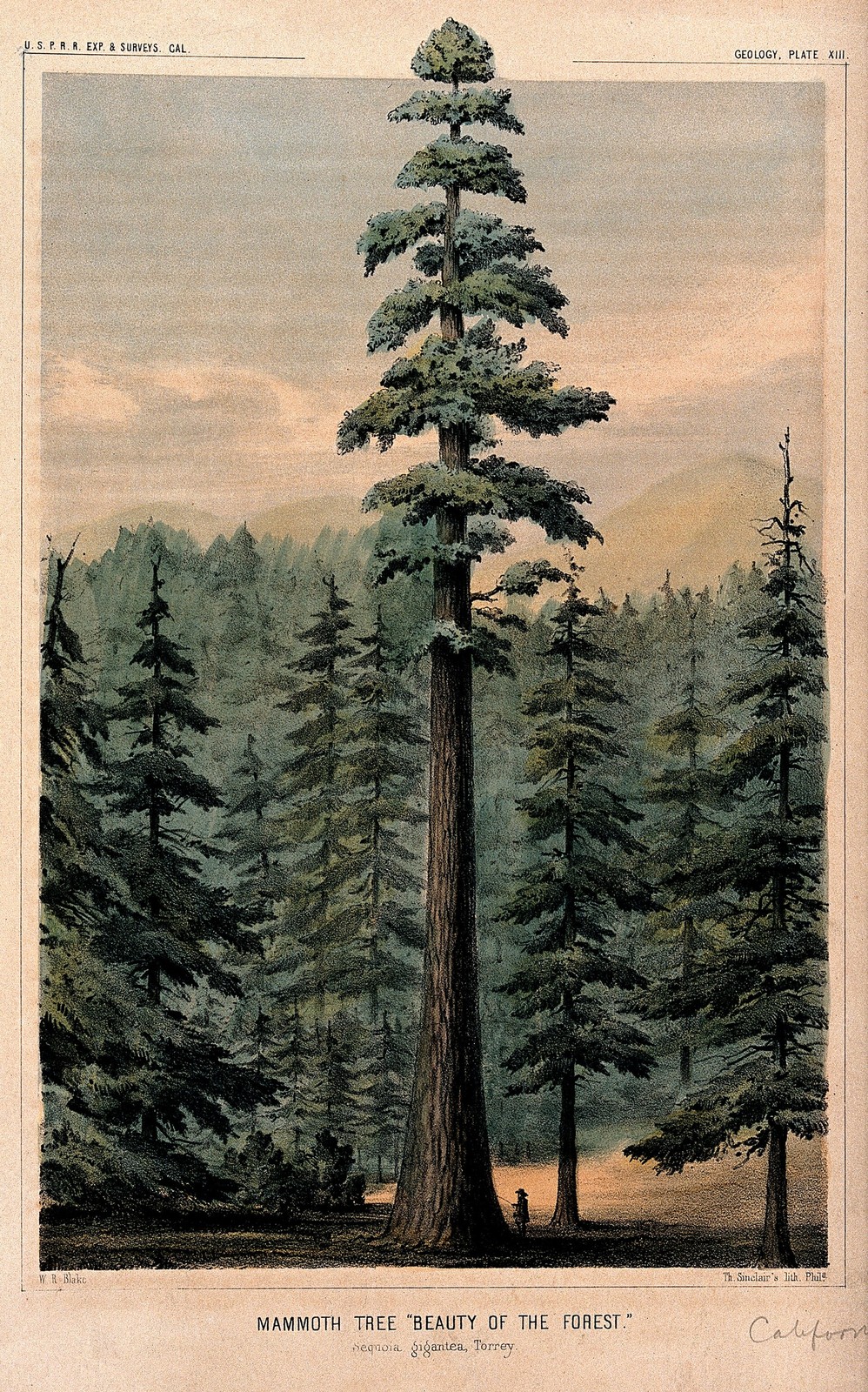
In his chapter on giants, Cooke notes a naming quirk: the great Californian conifers were “known to Englishmen as Wellingtonia and to Americans as Sequoia,” and were long regarded as the mammoth trees of the world.[1] By 1882, he writes, that supremacy had passed to the “big trees” of Australia, though reliable dimensions were “very difficult to determine” in both countries.[2]
He trusted modest numbers. A work of authority put the tallest known Sequoia at 325 feet, in the Calaveras Grove, and the Grizzly Giant of the Mariposa Grove at 93 feet around at the ground.[3] Heights of four hundred feet and upwards, he warns, “are believed to be wholly unreliable.”[4]
Felling one showed what the size meant. In an account Cooke credits to Dr. Berthold Seemann, the “big tree” was 96 feet around at the base and solid throughout; twenty-five men spent five days boring it with augers and cutting between the holes with an axe.[5] It fell only with a wedge, strong leverage and a heavy breeze, and the crash threw stones and earth that marked the surrounding trees nearly a hundred feet up.[6]
Australia's rivals were gum trees. One hollow Karri was said to admit three riders and a pack horse, who could turn inside without dismounting.[7] Other eucalypts were measured at 480 feet and estimated at 500.[8] Cooke's source concluded that these trees rival the Californians “in length, though evidently not in thickness.”[9]
These are Victorian reports and estimates as Cooke compiled them, not modern verified records. His suspicion of sensational heights is part of the marvel.
Examinons les alternatives :
- Modifier la requête.
- Démarrer une nouvelle conversation.
- Supprimer des sources (si elles ont été ajoutées manuellement).