Mars Direct: Why Make the Return Fuel on Mars?
Mars Direct: Why Make the Return Fuel on Mars?
Mars Direct, proposed by Robert Zubrin and David Baker in 1990, changed the mission architecture by moving the key refueling task from Earth orbit to the Martian surface. Its central idea was simple: send the equipment and supplies first, make the return propellant on Mars, and launch the crew only after the automated system had succeeded. This reduced the amount of propellant that had to be launched from Earth, but it also made the crew's safety depend on an uncrewed factory operating reliably on another planet.[1][2][3]
The Cargo-First Sequence
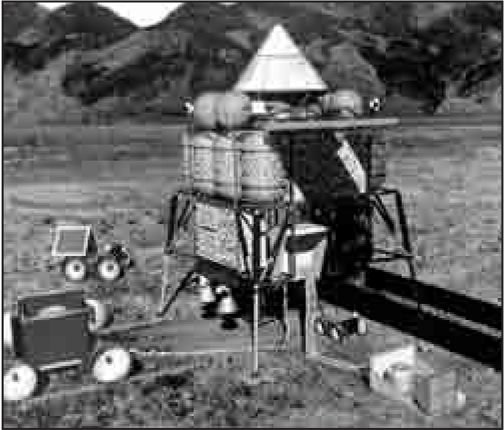
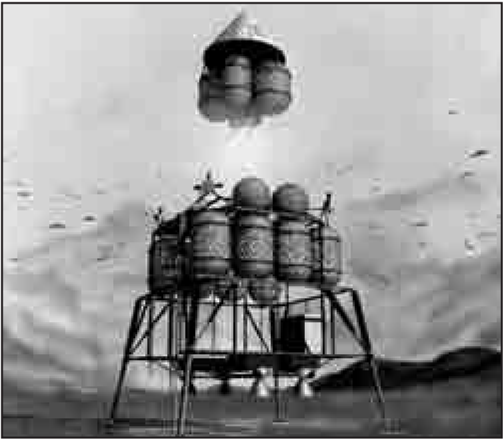
The proposed sequence was cargo first, crew later. An uncrewed cargo lander would travel directly to Mars carrying the Earth-Return Vehicle, an in-situ resource utilisation plant, liquid hydrogen feedstock, and a nuclear reactor. The crewed spacecraft would not depart until the plant had produced the propellant required for the return journey, so the crew would arrive at a site where the means of getting home had already been prepared.[4]
What ISRU Did in Mars Direct
In-situ resource utilisation, or ISRU, means making useful resources from materials found at the destination rather than transporting every required supply from Earth. In Mars Direct, ISRU was not a general slogan. Its specific job was to manufacture return-vehicle propellant from imported hydrogen and Martian atmospheric carbon dioxide, thereby reducing the mass that had to leave Earth.[10][11]
The chemical system worked as follows:
- The cargo lander carried 5.8 tons of liquid hydrogen as feedstock.[12]
- A 100-kilowatt nuclear reactor, transported on a robotic truck, supplied power to compressors and the propellant factory.[13][14]
- The compressors collected Martian air and supplied its carbon dioxide to the reactor system.[15]
- Through the Sabatier process, hydrogen and carbon dioxide reacted in the presence of a catalyst to produce methane and water.[16]
- The methane was stored as fuel. The water was electrolyzed to produce oxygen and recover hydrogen, allowing the hydrogen to be recycled through the process.[17]
- Additional oxygen could be made by decomposing carbon dioxide into carbon monoxide and oxygen, with the carbon monoxide vented.[18]
The source states that the factory was expected to produce 107 tons of methane and oxygen in one year. That propellant would support the return vehicle, allowing the crewed spacecraft to depart for Mars with less return fuel launched from Earth.[19]
The Architectural Trade-Off
Earlier mission concepts could require substantial propellant to be lifted into Earth orbit, assembled, and then used for the Mars expedition. Mars Direct attacked that burden by sending the cargo directly to Mars and manufacturing the return propellant there.[20][21] The benefit was lower launch mass and less dependence on extensive Earth-orbit refueling. The cost was a serious new dependency: before any astronauts left Earth, an automated plant had to land, deploy its power system, process Martian carbon dioxide, and produce a verified supply of methane and oxygen.[22][23][24]
That trade-off is the historical significance of the proposal. Mars Direct did not eliminate the difficulty of supplying a Mars mission. It relocated the most important resupply operation from Earth orbit to Mars, exchanging orbital logistics and launch mass for confidence in autonomous surface production. This discussion concerns a proposed 1990 mission architecture recorded in the history of Mars planning, not hardware that was flown or a mission that was implemented.
Crea el teu compte per conservar aquesta resposta i continuar-hi més tard.
Veiem alternatives:
- Modifica la consulta.
- Inicia un nou fil.
- Elimina les fonts (si s'han afegit manualment).